Are neural Oscillations necessary or a mere epiphenomenon?
Abstract
Oscillations in the brain canNeurons firing produc current changing the
Introduction
Are Neural Oscillations Necessary or Just a Byproduct?
Neural oscillations are everywhere in the brain, from alpha to gamma waves, from sleep to focused attention. We can measure them with EEG or MEG and observe how they change when we move, think, or rest. But do these oscillations actually play a necessary role in brain function, or are they just the byproduct of neurons communicating via action potentials?
This question is at the center of a major debate in neuroscience. On one side, theorists like Pascal Fries (2015) argue that oscillations are essential for neural communication through his Communication Through Coherence (CTC) hypothesis. According to CTC, rhythmic synchrony ensures that signals between brain areas are effectively timed, like a flickering torch shining through a rhythmically opening window. Without oscillations, the signal might miss its target, leading to weak or lost communication.
On the other side, researchers like Schneider et al. (2021) suggest that oscillations might just be a byproduct of neuronal firing. Their work shows that gamma-like rhythms can naturally emerge in spiking neural networks (SNNs) without any explicit need for oscillatory coding. This raises the question: Are oscillations merely reflections of underlying spike patterns, or do they actively shape communication?
To address this question, I will:
-
Define the Communication Through Coherence (CTC) hypothesis and contrast it with the epiphenomenon argument, referencing Fries (2015), Schneider et al. (2021), and other relevant studies.
-
Review the classical view of neural communication as purely spike-rate dependent versus the rhythmic view emphasizing oscillatory synchrony.
-
Present a novel experimental approach using C. elegans, a minimal nervous system with 302 neurons, to test whether disrupting phase coherence selectively impairs neural communication, even when spike rates are preserved.
-
Discuss the broader implications for understanding brain connectivity, considering predictive coding frameworks and evolutionary perspectives.
In doing so, I aim to bridge the gap between oscillations as inevitable byproducts of neuronal dynamics and oscillations as functional mechanisms critical for neural communication.
Neural oscillations
A variety of Neural oscillations can be found in the brain from 2-4Hz delta rhythym upto gamma rhythm with about 60-90Hz. The functions vary from delta waves moderating sleep, theta waves change in shifts of attention
To understand rhythmic communication, let’s briefly overview the important brain rhythms and their roles:
Gamma Rhythm (30–90 Hz)
- Short, rapid excitation windows for precise timing.
- Drives feedforward communication and attention.
Beta Rhythm (13–30 Hz)
- Mediates top-down predictions (as attention)
- Associated with deeper cortical layers and feedback processes.
- Influences gamma rhythms.
Alpha Rhythm (8–12 Hz)
- Provides rhythmic inhibition of gamma rhythms.
- Acts as a suppressive rhythm, turning off communication channels for unattended (unimportant) stimuli.
Theta Rhythm (4–8 Hz)
- Organises gamma phase resets (for new assessment of attention).
- Saccadic rhythms occur at a theta rhythm. You look somewhere else a few times a second, mostly consistent with the theta-rhythm in your brain.
Results
The debate whether neural oscillations are necessary is still not solved.
The are many studies supporting the view that oscillations play an important role in attention
Communication Through Coherence
The Communication Through Coherence (CTC) hypothesis by Pascal Fries (2005) suggests that oscillating rhythms (especially in the gamma range) enable effective communication between distant brain regions.
Imagine a lower brain area as someone trying to shine a light torch (a neural signal) through a window. The window represents a higher brain area, which only opens at specific times, rhythmically. If the torch is turned on while the window is closed, no light gets through.
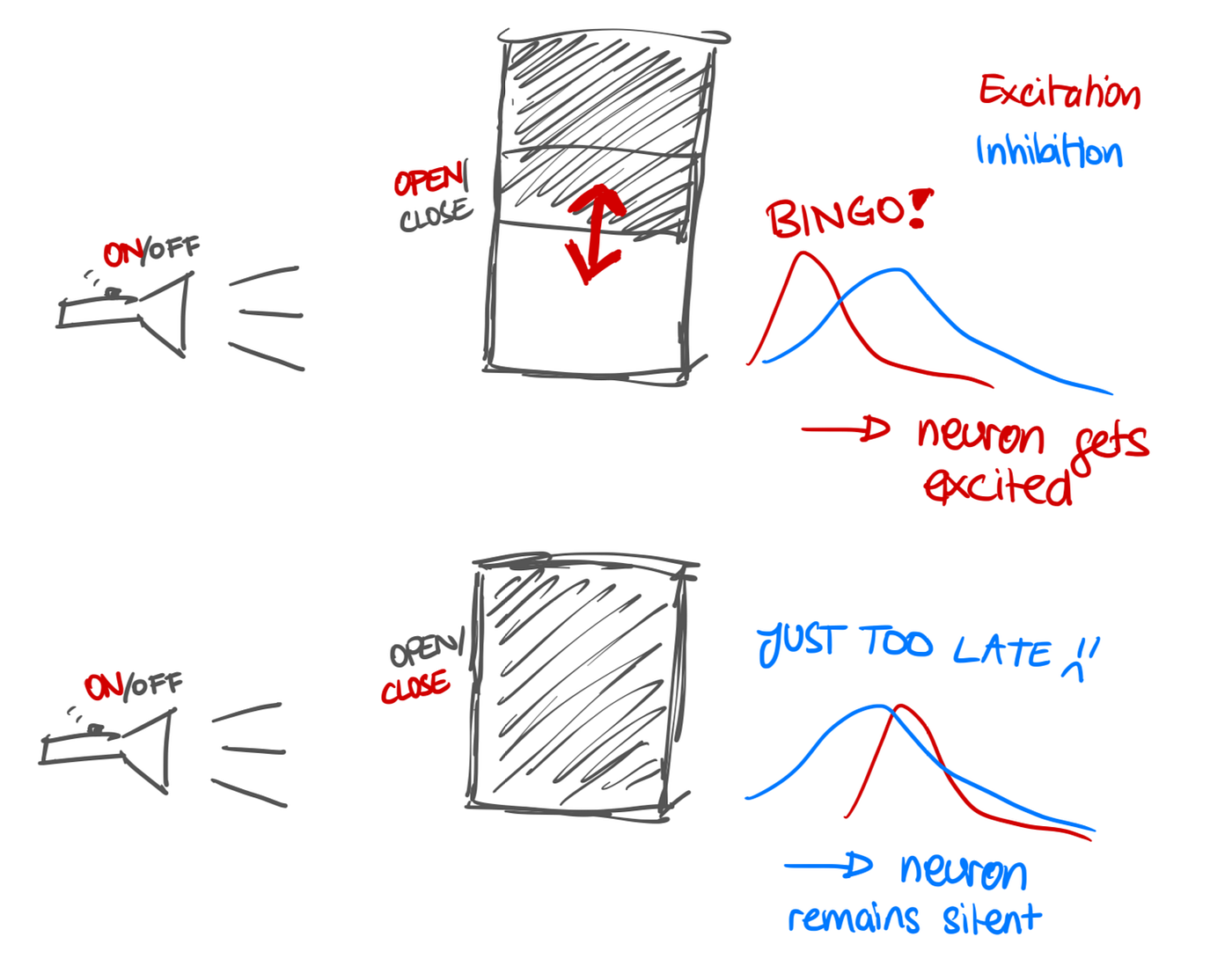
The torch needs to be just in time. Both need to have the same rhythm for communication, source: drawing by the author
But if the torch is flicked on precisely when the window opens, the signal passes.
In the same way, rhythmic synchronisation aligns the excited brain regions, making sure that the signals from one group of neurons arrive when the higher brain region is receptive. Without such temporal alignment, communication would be weak or lost. The one stimulus that matches the window opening wins over the other torches.
Supporting Evidence for the CTC Theory
To see how these rhythms interact, let’s look at an experimental study with macaques:
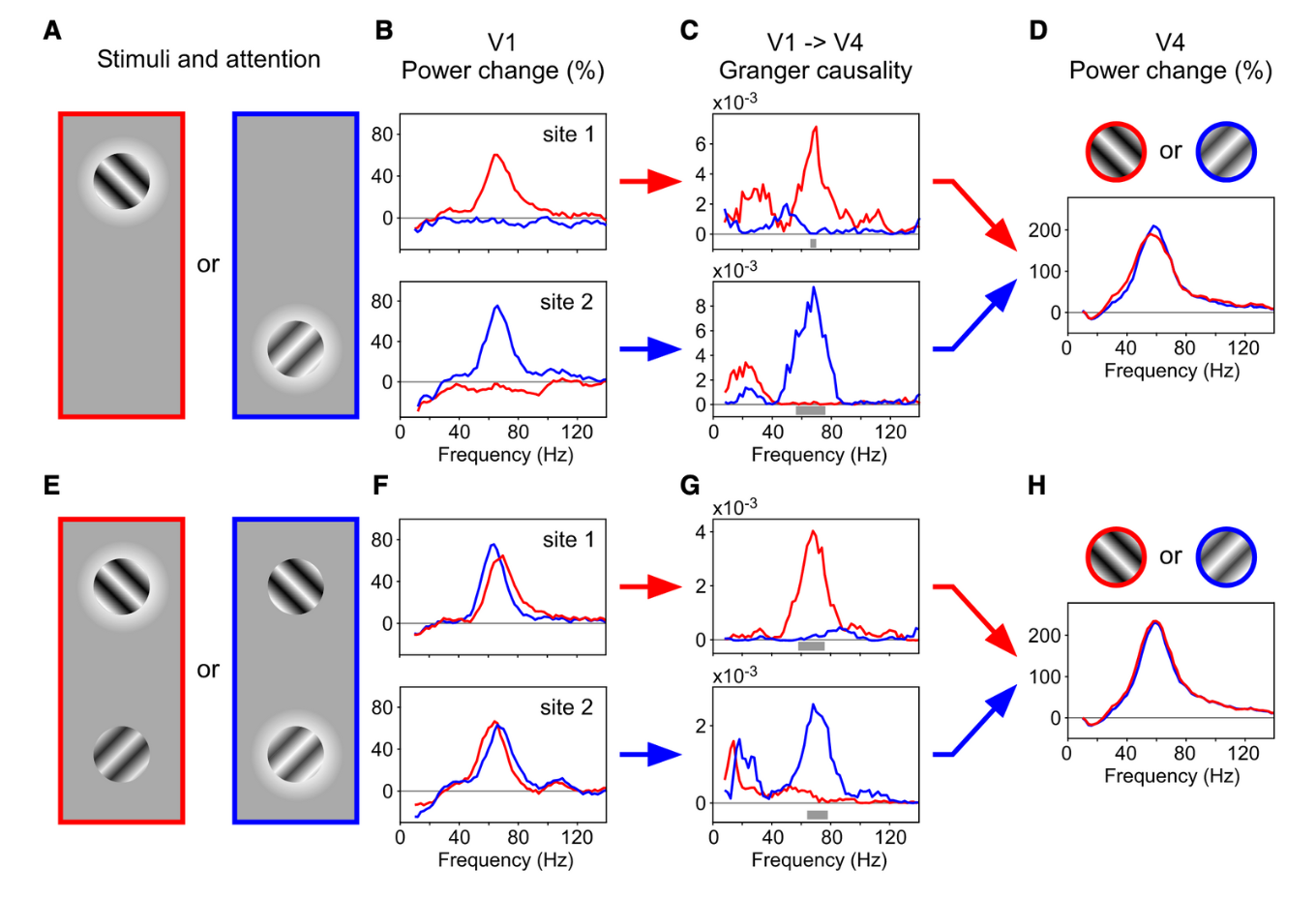
attention task with macaques; source: Fries, 2015 (adapted and modified from Bosman et al., 2012)
The macaques’ task was to attend to one of two simultaneously presented stimuli. Although both stimuli activated neuronal responses in area V1 (figure E-H), only the stimulus attended by the macaque successfully entrained gamma rhythms in area V4 and silenced the other stimulus. This phenomenon, known as the “winner takes all” principle, shows how gamma rhythms selectively route information in the brain.
This is proof that the same gamma frequencies emerge in two distant brain regions through attention and synchronise strongly.
But does this prove we actually need oscillations? Pascal Fries certainly believes so, yet there are opposing viewpoints.
Neural Oscillations as an Epiphenomenon
Schneider and other papers argue that coherence is a consequence of anatomical connections.
Possible Outline
1. Introduction
-
Define neural oscillations and how they are measured (EEG, MEG).
-
Gamma (30–90 Hz), Beta (13–30 Hz), Alpha (8–12 Hz), Theta (4–8 Hz).
-
Rhythmic patterns linked to states: sleep, attention, sensory processing.
-
-
Present the central question:
-
Are neural oscillations necessary for effective communication, or merely by-products of neural firing?
-
Highlight the debate between Pascal Fries’s Communication Through Coherence (CTC) and the epiphenomenon perspective (Schneider et al., 2021).
-
-
Introduce CTC hypothesis (Fries, 2015):
-
Rhythmic synchrony ensures precise timing for inter-regional communication.
-
Torch-window analogy: Rhythmic alignment as a gating mechanism.
-
-
Present Schneider et al. (2021):
-
Coherence as a consequence of anatomical connectivity and oscillatory power, not a functional mechanism.
-
Gamma-like patterns emerging in Spiking Neural Networks (SNNs) without explicit oscillatory coding.
-
-
Preview the structure:
-
CTC as a necessary mechanism.
-
Schneider’s counterargument: oscillations as by-products.
-
Testing these perspectives in C. elegans.
-
Implications for brain connectivity and predictive coding frameworks.
-
2. Communication Through Coherence: Oscillations as Necessary Mechanisms
-
Gamma Rhythms as Essential for Communication:
-
Fries (2015):
-
Communication depends on phase coherence in gamma band.
-
Selective routing of information by phase-locking.
-
-
Torch-window analogy:
-
Effective communication occurs only when sender and receiver are phase-aligned.
-
Otherwise, signals are lost or diluted by competing inputs.
-
-
-
Evidence Supporting CTC:
-
Baldauf & Desimone (2014): Gamma coherence between V1 and V4 during attention tasks.
-
Cardin et al. (2009): Optogenetic manipulation of gamma rhythms in mice enhances sensory processing.
-
Fries (2015): Attention-dependent gamma synchronization facilitates winner-takes-all processing in macaques.
-
-
Classical vs Rhythmic View of Communication:
-
Classical view:
-
Communication as spike-rate dependent.
-
Fixed synaptic pathways; no flexible routing.
-
-
Rhythmic view (Fries, 2015):
-
Flexible communication through oscillatory synchrony.
-
Spike timing becomes crucial for effective signal transmission.
-
-
Example: Macaque attention task (Fries, 2015)
-
Attended stimuli induce gamma coherence in V1–V4.
-
Unattended stimuli fail to synchronize, reducing effective communication.
-
-
3. The Epiphenomenon Argument: Are Oscillations Just a Byproduct?
-
Schneider et al. (2021): Coherence as a Byproduct of Connectivity and Oscillatory Power:
-
Key finding: Gamma coherence emerges naturally due to connectivity patterns and oscillatory power, not due to active communication mechanisms.
-
SNNs: Gamma-like patterns appear without explicit oscillatory coding.
-
Implication: Coherence may reflect structural and functional connectivity, not intentional communication.
-
-
Aplysia and C. elegans Cases:
-
Aplysia californica:
-
Simple neural circuits; primarily spike-rate communication.
-
Absence of complex gamma rhythms.
-
-
C. elegans:
-
302 neurons, no clear oscillatory patterns.
-
Effective communication observed through direct spike-rate interactions.
-
-
-
Counterarguments and Implications:
-
Even if coherence emerges naturally, it can still serve a functional role.
-
Rhythmic synchronization may amplify signals, even if it isn’t the primary communication mechanism.
-
4. Testing the CTC Hypothesis in C. elegans: A Novel Approach
-
Why C. elegans?
-
Complete connectome: 302 neurons, fully mapped synaptic architecture.
-
Optogenetic control allows precise, closed-loop interventions.
-
Whole-brain calcium and voltage imaging to track network activity.
-
-
Proposed Experiment:
-
Baseline Measurement:
-
Identify spontaneous oscillations across the network.
-
Measure baseline coherence in sensory and motor circuits during directed locomotion.
-
-
Experimental Manipulation:
-
Target specific neuron pairs or microcircuits.
-
Disrupt phase coherence using optogenetic inhibition (e.g., ArchT).
-
Preserve firing rates while desynchronizing oscillations.
-
-
Behavioral Analysis:
-
Assess effects on sensory processing (e.g., odor discrimination task).
-
Measure impact on locomotion (e.g., chemotaxis).
-
Quantify communication effectiveness by tracking latency and accuracy of sensory-motor responses.
-
-
-
Hypotheses:
-
If coherence disruption impairs sensory processing and directed behavior despite intact firing rates, it supports the CTC hypothesis.
-
If communication remains intact, it supports the Schneider et al. epiphenomenon argument.
-
5. Discussion: Implications and Broader Impact
-
Synthesis of Findings:
-
Compare CTC and Schneider perspectives in light of proposed experiment.
-
Highlight potential implications for interpreting coherence in larger networks.
-
-
Predictive-Coding Extension:
-
How do oscillations fit within predictive-coding frameworks?
-
Do oscillations serve as markers for prediction errors, or do they actively regulate error signaling?
-
-
Evolutionary Perspective:
-
Did oscillations emerge as functional mechanisms or as by-products of excitation–inhibition dynamics?
-
How might C. elegans data inform our understanding of oscillatory communication in more complex brains?
-
-
Methodological Considerations:
-
Potential confounds: volume conduction, filtering artifacts in LFP/EEG vs. direct imaging in C. elegans.
-
Analytical approaches: Phase-locking value, coherence metrics, spike-triggered LFP analysis.
-
6. Conclusion
-
Recap the central question: Are oscillations necessary or merely epiphenomenal?
-
Summarize the CTC hypothesis and its evidence base.
-
Present Schneider’s argument that coherence is a byproduct of connectivity and oscillatory power.
-
Highlight how the proposed C. elegans experiment could clarify the functional role of oscillations in neural communication.
-
Future directions: Extending the C. elegans model to more complex systems; integrating predictive-coding frameworks; exploring evolutionary origins of rhythmic communication.
Would you like me to proceed with drafting any specific section based on these points, or further refine the outline?
-
References
-
Buzsáki, G., & Draguhn, A. (2004). Neuronal oscillations in cortical networks. Science, 304(5679), 1926–1929.
-
Fries, P. (2015). Rhythms for Cognition: Communication through Coherence. Neuron, 88(1), 220–235.
-
[C. elegans whole-brain voltage imaging]
-
[Closed-loop optogenetics in C. elegans]
-
Questions to push further:
-
How might varying prediction-error statistics modulate phase-reset strength in your worm model?
-
Can you identify minimal subcircuits that suffice for CTC in C. elegans?
-
What controls would you include to ensure that behavioral effects aren’t due to overall excitability changes rather than coherence per se?
Notes
- neurons can affect each others membrane potentials without being physically connected
- Anastassiou, C. A., Perin, R., Markram, H., & Koch, C. (2011). Ephaptic coupling of cortical neurons. Nature neuroscience, 14(2), 217-223.
- there are things like gap junctions
- Kopell, N., Ermentrout, G. B., Whittington, M. A., & Traub, R. D. (2000). Gamma rhythms and beta rhythms have different synchronization properties. Proceedings of the National Academy of Sciences, 97(4), 1867-1872.
- brick passing oscillation
see also
Tags: neuroscience science
Superlink: 050 🧠Neuroscience
Deep research neural oscillations necessary or epiphenomenon?
Source
Created: 09-05-25 11:05