Communication through Coherence
The brain is full of
- several different frequencies
- but gamma has a high frequency which makes for higher chances of getting a signal through (i guess)
how does attention start this gamma-rythm in higher areas?s
Article for Medium
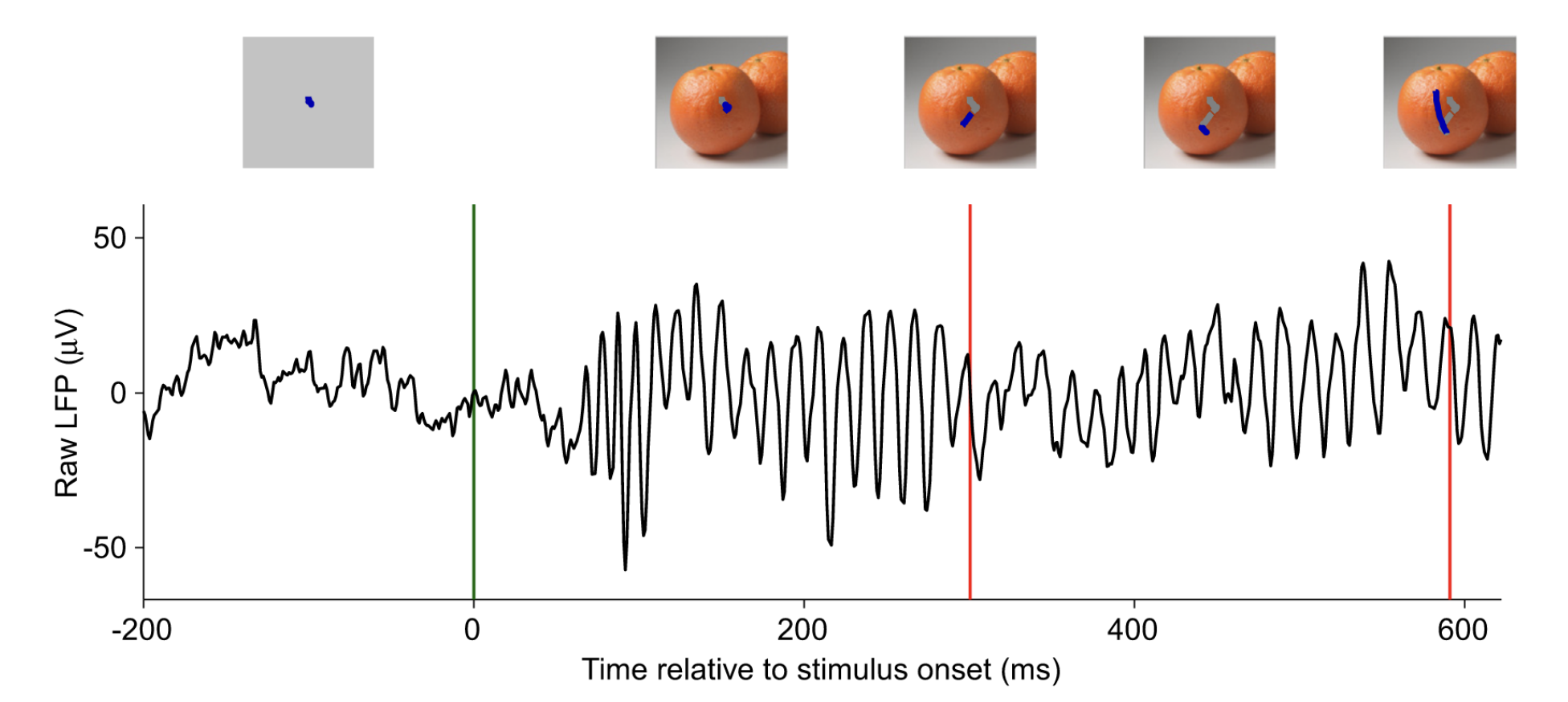
Wenn wir etwas anschauen, können wir sehen, dass sich ein Gamma-Rhythmus entwickelt. und das wirklich bei allen möglichen Stimuli. Also was könnte das bedeuten? Es muss doch eine Bedeutung haben!
oder ist es vielleicht auch nur ein epiphenomenon wie consciousness?
Also wenn Neurons auf diesen Stimulus reagieren und eben zusammen feuern, könnte es sein, dass sich dadurch ein Gamma-Rhythmus entwickelt.
Aber Pascal Fries ist der festen Überzeugung, dass diese Gamma-Rhythmen wichtige Aufgaben im Gehirn haben.
Und das ist der Grundstein der Theorie “Communication Through Coherence” (CTC).
because the classical view has some problems with explaining cognition correctly:
We know the neurons are connected to each other by synapses. Each neuron has around 10,000 synaptic connectionsto other neurons.
Also we know that neurons only way to vary in strength is through the firing rate
classical view:
- anatomical connections
- Firing rates determine information strengths
- No mechanism for selective signal routing
- Timing doesn’t matter
- Can’t explain flexibility in attention
rhythmic view
- oscillatory synchronization
- precise timing → signal flow
- selective routing
- who talks to whom
- hierarchical, context-dependent cognition
So the rhythmic view’s approach by Fries is an apporach that addresses all these issues.
With the possibility of communication of distant neuronal groups could explain selective routing in the brain.
How does the brain direct infortmation flow? Can this only be achieved through anatomical connections?
To get how the rhythms might interact in the brain, here is an overview of the different rythms we have in our brains:
Gamma-Rhythm (30-90 Hz)
- Fast, short excitation windows for precise timing
- Drives feedforward communication and attention
- Pulsatile signal flow — not just firing rate.
Beta-Rhythm (13-30 Hz)
- Mediates top-down predictions
- Linked to deeper cortical layers and feedback
- Can influence and modulate gamma rhythms
Alpha-Rhythm (8-12 Hz)
- Provides rhythmic inhibition
- Acts like a suppressive rhythm for unattended stimuli
- Blocks communication by keeping circuits in an “off” state
Theta-Rhythm (4-8 Hz)
- Organizes gamma phase resets attentional sampling
- Reflects saccadic rhythm and continuous attention switching
So to understand how these rhythms change connections in the brain, let’s look at a study:
This is the theory behind CTC.
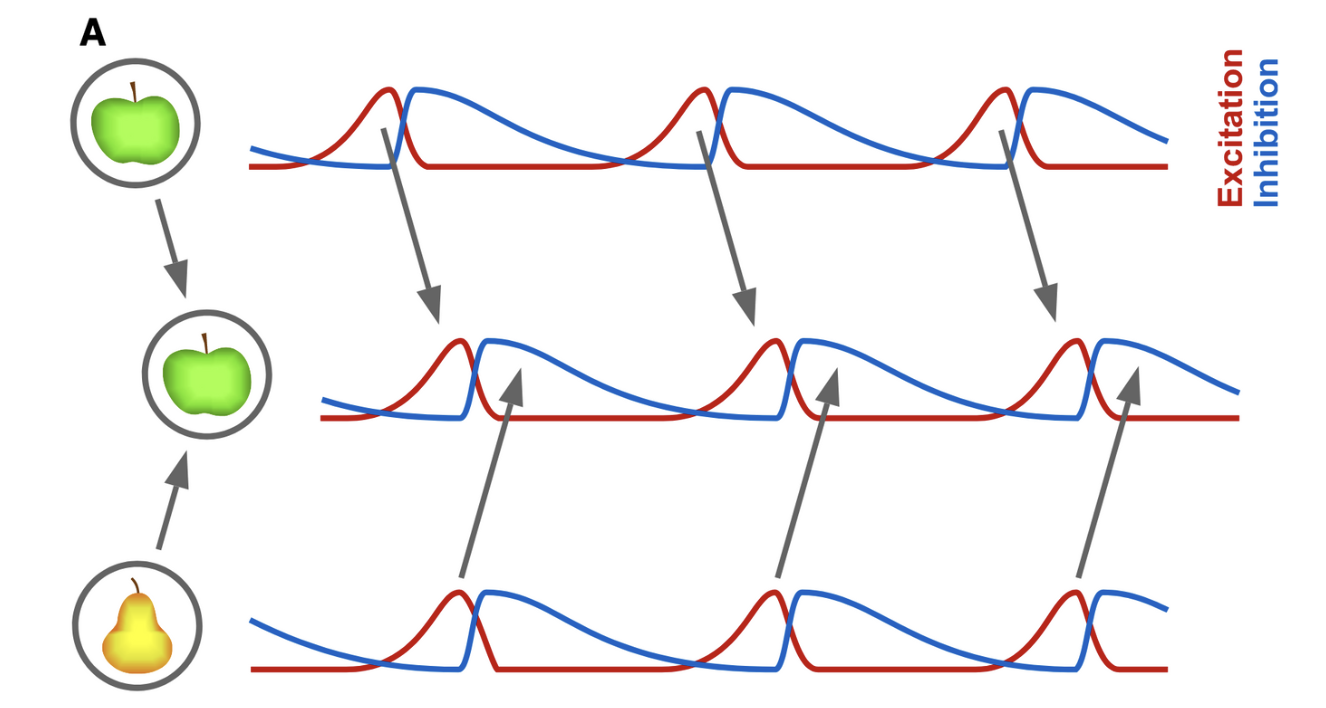
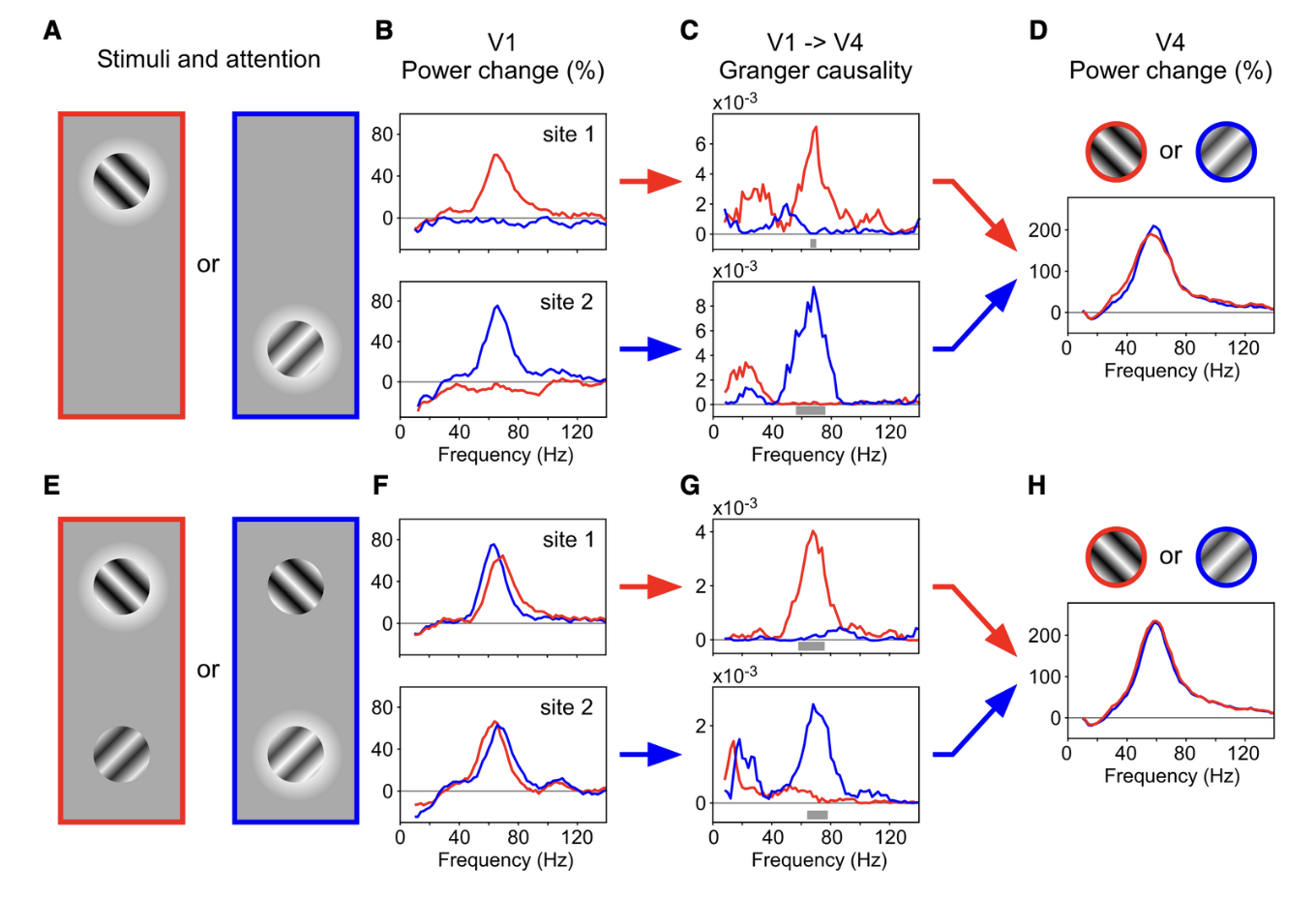
So the macaques task was to pay attention to one of the stimuli.
Let’s look at the figure A first.
The red boundaries are not shown to the macaque. It is for demonstration purpooses for the readers to better understand.
But what happens if the macaque sees both stimuli at the same time. Both sites get active, but only the one the macaque is instructed to look at will entrain the gamma rhythms in V4.
This is also called the “winner takes it all” principle.
I can show you more studies proving the existence of oscillations, but i think you get the point.
A lower area looking at the stimulus shows the same gamma frequency as the higher area attending to the stimulus. All other stimuli are inhibited. That makes sense.
But is it a prove that we need oscillations in the brain?
Pascal Fries really thinks so. But there are also opposing views. Showing for example in Spiking Neural Networks that when two consecutive neurons fire in this network they automatically fire in a gamma-like pattern. Which means oscillations are not the cause but rather the consequence of neuronal activity (Schneider, 2021). I have put the full citatation at the bottom of the article.
But how could you tests Fries theory?
there is a few possibilities:
- create some kind of noise of other oscillations in a mouse brain to prevent neurons from detecting any gamma rhythm. Make them blind, so to say. Then you could test whether firing still occurs the same way as it does with the oscillations. This is what has been done in a study from Cardin, 2009, supporting the CTC hypothesis from 2005. But this study only shows a decrease of the stimulus without the gamma rhythm. So the communication still seems to work.
- This might raise the point. Are the oscillations only amplifying the signal, or are they really necessary.
- This will need further research to work on
- Also building computational models like the Spiking Neural Network by Schneider that could prove that there is no such need for oscillations.
Is spike rate enough?
So when we look at simpler organisms like c elegans or aplysia californica
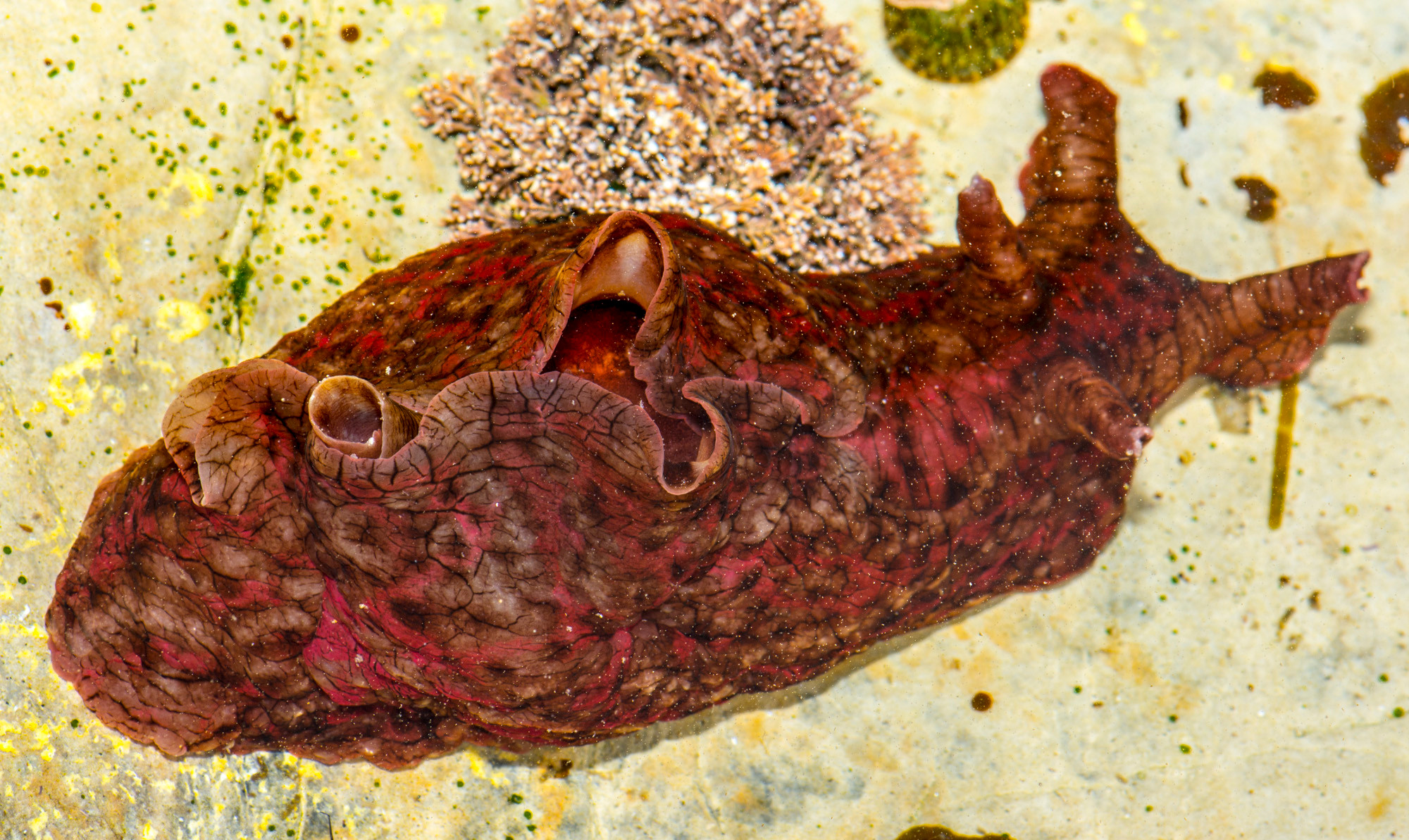
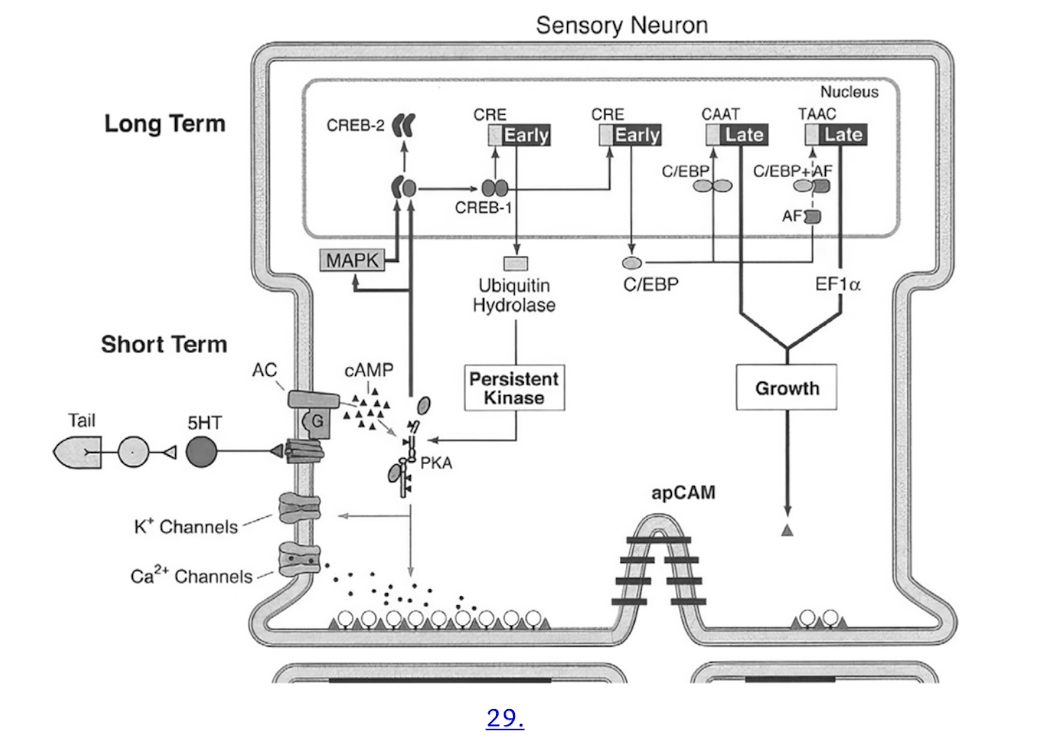
So in aplysia neurons communicate through spiking rate. There cannot be oscillations because of the lack of many neurons firing at the same time to create a gamma rhythm.
There maybe though slower weaker rhythms in aplysia, but anything close to gamma rhythm.
C. elegans is a small worm with an even simpler neural network.
So for those mechanisms it seems oscillations do not play a big role or at least are not necessary.
But where do you draw the border of necessity then?
I think you cannot do that.
For example when are animals becoming conscious. We humans are surely conscious. But at what point does an organism get conscious?
Different question same problem.
I do not know the answer.
But still, oscillations seem to be important and predict neurons firing better than spiking rate alone. This shows that at least the brain works in a rhythmic manner. The brain communicates in rhythms.
Imagine a room full of people clapping. After a very nice concert. The band says thank you to the crowd. What happens after a while?
All people clap at the same time. A rhythm emerges without actually anyone planning it.
How can this be?
But this rhythm has no purpose. But it makes people connect with each other and makes the claps in total louder.
So this rhythm makes commucation better, stronger, but emerged out of thousands of single claps.
Maybe the same way oscillations emerge from millions of neurons firing at the same time and becuase neurons listen to their neighbours like people do in the crowd, the entire brain or concert hall ends up having the same rhythm
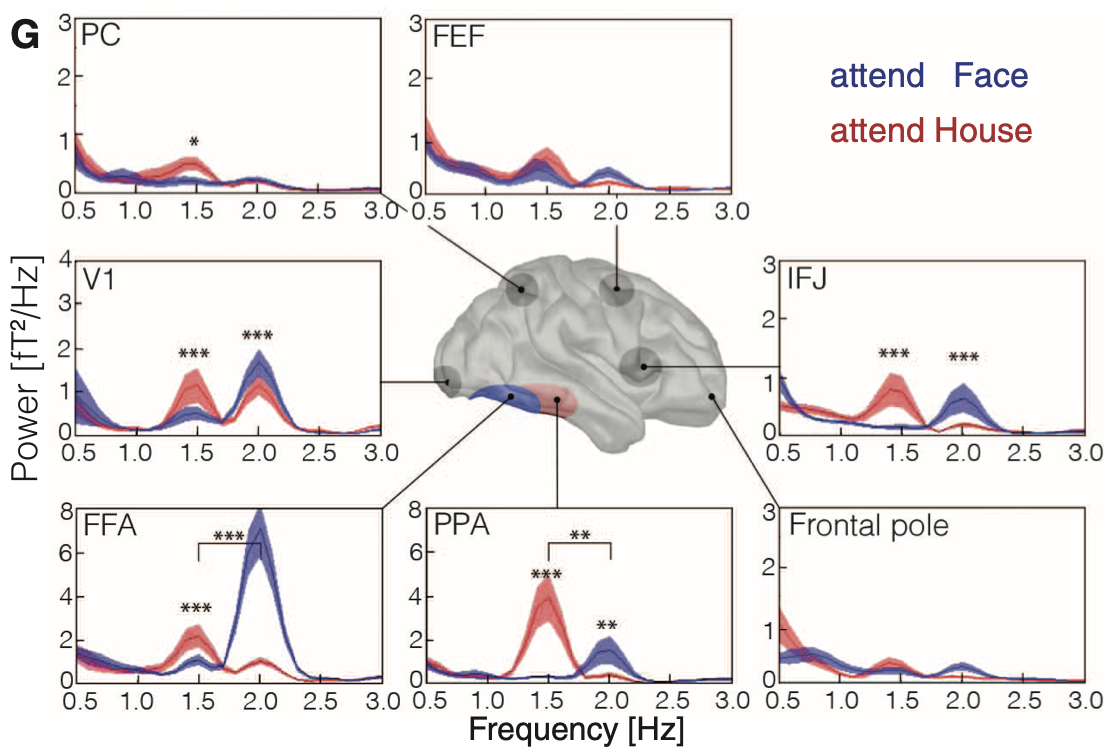
But one weird fact shows in the brain when looking which brain regions show the same rhythm and actually when attending objects like faces or houses, either the inferior frontal junction(IFJ) had the same synchrony with either the fusiform face area (FFA) or (parahippocampal place area).
So here the analogy of all clapping at the same time does not quite work because only regions that talk to each other actually show the same rhythm synchrony.
But maybe because they talk to each other through long-distance axons they might still exhibit neurons firing at the same rhythm.
But as we see, we need more research in this field.
Conclusion
I believe that oscillations werent there at the very beginning in simple organisms. it just happened to be because of the electrochemical signalling of neurons.
I imagine that at some point there were so many neurons that strong oscillations started to occur which could trigger other neurons as well and neurons started using this oscillations to better communicate with each other.
So i think the moment came in which oscillations became useful and the bigger the brain became, the more necessary those oscillations became and therefore the answer is a two-sided sword. I believe oscillations to be necessary, but they not always were and the brain would still function without, but not as good as it does.
That’s what I currently think.
But neurosicence is such a young science that we will probably get many studies on that either supporting the CTC or denying it. I am excited what it will become in the future
Sources:
Cardin, J. A., Carlén, M., Meletis, K., Knoblich, U., Zhang, F., Deisseroth, K., … & Moore, C. I. (2009). Driving fast-spiking cells induces gamma rhythm and controls sensory responses. Nature, 459(7247), 663-667.
Schneider, M., Broggini, A. C., Dann, B., Tzanou, A., Uran, C., Sheshadri, S., Scherberger, H., & Vinck, M. (2021). A mechanism for inter-areal coherence through communication based on connectivity and oscillatory power. Neuron, 109(24), 4050-4067.e12. https://doi.org/10.1016/j.neuron.2021.09.037
Baldauf, D., & Desimone, R. (2014). Neural Mechanisms of Object-Based Attention. Science, 344(6182), 424–427. https://doi.org/10.1126/science.1247003
Fries, P. (2015). Rhythms for Cognition: Communication through Coherence. Neuron, 88(1), 220–235. https://doi.org/10.1016/j.neuron.2015.09.034
Chatties Version
Why Gamma Rhythms Might Matter for Brain Communication
Imagine the last time you went to a concert with the audience giving applause after the show. They clap randomly at first, but then slowly synchronise into a single rhythm. No one planned it; the rhythm emerges spontaneously.
Same with oscillations in your brain. They might arise spontaneously from millions of neurons firing and influencing their neighbours. Although this analogy isn’t perfect, since only specific brain regions synchronise and communicate with each other, it shows how rhythmic synchrony can spontaneously emerge and lead to stronger communication, like in the audience.
Whenever we look at something, gamma rhythms appear in our brains.
This happens consistently, regardless of the stimulus. But what does that imply? There must be some significance to this phenomenon—or could it merely be an epiphenomenon, much like consciousness?
If neurons react to a stimulus by firing together, a gamma rhythm emerges naturally. Pascal Fries strongly believes these gamma rhythms play crucial roles in the brain, stating: “Neuronal communication is subserved by neuronal synchronization” (Fries, 2015). This belief forms the cornerstone of the “Communication Through Coherence” (CTC) theory.
Classical vs. Rhythmic View
The classical view of neuronal communication faces several challenges when explaining cognition:
-
Neurons communicate through anatomical synaptic connections.
-
Information strength depends solely on firing rates.
-
There’s no clear mechanism for selective routing.
-
Timing isn’t considered significant.
-
It cannot adequately explain cognitive flexibility, such as attention.
In contrast, Fries’ rhythmic view addresses these issues:
-
Communication relies on oscillatory synchronization.
-
Precise timing controls signal flow.
-
Selective routing determines which neural groups communicate.
-
Hierarchical and context-dependent cognition becomes possible.
Rhythms in the Brain
To understand rhythmic communication, let’s briefly overview brain rhythms:
Gamma Rhythm (30–90 Hz)
-
Short, rapid excitation windows for precise timing.
-
Drives feedforward communication and attention.
-
Enables pulsatile signal flow rather than relying solely on firing rate.
Beta Rhythm (13–30 Hz)
-
Mediates top-down predictions.
-
Associated with deeper cortical layers and feedback processes.
-
Influences gamma rhythms.
Alpha Rhythm (8–12 Hz)
-
Provides rhythmic inhibition.
-
Acts as a suppressive rhythm, turning off communication channels for unattended stimuli.
-
Keeps neural circuits in a suppressed state.
Theta Rhythm (4–8 Hz)
-
Organizes attentional sampling and gamma phase resets.
-
Reflects saccadic rhythms and continuous attention shifts.
Testing the Communication Through Coherence Hypothesis
To see how these rhythms interact practically, let’s consider an experimental study with macaques:
The macaques’ task was to attend to one of two simultaneously presented stimuli. Interestingly, although both stimuli activated neuronal responses in area V1, only the stimulus attended by the macaque successfully entrained gamma rhythms in area V4. This phenomenon, known as the “winner takes all” principle, illustrates how gamma rhythms selectively route information in the brain.
But does this prove we actually need oscillations? Pascal Fries certainly believes so, yet there are opposing viewpoints. For instance, Schneider et al. (2021) demonstrated that neurons in Spiking Neural Networks (SNNs) naturally produce gamma-like patterns when firing consecutively. This suggests oscillations could be a consequence rather than a cause of neuronal activity.
How Can We Test Fries’ Theory?
Possible methods to test Fries’ hypothesis include:
-
Introducing rhythmic noise or competing oscillations to disrupt gamma rhythms in animal models, making neurons rhythmically “blind.” For instance, a study by Cardin et al. (2009) demonstrated reduced neuronal responses without gamma rhythms, supporting CTC. However, communication wasn’t entirely lost, raising the question: are oscillations merely amplifying signals or genuinely essential?
-
Developing computational models (like Schneider’s SNNs) that test if rhythmic oscillations are necessary for effective neural communication.
Is Spike Rate Alone Enough?
Looking at simpler organisms helps clarify the debate. Aplysia californica, a sea slug, relies primarily on spike-rate communication. With fewer neurons, gamma-like oscillations can’t form. While slower rhythms might exist, there’s no evidence for gamma rhythms.
Similarly, C. elegans, an even simpler organism, seems to function effectively without clear oscillatory communication. This raises the question: At what point do oscillations become necessary? The answer isn’t straightforward.
It’s comparable to questioning when organisms become conscious. Humans undoubtedly are, but where do we draw the line for other animals? Oscillations appear beneficial, predicting neuron firing patterns better than spike rate alone. They enhance communication by synchronizing neural activity.
Research indicates synchronized rhythmic activity occurs selectively between brain regions that communicate directly, like the inferior frontal junction (IFJ) syncing selectively with either the fusiform face area (FFA) or the parahippocampal place area (PPA), depending on attended objects.
Conclusion
I believe neural oscillations weren’t initially necessary when organisms with neurons emerged. They likely emerged spontaneously due to electrochemical signaling between neurons. Eventually, neural networks grew sufficiently complex that these rhythmic patterns became advantageous, enhancing neuronal communication. Consequently, oscillations have become increasingly critical with growing brain complexity.
Neuroscience remains young, and ongoing research will undoubtedly continue testing theories like CTC. I eagerly anticipate seeing how future findings shape our understanding of neural rhythms.
Sources:
-
Fries, P. (2015). Rhythms for Cognition: Communication through Coherence. Neuron, 88(1), 220–235. https://doi.org/10.1016/j.neuron.2015.09.034
-
Cardin, J. A., et al. (2009). Driving fast-spiking cells induces gamma rhythm and controls sensory responses. Nature, 459(7247), 663-667.
-
Schneider, M., et al. (2021). A mechanism for inter-areal coherence through communication based on connectivity and oscillatory power. Neuron, 109(24), 4050-4067.e12.
-
Baldauf, D., & Desimone, R. (2014). Neural mechanisms of object-based attention. Science, 344(6182), 424–427.
Notes 17.04.2025
Presentation Notes: Communication Through Coherence by Pascal Fries (2015)
1. Introduction and Motivation
-
Cognitive functions are fast and flexible — but brain anatomy is relatively fixed.
-
Firing rates alone cannot explain selective routing or dynamic attentional shifts.
-
Fries proposes that neuronal communication relies on rhythmic synchronization, not just firing strength or anatomical wiring.
-
Key quote: “Neuronal communication is subserved by neuronal synchronization.”
-
Question posed: How does the brain achieve selective and efficient communication between distant neural populations?
2. The Old vs New View
Old View:
-
Focused on structural connections and spike rate.
-
No mechanism for dynamic signal routing or attentional flexibility.
New Rhythmic View:
-
Oscillatory synchronization enables temporal precision.
-
Rhythms define who talks to whom, moment to moment.
-
“In the absence of coherence, inputs arrive at random phases.”
-
Synchrony introduces selectivity by aligning communication windows.
3. Alpha, Beta, Gamma, Theta Rhythms
-
Gamma (30–90 Hz): fast excitation/inhibition cycles (~3ms), ideal for precise feedforward transmission.
-
Beta (13–30 Hz): linked to feedback, prediction; modulates local gamma.
-
Alpha (8–12 Hz): inhibitory rhythm, blocks transmission; “keeps regions in off-state.”
-
Theta (4–8 Hz): coordinates attentional sampling and gamma resets.
Quotes:
-
“Gamma-band synchronization is particularly strong in superficial cortical layers.”
-
“Alpha/beta-band synchronization is strong in deep cortical layers.”
4. What is Communication Through Coherence (CTC)?
-
Dynamic gating of communication: only synchronized inputs get through.
-
Coherent input arrives during high excitability windows.
-
“Inputs that consistently arrive at moments of high input gain benefit from enhanced effective connectivity.”
-
“A postsynaptic group responds primarily to the presynaptic group to which it is coherent.”
5. Pulsatile Gamma Cycle
-
Gamma cycles produce brief excitatory windows (~3 ms).
-
Spike timing in V1 aligns with gamma phase (Figure 4A).
-
Orientation selectivity changes across gamma phase bins — even with equal spike count (Figure 4B-C).
-
Key idea: firing phase matters, not just spike count.
6. Attention and Gamma Routing
-
Attention increases V1 gamma’s ability to entrain V4 (Figure 5).
-
Two stimuli → both evoke V1 gamma, but only the attended one synchronizes with V4.
-
“Selective gamma coherence = selective routing.”
-
V1 gamma coherence, not power, determines access to V4.
-
“Attentional top-down influences modify gamma-band synchronization in the lower-area neuronal group.”
7. Gamma-Band Peak Frequency
-
Gamma frequency increases with:
- Stimulus clarity, attention, salience, repetition, and smaller size.
-
Faster gamma rhythms reach V4 earlier post-reset → gain advantage.
-
Frequency encodes salience: faster gamma = stronger influence.
-
“Gamma peak frequency also increases with decreasing stimulus size.”
-
“One might speculate that larger stimuli are treated as nonsalient background.”
8. Theta-Rhythmic Phase Reset
-
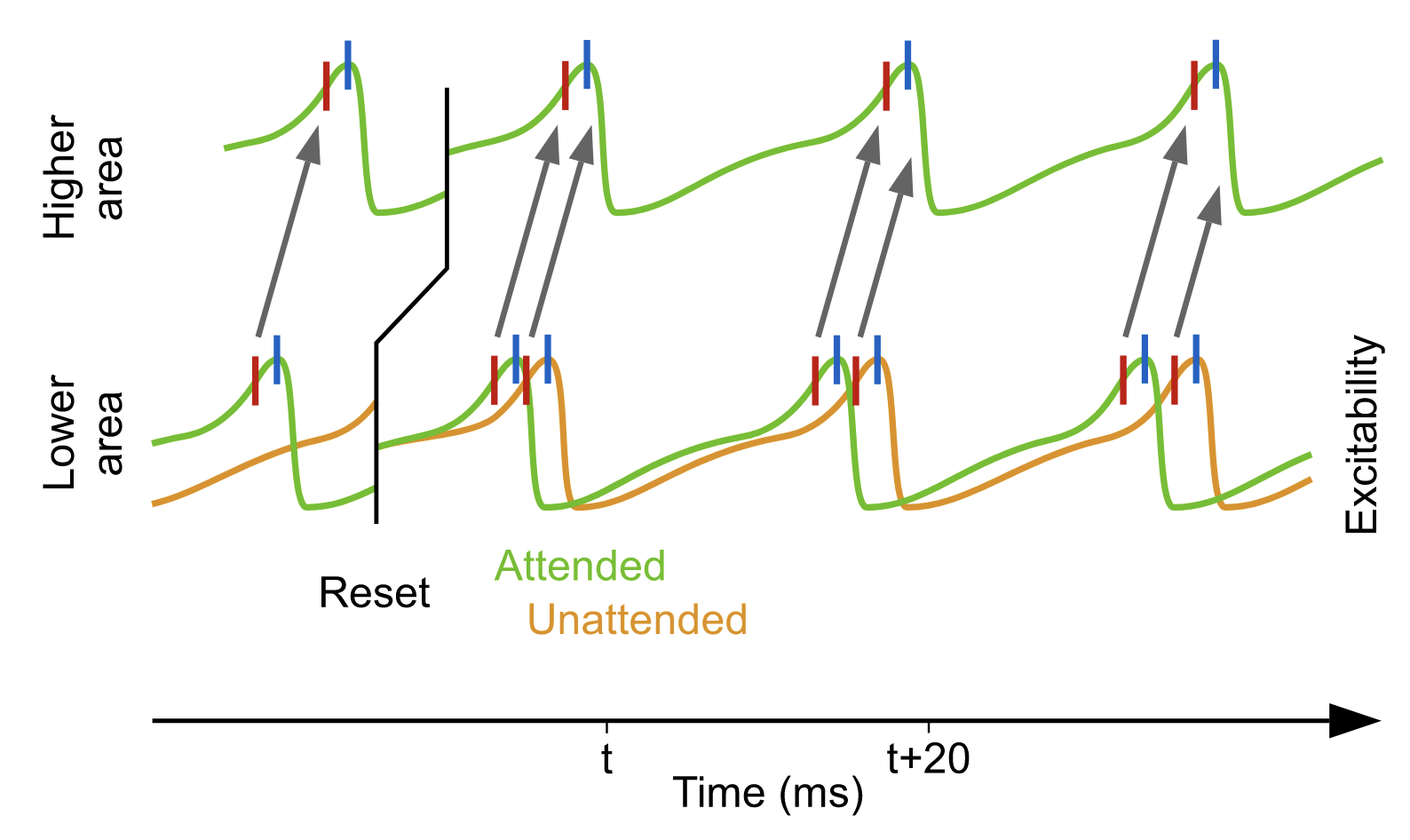
Theta rhythm (~4 Hz) periodically resets gamma across areas.
-
Enables competition: faster gamma wins early arrival in V4.
-
“Stimulus salience and top-down attention are translated into gamma frequency, and theta resets transform this into input-latency differences.”
-
Figure 7 illustrates this mechanism.
9. Feedforward vs Feedback
-
Gamma mediates feedforward influences → superficial layer origin.
-
Alpha/beta mediate feedback influences → deep layer origin.
-
Experimental evidence:
-
Stimulating V1 → gamma in V4.
-
Stimulating V4 → alpha in V1.
-
-
Granger causality supports rhythm-specific signaling.
-
Figure Description:
-
Panel B: Shows the correlation between SLN (an anatomical metric of projection direction) and DAI (a Granger-causal asymmetry index).
-
Positive correlations in gamma band → stronger Granger influence in feedforward direction.
-
Negative correlations in alpha/beta band → stronger influence in feedback direction.
-
-
Summary:
- This analysis links structure (SLN) to function (DAI), confirming that different frequency bands align with anatomical pathways for feedforward and feedback communication.Gamma mediates feedforward influences → superficial layer origin.
-
Alpha/beta mediate feedback influences → deep layer origin.
-
Experimental evidence:
-
Stimulating V1 → gamma in V4.
-
Stimulating V4 → alpha in V1.
-
-
Granger causality supports rhythm-specific signaling.
10. Theta-Rhythm in Saccades
-
Theta organizes visual sampling:
- Eye movements (~7 Hz) and attentional resets (~4 Hz).
-
Detection of bilateral stimuli oscillates in antiphase → hemispheres alternate attention.
-
Figure 9D–E: performance fluctuates at ~4 Hz after a reset flash.
-
“Selective attention samples visual input at a theta rhythm.”
11. Conclusion & Discussion
-
Rhythmic coherence enables selective, flexible communication.
-
Different frequencies serve distinct roles:
-
Gamma = bottom-up
-
Alpha/beta = top-down
-
Theta = control/reset
-
-
Attention exploits these rhythms to route information.
-
Key quote: “CTC offers a unifying mechanism to link attention, prediction, and hierarchical processing.”
Discussion Questions:
-
Is coherence necessary for communication, or just helpful?
-
How does this support or challenge predictive coding models?
-
Could rhythm dysfunction explain disorders like ADHD or Alzheimer’s?
-
How might this inform brain-computer interface design?
-
What mechanisms set up attentional synchronization?
-
Is gamma frequency a cause or a consequence of attention?
Notes
Structured Overview of Key Highlights from Fries (2015): Rhythms for Cognition: Communication Through Coherence
1. Core Concepts
-
Neuronal Communication:
-
Defined as the transfer of one representation in a presynaptic group to a postsynaptic group.
-
Requires more than structural connectivity: it relies on timing and rhythmic alignment.
-
-
Neuronal Representation:
- The spatial activation pattern in a group of neurons that reflects the current input.
-
Communication Through Coherence (CTC):
-
Neuronal synchronization facilitates communication.
-
Rhythmic synchronization creates excitation/inhibition sequences that focus output and input sensitivity to narrow windows.
-
Only coherent presynaptic groups can effectively influence a postsynaptic group.
-
2. Gamma Rhythm (30–90 Hz) as Communication Channel
-
Gamma is driven by excitation-inhibition loops in local circuits.
-
Excitatory neurons trigger inhibition within ~3 ms, producing brief windows for spikes.
-
Selective communication emerges when presynaptic and postsynaptic groups are synchronized in gamma.
-
Stronger and higher-frequency gamma occurs when stimuli are attended.
-
Gamma enables fast, precise, pulsatile coding.
-
Inputs arriving during high gain gamma phases lead to enhanced effective connectivity.
3. Alpha/Beta Rhythms (8–20 Hz) as Top-Down Inhibitory Control
-
Alpha is linked to inhibition and can block irrelevant local activity from spreading.
-
Alpha blocks communication by narrowing postsynaptic excitability.
-
Beta modulates local gamma, enhances its strength/frequency among stimulus-driven neurons.
-
Alpha/beta originate from deep layers and modulate local rhythms.
4. Theta Rhythm (~4–8 Hz) as Attentional Timing Mechanism
-
Theta organizes attentional sampling and resets gamma phases.
-
Gamma phase resets at theta rhythm enable saliency-based prioritization.
-
Eye movements (saccades) and attention operate at theta frequency.
5. Experimental Evidence
-
Optogenetic stimulation of fast-spiking interneurons induces gamma resonance and modulates behavior.
-
Gamma-band synchronization stronger in superficial layers (linked to feedforward); alpha/beta stronger in deep layers (feedback).
-
Effective connectivity peaks at phase relations typical for gamma synchronization.
-
Gamma frequency increases with:
-
Stimulus salience
-
Attention
-
Stimulus repetition
-
Elimination of noise
-
Smaller stimulus size
-
6. Figure-Based Key Points
-
Figure 4: Gamma Cycle Implements Pulsatile Representations
-
Panel A: Spike probability is highest at certain gamma phases (neurons prefer to spike in specific parts of the gamma cycle).
-
Panel B: Gamma cycle divided into 8 phase bins, each with equal spike counts. Orientation selectivity changes across bins, even though spike numbers are constant. → Gamma phase matters beyond firing rate.
-
Panel C: Orientation Selectivity Index (OSI) varies across bins, peaking at specific gamma phases. Strongest selectivity aligns with the average preferred phase of spiking.
-
-
Figure 5: Attention-Driven Gamma Entrainment (V1 to V4)
-
Panels A–C: When a single stimulus is presented and attended, its gamma rhythm in V1 entrains V4’s gamma.
-
Panels F–G: When both stimuli are presented simultaneously, only the gamma rhythm of the attended stimulus in V1 succeeds in entraining V4 — the ignored stimulus fails to synchronize V4.
-
Conclusion: Attention modulates gamma in V1, and this modulation gates access to higher-level visual areas like V4.
-
-
Figure 6: Gamma Frequency and Attention/Salience
- Gamma frequency increases with attention, repetition, salience, and clarity (less noise). This frequency boost gives faster rhythms a competitive edge in entraining downstream neurons.
-
Figure 7: Theta-Rhythmic Gamma Phase Reset
- Theta rhythm resets gamma phases across competing inputs. Faster gamma rhythms (associated with more salient or attended stimuli) gain a timing advantage in reaching V4 first.
-
Figure 8: Frequency-Specific Top-Down and Bottom-Up Influences
- Electrical stimulation of V1 increases gamma power in V4 (bottom-up). Stimulation of V4 increases alpha power in V1 (top-down). Supports the idea that gamma = feedforward, alpha/beta = feedback.
(B) The Spearman-rank correlation, across area pairs, between an anatomical metric of the feedforward/feedback character of an interareal projection (SLN) and an electrophysiological metric of the asymmetry in Granger-causal influences (DAI). A positive (negative) correlation value indicates that Grangercausal influences in the respective frequency are stronger in the anatomically defined feedforward (feedback) direction.
-
Figure 9: Laminar Origins of Rhythms
- Gamma is strongest in superficial cortical layers (origin of feedforward projections). Alpha/beta are stronger in deep layers (origin of feedback projections). Anatomical and rhythmic hierarchies align.
7. Mechanistic Insights
-
Entrainment occurs bidirectionally via delays.
-
Each brain area has sending and receiving neurons.
-
Postsynaptic gamma inhibition is timed to vanish before inputs arrive.
-
Preferred stimuli cause earlier spiking in the gamma cycle.
8. Attentional Implementation
-
Attention enhances gamma synchrony locally and in projection areas.
-
Selective attention gives V1 neurons an advantage in influencing V4.
-
Gamma-band synchronization implements selection.
-
Beta and alpha modulate and control this implementation.
9. Hierarchy and Frequency Roles
-
Gamma: feedforward, superficial layers.
-
Beta/Alpha: feedback, deep layers.
-
Feedforward = faster rhythm entrains postsynaptic area.
-
Feedback = slower rhythm modulates or inhibits areas.
10. Key Quotes and Phrasings for Presentation
-
“Neuronal communication is subserved by neuronal synchronization.”
-
“Dynamic changes in synchronization can flexibly alter the pattern of communication.”
-
“The gamma rhythm generates fluctuations in network excitation and inhibition that are sufficiently rapid, such that excitation can essentially temporally escape its ever chasing inhibition.”
-
“Selective attention gives lower-area neurons a competitive advantage in entraining postsynaptic neurons in higher areas.”
-
“Spikes occurring close to the gamma phase to which spikes synchronized on average showed stronger orientation selectivity.”
Slides
Great! Based on your structured overview, here’s a complete slide deck outline for your presentation, with clear slide titles, 3 concise bullet points per slide, and dedicated slides for each rhythm and each figure. This keeps your visuals and your audience aligned while enabling you to guide them through the logic of the paper with clarity.
🟣 Slide 1: Title Slide
-
Title: “Tuning In: Rhythms for Cognition”
-
Subtitle: Communication through Coherence in the Brain
-
Your name, date, course
🧠 Slide 2: Why This Matters
-
Brain function relies on dynamic communication, not static wiring.
-
Rhythmic synchronization can flexibly route information.
-
Communication becomes effective only when rhythms align.
❓ Slide 3: Key Question
-
How does the brain achieve selective and efficient communication?
-
What role do oscillations play in that process?
-
CTC: communication is gated by rhythmic coherence.
🔄 Core Mechanism
⚙️ Slide 4: Core Idea of CTC
-
Neuronal groups communicate better when they are phase-aligned.
-
Coherence creates windows for excitation and sensitivity.
-
Synchrony acts as a dynamic filter for signal transmission.
🧬 Rhythms of Communication (1 slide each)
🔵 Slide 5: Gamma Rhythm (30–90 Hz)
-
Fast, short excitation windows for precise timing.
-
Drives feedforward communication and attention.
-
Pulsatile signal flow — not just firing rate.
🟡 Slide 6: Beta Rhythm (13–30 Hz)
-
Mediates top-down predictions and maintenance of the current state.
-
Linked to deeper cortical layers and feedback.
-
Can influence and modulate gamma rhythms.
🟣 Slide 7: Alpha Rhythm (8–12 Hz)
-
Provides rhythmic inhibition — “gates” irrelevant signals.
-
Acts like a suppressive rhythm for unattended information.
-
Blocks communication by keeping circuits in an “off” state.
🔷 Slide 8: Theta Rhythm (4–8 Hz)
-
Coordinates longer-range attention cycles.
-
Organizes gamma phase resets — attentional sampling.
-
Reflects saccadic rhythm and continuous attention switching.
Slide 14: Figure 9 — Laminar Organization of Rhythms
-
Gamma: superficial layers → feedforward connections.
-
Alpha/Beta: deep layers → feedback projections.
-
Anatomical pathways match rhythmic organization.
🧠 Functional Architecture Summary
🧭 Slide 15: How Rhythms Organize Brain Hierarchies
-
Gamma = fast feedforward information flow.
-
Beta/Alpha = slower, modulatory feedback.
-
Rhythms create a temporal hierarchy for cognition.
✅ Conclusion
✔️ Slide 16: Key Takeaways
-
Rhythmic coherence enables selective, dynamic communication.
-
Gamma entrains targets and conveys sensory input.
-
Slower rhythms control, gate, or suppress signal transmission.
🗣️ Discussion
💬 Slide 17: Questions for Discussion
-
Is coherence necessary for communication, or just helpful?
-
How might disorders like ADHD or schizophrenia involve rhythm dysfunction?
-
Can this rhythmic architecture be used in brain-computer interfaces?
-
How does this support (or challenge) predictive coding models?
-
What open questions remain about how attention is implemented?
📚 Optional
🧪 Slide 18: Methods & Experimental Models (if needed)
-
Mention monkey studies, optogenetics, Granger causality.
-
Cortical layering and laminar electrophysiology.
Would you like this turned into a PowerPoint/Keynote or Google Slides template? I can also help generate figure visuals or minimalist icons for each rhythm!
see also
Tags: neuroscience science
Superlink: 050 🧠Neuroscience
Mein Blog
Source
Created: 15-04-25 09:56