Do we really know how the brain works? Deutscher Text
Gerade Anfang diesen Jahres kam bei mir im Kopf ein Moment: Ahh, ich glaube, ich habe verstanden, wie das Gehirn funktioniert.
Und dann fange ich dieses Buch von Jeff Hawkins an und stelle fest:
Das könnte gar nicht stimmen, was ich über das Gehirn weiß.
Die Theorie aus Jeff Hawkins’ 2021 veröffentlichtem Buch “A Thousand Brains” wirft die Theorie von Jahren an Neuroscience-Forschung über den Haufen.
Das ist normal in einer relativ jungen Wissenschaft.
Als Louis Pasteur und Robert Koch Mitte des 19. Jahrhunderts Bakterien nachweisen konnten, dauerte es eine Zeit lang, bis Menschen das überhaupt glauben konnten.
Und so kommt Jeff Hawkins mit einer neuen Theorie um die Ecke:
Bisher dachten wir und so habe ich es auch in den Vorlesungen gelernt:
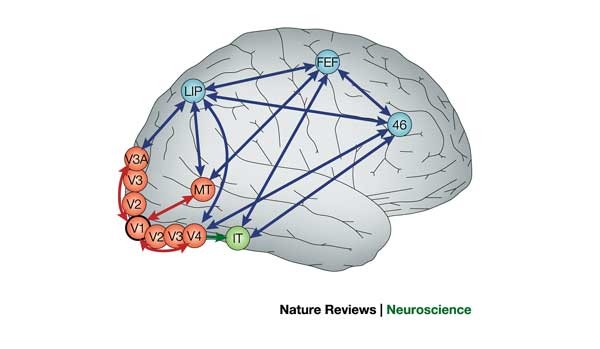
Der Visual Cortex ist hierarchisch organisiert. In V1 werden Striche, Kontraste und Farbe erkannt und je weiter wir in der Hierarchie nach oben (also im Gehirn nach vorne) gehen, desto komplexer werden die Merkmale, die erkannt werden (Bewegung, Muster).
Bis schließlich unten im IT ganze Gesichter oder Gebäude erkannt werden können.
Die vielen hundert Studien zu diesem Thema liegen auch alle richtig. Ja, im V1 kann man keine Reaktion auf Halle Berry finden, im IT aber schon (Und ja, es gibt das Helle-Berry Neuron https://www.caltech.edu/about/news/single-cell-recognition-halle-berry-brain-cell-1013).
Natürlich gibt es das. So wie du jedes Objekt oder jeden Mensch, den du kennst, erkennen kannst. Dazu gehören natürlich auch Celebrities.
Also muss die Hierarchie wohl stimmen. Die Verarbeitung wird immer komplexer, bis sie schließlich bei Halle Berry oder eben deiner Mutter landet.
Um weiterzugehen, müssen wir noch eine Sache über V1 klären.
V1 ist die erste Verbindung vom Auge in den Visual Cortex. Bedeutet, hier kommt das Signal der Augen an.
Und ein Neuron im V1 schaut auf die Welt wie durch einen Strohhalm. Also es bekommt die Informationen von nur sehr wenigen Photoreceptors auf der Retina im Auge.
Es kann also nur einen kleinen Ausschnitt sehen. Da ergibt die Hierarchie-Theorie Sinn.
Dabei kann auch V1 hauptsächlich auf Dinge schauen, die nahe dran sind.
Dennoch findet Hawkins eine Sache bemerkenswert.
auch im “dummen” V1 werden die Neurons aktiv, bevor es überhaupt den Zielgegenstand sehen wird. Also bevor der Fokus des Auges auf dem Objekt liegt, hat das Neuron in V1 bereits die Konturen vorhergesagt.
Bedeutet, dass es Informationen über das kommende Objekt haben muss, ohne es vorher gesehen zu haben.
Das bringt Hawkins zu der Annahme, dass die V1 neurons doch gar nicht so dumm sind und auch größere, komplexere Objekte erkennen können, nur eben auf die Nähe spezialisiert sind.
Was also ist jetzt daran so neu?
Der cortex besteht auch ca. 150.000 cortical columns. Jede davon mit ca. 100.000 neurons.
Und der V1 und alle anderen Cortical areas bestehen aus diesen Columns, die sich alle mehr oder weniger ähneln.
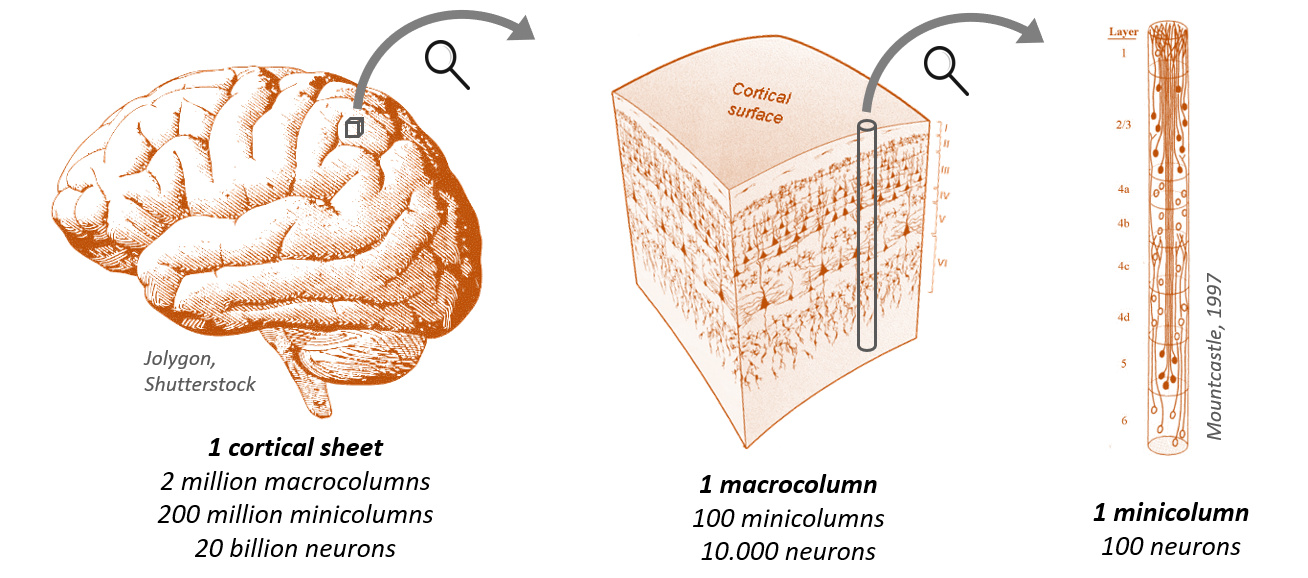
(Hier in dem Bild von 1997 von Mountcastle benutzt er andere Größenordnungen. Die oben genannten Zahlen sind die, welche heute aktuell benutzt werden.)
Seine Thousand-Brain-Theorie besagt, dass eine Column selbst hunderte Objekte erkennen kann und dass das eben auch für den V1 gilt.
Und das ganze funktioniert mit sehr den Interneurons zwischen den Columns. Auf der Ebene (2-3 und 5) komunizieren die Columns miteinander und stimmen quasi ab.
Die Column, die zuerst feuert, ist am stärksten und unterbricht die Signale der anderen.
Somit einigen sich alle Columns auf ein Objekt, welches wir dann auch erkennen.
Das bedeutet, dass schlichtweg V1 einfach nur nahe Objekte besser erkennen kann, während im IT das Halle-Berry-Neuron weit entfernte Dinge erkennen kann und die spezielle Column sich das Gesicht von Halle-Berry gemerkt hat.
Kann deshalb jetzt eine einzelne Column ein komplettes Objekt erkennen?
Nein, dafür sind die 100,000 neurons in einer column zu wenig. Jede Column kennt Teile von vielen verschiedenen Objekten. Eben zum Beispiel eine Tasse aus einem ganz bestimmten Winkel.
So feuern ständig mehrere Columns gleichzeitig. Nur je näher das Objekt an den Tatsächlichen Feuermustern in einer Column ist, desto stärker wird diese Column auch feuern und sich gegenüber der anderen durchsetzen.
Deshalb ist unser Gehirn auch eine Vorhersage-Maschine. Kann ein neuron die eigene Aktivität vorhersagen, ist es schneller als benachbarte Neurons und lässt daraufhin die Nachbarn verstummen. Es hat sich als durchgesetzt.
Deshalb versucht unser Gehirn, die ganze Zeit Vorhersagen zu treffen.
Das ist auch ein Grund, warum unser Gehirn so schnell Dinge erkennen und auf diese auch reagieren kann.
Dass es im Gehirn und vor allem im Visual Cortex so struktiert und nacheinander abläuft, wie die Hierarchie-Theorie aussagt, kann ich mir nach der Thousand-Brains-Theorie nicht mehr vorstellen.
Es ist mehr, dass diese Regionen V1, V2, V4 und IT alle parrallel arbeiten und jeder Bereich seine Spezialgebiete besitzt.
Das ergibt im Nachhein so viel mehr Sinn.
Aber wer weiß. Vielleicht wird auch diese Theorie mal überholt und/oder verbessert.
Wir sind noch in den Kinderschuhen, unser Gehirn zu verstehen.
Wir verstehen viele kleine einzelteile und dort ergeben sie auch Sinn. Wir müssen nur noch das Große Ganze verstehen.
Und da freue ich mich so drauf. Teil dieses Weges zu sein und live dabei zu sein, wenn wir lernen, wie das Gehirn funktioniert.
Do we really know how the brain works? English Text
At the beginning of this year, a moment occurred: ‘Ahh, I think I have understood how the brain works!‘. Then I started reading this book by Jeff Hawkins and realised that what I know about the brain might not be true at all.
The theory in Jeff Hawkins’ book A Thousand Brains, published in 2021, overturns years of neuroscience research.
This is normal in a relatively young science. An example would be in the time around 1830-1850, even before the American Civil War started, when Louis Pasteur and Robert Koch could prove the existence of bacteria in the mid-19th century; it took a while for people actually to adapt and believe it.
And so, Jeff Hawkins comes around with a new theory:
Until now, we thought, and this is also how I learned it in lectures:
The visual cortex is hierarchically organized. In V1, lines, contrasts, and colors are recognized, and as we move up the hierarchy (i.e., forward in the brain), the features recognized become more complex (movement, patterns). Until finally, in the IT, entire faces or buildings can be recognized.
The many hundreds of studies on this topic are also all correct. Yes, in V1, you cannot find a reaction to Halle Berry, but in IT you can (And yes, there is the Halle Berry neuron https://www.caltech.edu/about/news/single-cell-recognition-halle-berry-brain-cell-1013). Of course, it exists. Just as you can recognize every object or person you know. This naturally includes celebrities as well. So, the hierarchy must be correct. The processing becomes more complex until it finally lands on Halle Berry or your mother.
But does it? Do the hierarchies work that way?
To move on, we need to clarify one more thing about V1. V1 is the first connection from the eye to the visual cortex. Meaning, this is where the signal from the eyes arrives. And a neuron in V1 looks at the world as if through a straw. So, it receives information from only very few photoreceptors on the retina in the eye. It can thus only see a small section. This makes the hierarchy theory make sense. In this, V1 can mainly look at things that are close by.
(picture of a )
Nevertheless, Hawkins finds one thing remarkable. Even in the “dumb” V1, the neurons become active before they will even see the target object. So, before the eye’s focus is on the object, the neuron in V1 has already predicted the contours. This means that it must have information about the upcoming object without having seen it before. This leads Hawkins to assume that the V1 neurons are not so dumb after all and can recognize larger, more complex objects, just specialized in proximity.
So, what is so new about this?
The cortex consists of about 150,000 cortical columns. Each of them with about 100,000 neurons. And the V1 and all other cortical areas consist of these columns, which all more or less resemble each other.
(Here in the picture from 1997 by Mountcastle, he uses different magnitudes. The numbers mentioned above are those currently used.)
His Thousand-Brain Theory states that a column itself can recognize hundreds of objects, and that this also applies to V1. And the whole thing works with the interneurons between the columns. On the level (2-3 and 5), the columns communicate with each other and essentially vote. The column that fires first is the strongest and interrupts the signals of the others. Thus, all columns agree on an object, which we then recognize.
This means that simply V1 can recognize nearby objects better, while in the IT, the Halle Berry neuron can recognize distant things, and the specific column has remembered the face of Halle Berry.
Can a single column recognize a complete object now? No, for that, the 100,000 neurons in a column are too few. Each column knows parts of many different objects. For example, a cup from a very specific angle. Thus, several columns are constantly firing at the same time. Only the closer the object is to the actual firing patterns in a column, the stronger this column will also fire and assert itself against the others.
Therefore, our brain is also a prediction machine. If a neuron can predict its own activity, it is faster than neighboring neurons and consequently silences the neighbors. It has asserted itself.
That’s why our brain is always trying to make predictions.
This is also a reason why our brain can recognize things so quickly and react to them.
That it is structured in the brain, and especially in the visual cortex, sequentially as the hierarchy theory states, I can no longer imagine after the Thousand-Brains Theory. It is more that these regions V1, V2, V4,
see also
Type:
Tags:
Status:
Location:
Created: 20-09-24 09:42