Functional Connectivity and Functional Networks
Just as different parts of the city’s road network are involved in achieving different goals, so different parts of the brain’s neural network are involved in carrying out different cognitive or motor goals.
(p. 159)
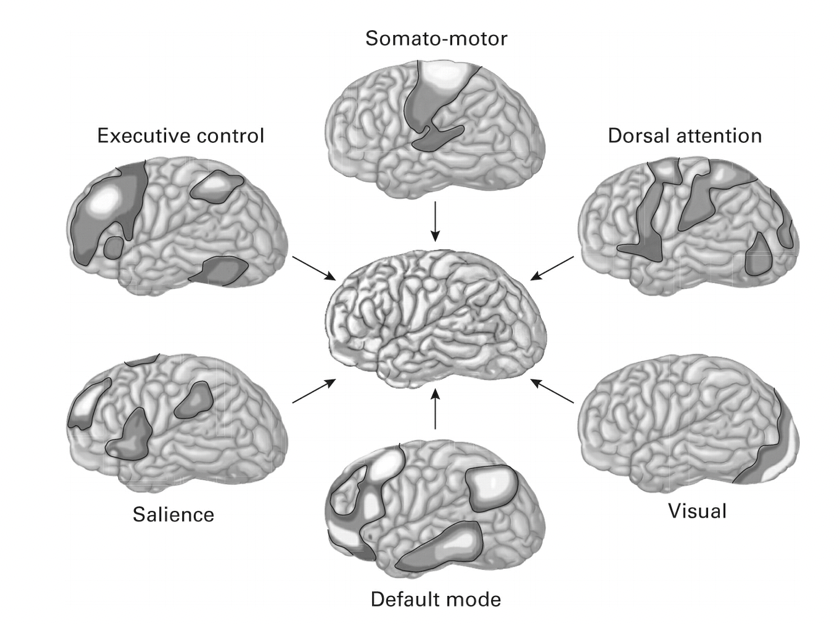
| Network | Function |
|---|---|
| Visual | Vision, visual perception |
| Somato-motor | Movement and touch |
| Dorsal attention | Attention to visual stimuli and spatial locations |
| Executive control | Higher-level cognitive tasks and directing attention during tasks |
| Salience | Attending to behaviorally relevant events |
| Default mode | Mind wandering and cognitive activity related to personal life story, social functions, future simulation, and creativity |
(p. 161)
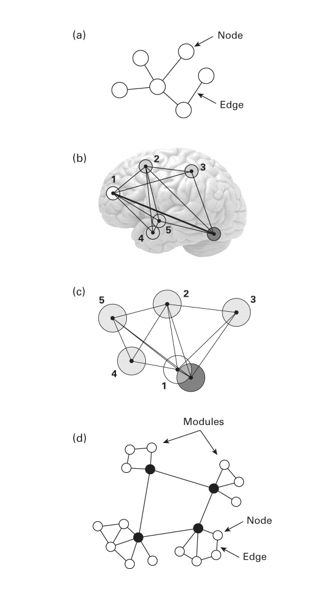
Figure 6.4 (a) A simple graphical network showing nodes and the edges that connect the nodes. (b) Functional connectivity between areas, shown in anatomical space, with their locations corresponding to their locations on the brain. The strength of connection is indicated by the thickness of the edges. (c) Functional connectivity shown in functional space. The strength of connection is indicated by the distance between nodes, with shorter distances indicating stronger connections. (d) A functional network that contains four modules, each of which serves a specific function.
functional connectivity between areas. These connections change depending on conditions.
⇒ this looks like connections in terms of informatics.
see also
Tags: neuroscience science
Superlink: 050 🧠Neuroscience
Quellen
Erstellt: 11-05-22 07:46