Structure:
- How to structure a system to model human cognition
- What is human cognition?
- Air Traffic Controller Task example
- Summary
We are far from explaining how the brain works. Thousands of neuroscientists are on about that one.
We understand circuits, how the brain regions are connected, we know how synaptic connections are formed, in what kind of tasks brain regions are involved.
But we do not know yet how and where long-term memory is stored in the cortex and how it is retrieved.
There are several theories about it and many of them seem plausible.
For testing your hypothesis you need a model and humans to perform a very similar task.
By looking at the results you can confirm or reject your hypothesis.
But how do you structure a model to mimic human cognition?
But before we answer this question we need to ask:
What is human cognition?
It is the ability of acquiring, retrieving and consolidating and processing information.
This includes abilities like perception, memory, language, attention, problem-solving and learning.
So you can say that every deliberate or habitual action can be seen as a form of human cognition. Not including things like breathing or walking which are trivial and barely need cognitive effort.
Are Neural networks good at modelling human cognition?
They have layers, predictions and feedforward systems just like the brain.
But they lack of the ability of interpretability of the system.
They are really good for modeling attention and vision as they can process great amounts of data.
For example LLMs like chatGPT are able to mimic human way to communicate text-based.
To model human cognition one needs to think about the components we need in order to model that.
What we need for every single task is:
- memory
- action
Everytime we learn something new we memorize this action. It can be lost, but for at least a while it will stay in the brain.
Also we need actions. These action are not just arbitrarily performed. They rely on preexisting rules that might be changed due to learning.
And that’s exactly what researchers are upto.
So cognition is something about information and an action upon it.
A great example to model human cognition is a complex but not too simple task. So something humans could still be better at than computers.
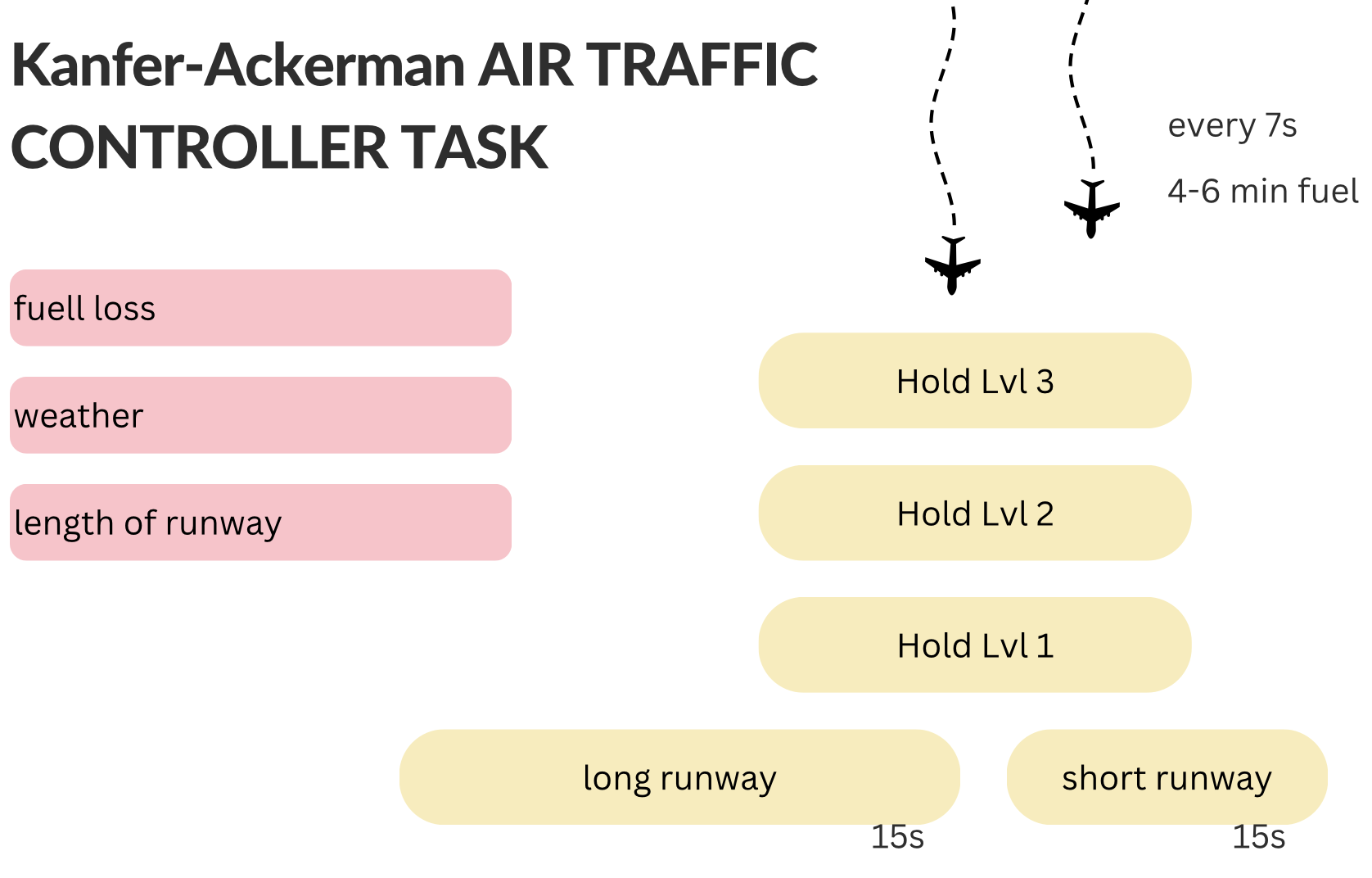
In the Air Traffic Controller task you have to assign planes of different types with different amount of fuel to the runways.
A 747 can only land on the long runway, other planes can land on both.
Every seven seconds, a new planes come in and it takes 15 seconds for a plane to clear the runway.
This is a task participants could easily perform on a screen pressing arrows up and down.
In this task you can see how the performance of humans increased over time.
But how can you model and understand this performance increase?
First, we create a declarative memory (DM) and a procedural memory (PM).
With this we can store information in the DM and rules for action in the PM.
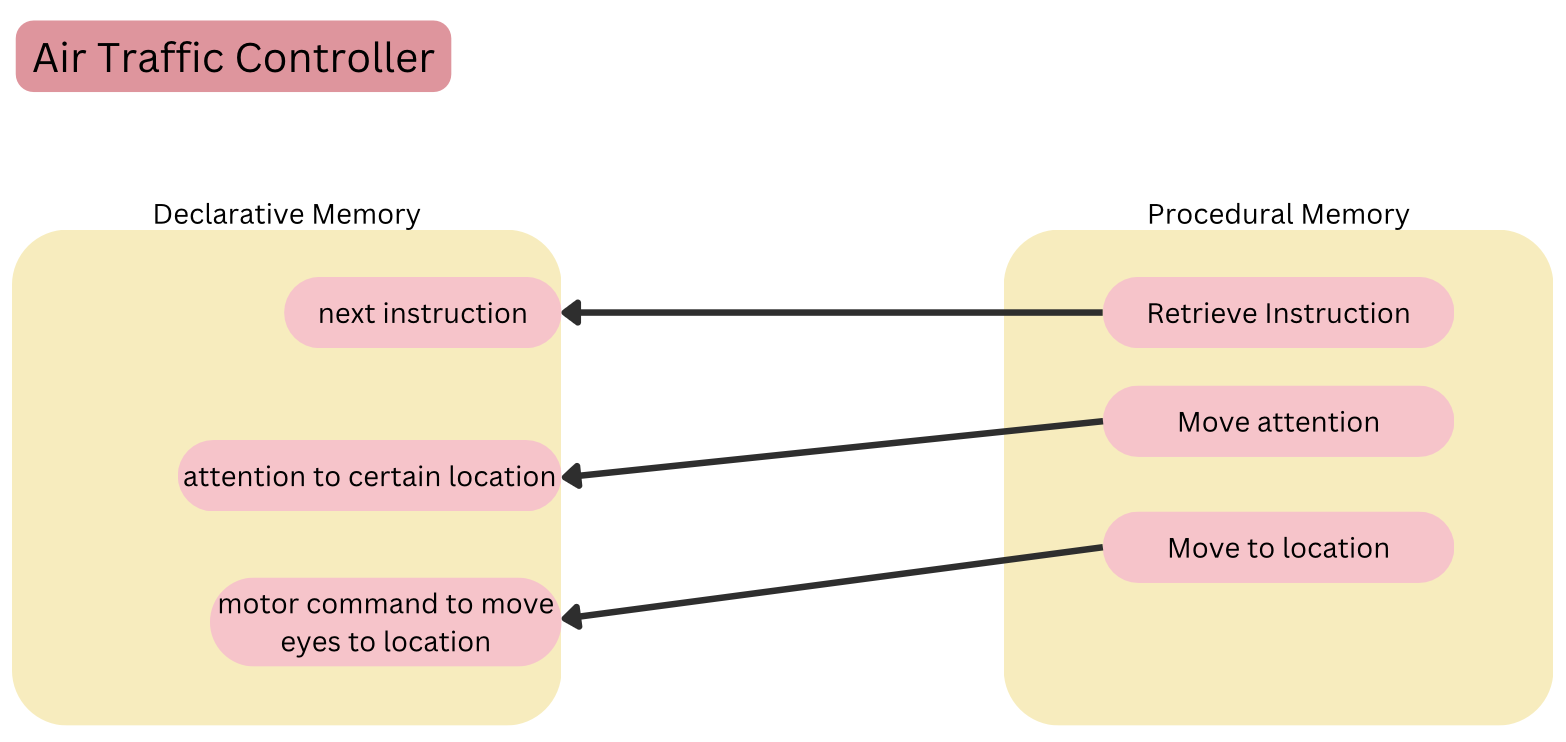
It is highly inefficient to retrieve evry single detail from declarative memory after every single task.
It is like you only do one step at a time. It is similar to learning how to drive a car.
You do one step at a time. You are very slow. Might fail to get the right gear in at the traffic light (yes I learned to drive a manual in driving school). You cannot blink and look in the mirror at the same time.
But the more you drive the more you do things in parallel. And this is what the computer does as well in the air traffic controller task.
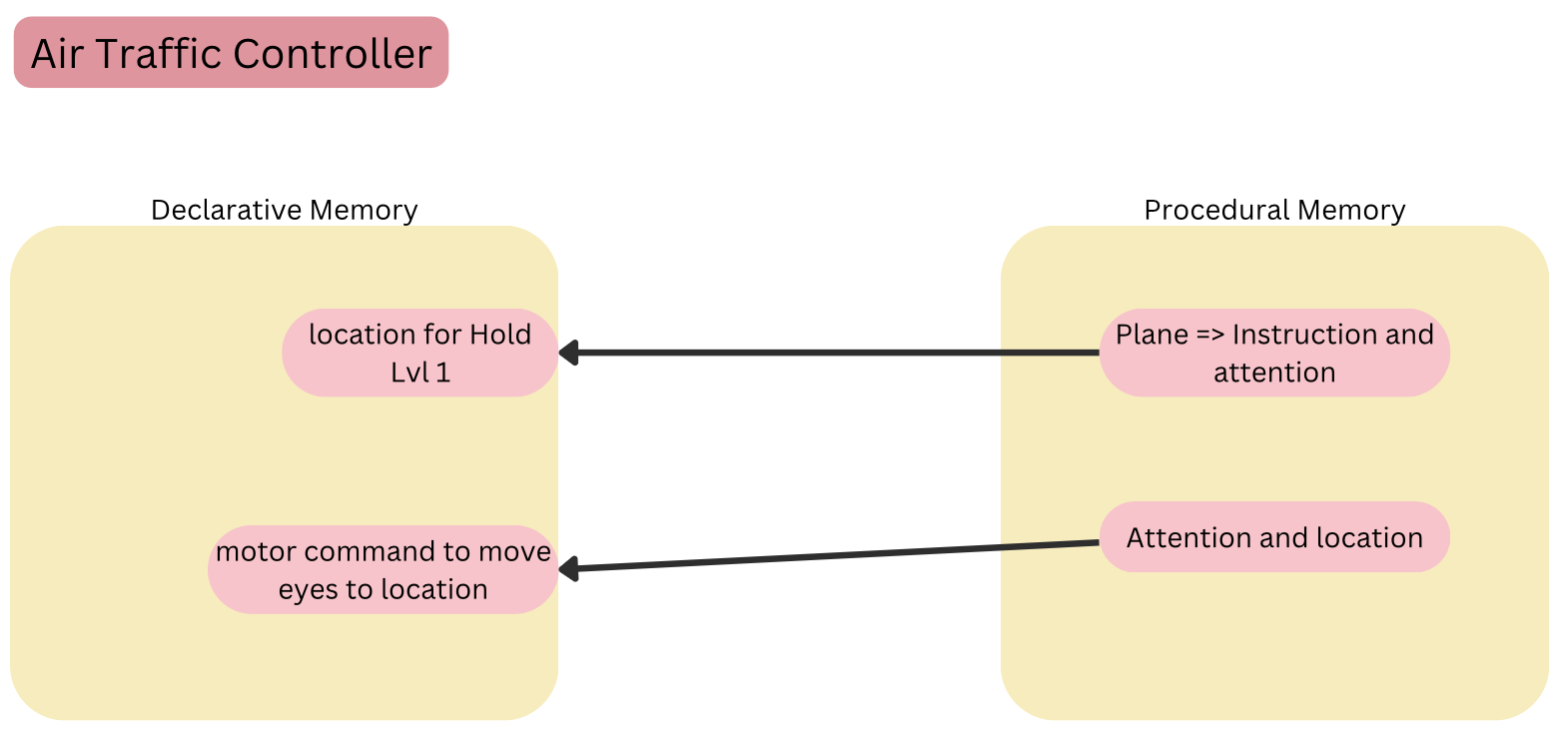
Here it reduced the amount of request to the declarative memory to 2.
If you eyes always move to the bottom left of the screen when a new plane comes in, you might even skip the second step.
So you are left with one single retrieval from declarative memory.
And this is what the ACT-R (Adaptive Control of Thought - Rational) system does with its so called ‘production rules’. It compiles the rules into more compact ones. A lot faster.
Let’s see how well this compared to human data:
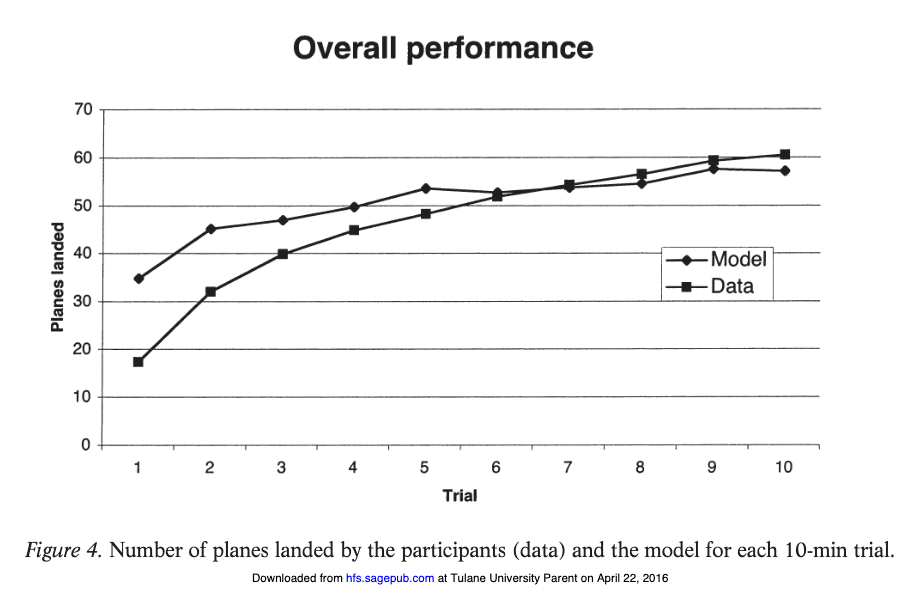
This paper is from 2003 but is already a very good approach to explain human cognition.
Summary
-
The brain’s complexity is not fully understood, with ongoing research in this area.
- Key components for modelling human cognition: memory and action.
- Neural networks excel at processing attention and vision but lack interpretability.
-
Human Cognition: Involves perception, memory, language, etc.; most deliberate actions are cognitive, unlike automatic ones like breathing.
-
Action and Learning: Actions are rule-based and adapt through learning.
-
Example - Air Traffic Controller Task:
- Demonstrates human decision-making and learning.
- Improvements in efficiency with practice.
-
ACT-R Cognitive Model:
- Uses declarative and procedural memory.
- Streamlines actions through production rules for faster execution.
-
Research Reference: Insights from Taatgen & Lee’s 2003 study on skill acquisition using ACT-R.
Source
Taatgen, N. A., & Lee, F. J. (2003). Production Compilation: A Simple Mechanism to Model Complex Skill Acquisition. Human Factors: The Journal of the Human Factors and Ergonomics Society, 45(1), 61–76. https://doi.org/10.1518/hfes.45.1.61.27224