Tutorial Script – Lecture 2: Cerebellum & Classical Conditioning
Date: 22 April 2026
Duration: 90 minutes
Lecture slides: AC_MS_2_Cerebellum.pdf (Slides 23–43)
Focus: Classical Conditioning in the Cerebellum – Mechanism, Circuit, Model
0. Before the Tutorial (prep, not spoken)
- Common confusion: students mix up the US/CS roles of the fibre types (which one comes via Mossy, which via Climbing?)
- Common confusion: LTD vs. LTP – which synapses are weakened, which are strengthened?
- The synopsis table (Slide 28) is gold – internalise it well
- The Prism Adaptation study (Martin et al. 1996) is an elegant lesion-based proof of the Climbing Fibre role – be able to explain the argument cleanly
- Doya framework (Slide 33): Cerebellum = supervised learning, Basal Ganglia = reinforcement – exam relevant!
- Personal question to think about: Why does timing even need its own dedicated mechanism?
1. Opening & Hook (5 min)
You’re sitting in the dentist’s chair. Before the needle even touches your tooth, you tense up. Why?
That’s not a coincidence – your cerebellum has learned to associate certain cues (the sound of the drill, the smell of the room) with the pain. And it didn’t just learn that something is coming – it learned when it will come.
Opening question for the group:
“Pavlov showed that dogs salivate at a bell after training. But imagine: the dog has to salivate exactly 500ms after the bell – not earlier, not later – because the food always arrives at precisely that moment. How could the brain learn something like that?”
(Goal: build the intuition that timing is the tricky part – and that this is exactly what the cerebellum solves.)
2. Link to Last Week (5 min)
Last week: the spinal cord as an “intelligent” reflex arc – patterns that are already hardwired (Force Fields, monosynaptic reflex arc).
This week: what happens when an animal has to acquire a new reflex? When behaviour needs to change through experience? That’s where the cerebellum comes in – it is the learning structure of the motor system.
3. Classical Conditioning – What Is It Really? (10 min)
Core Message
Classical conditioning is a paradigm that allows us to study the temporal precision of learning – and the cerebellum is where that timing is generated.
Explanation Approach
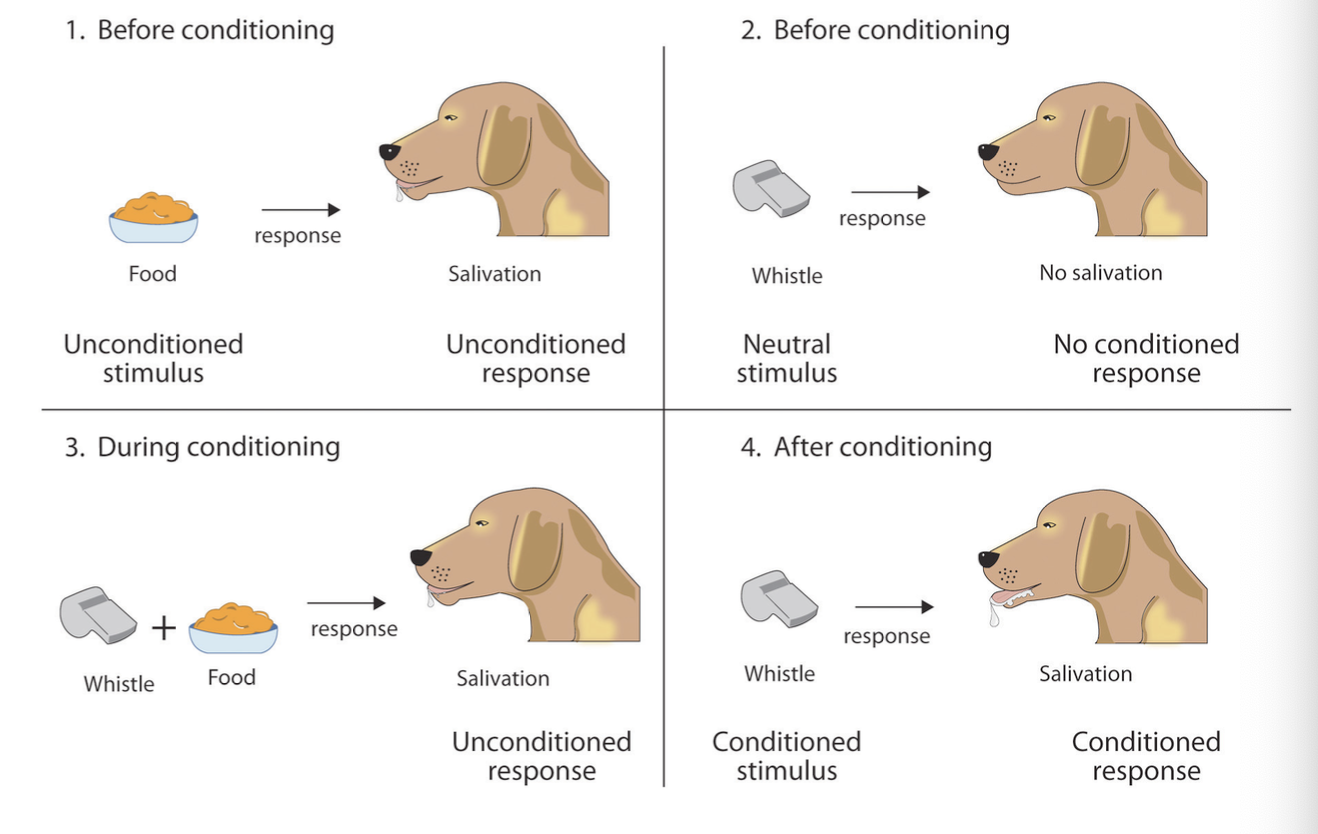
Pavlov (1927): dog salivates to food (US → UR). Bell alone: nothing. Bell + food repeated: soon the dog salivates to the bell alone (CS → CR).
Eyeblink paradigm: air puff to the eye (US) → blink (UR). A tone (CS) is given beforehand. After training: tone alone → blink (CR) – and exactly timed just before the air puff.
The elegant part: the CR does not appear immediately at CS onset, but with an adaptive delay. The cerebellum learns the interval CS → US.
Discussion Questions
- What is the difference between the unconditioned response (UR) and the conditioned response (CR) in the eyeblink paradigm?
- Why is the eyeblink paradigm particularly useful for studying timing in the brain – what makes it better than Pavlov’s salivation response?
- What would happen if the interval between CS and US were varied randomly across trials – would the animal still learn?
Common Misconceptions
- “CR = UR” → No, the CR is often slightly different (e.g. weaker, earlier onset) – it is a prediction, not a simple copy
- “The cortex learns this” → No – with cerebellar lesion the timing collapses, but the response itself doesn’t disappear entirely (Deep Nuclei retain a rudimentary response)
4. The Mechanism: How Does the Cerebellum Learn? (25 min)
Core Message
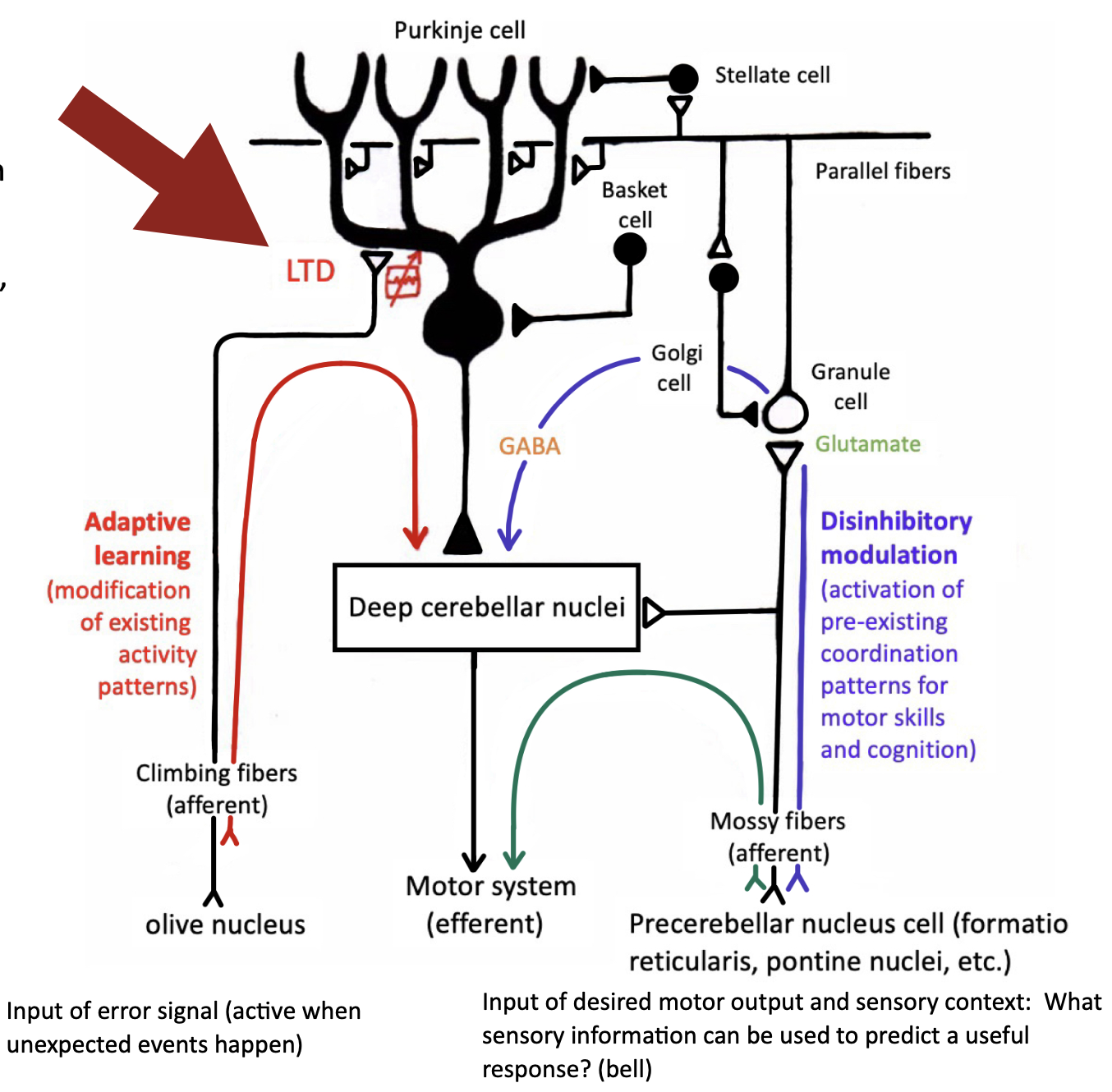
Learning is gated by the climbing fibres. The synapses of the parallel fibres targeting the Purkinje cells are modified. (Most important slide, Slide 27)
Explanation Approach: The Two Input Systems as CS and US
Think of the cerebellum as a learning machine that receives two types of information:
Mossy Fibres (= the CS, the bell):
- Come from the spinal cord, cortex, and vestibular system
- High frequency, detailed sensory context signal
- Carry information about the state of the world: “I’m standing in the lab, I hear a tone”
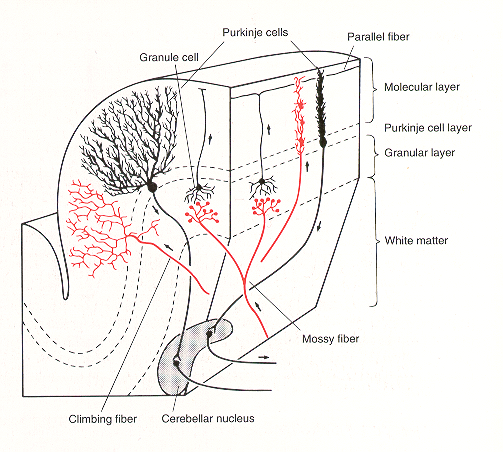
- Excite granule cells → parallel fibres → Purkinje cells
Climbing Fibres (= the US, the food / the error):
- Come from the Inferior Olive (brainstem)
- Low spontaneous firing rate (~1–2 Hz), only fire on unexpected events
- Encode: “Whoa, unexpected event – learn this!”
- Contact Purkinje cells directly with many synapses → complex spike
The Learning Rule: LTD at Parallel Fibre → Purkinje Synapses
When a climbing fibre and a parallel fibre are active simultaneously:
→ The synapse between the parallel fibre and the Purkinje cell is weakened (LTD)
What does this mean functionally?
- Purkinje cells normally inhibit the Deep Cerebellar Nuclei (DCN)
- When Purkinje cells fire less due to LTD → DCN are disinhibited → output signal possible → conditioned response
Granule Cells as a Clock
The activity patterns across thousands of granule cells encode time. Different granule cells are active at different moments after CS onset. The cerebellum learns which granule cells (= at which time point) co-occur with the US → LTD at exactly those synapses → the response appears at the right moment.
Analogy: Think of the granule cells as a giant clock where different hands light up at every moment in time. The cerebellum learns to trigger a response exactly when the hand points to the moment the US normally arrives.
Synopsis: Who Is Who? (Slide 28)
| Signal | Origin | Pathway | Conditioning Analogue |
|---|---|---|---|
| Intent/Plan | Cerebral Cortex | Middle Peduncle → Mossy Fibres | ”The tone (CS)“ |
| State/Reality | Spinal Cord + Vestibular | Inf./Sup. Peduncle → Mossy Fibres | ”I’m standing in the lab” |
| Error/Teacher | Inferior Olive | Inf. Peduncle → Climbing Fibres | ”The air puff (US)“ |
| Motor Output | → Spinal Cord | Sup. Peduncle (from DCN) | “Blink (CR)“ |
| Plan Update | → Cerebral Cortex | Sup. Peduncle (from DCN) | “Cognitive expectation” |
Discussion Questions
- Why does it make sense that climbing fibres have such a low spontaneous firing rate – what would happen if they fired constantly?
- What role do Purkinje cells play as inhibitory neurons – why is it clever to modulate inhibition rather than direct excitation?
- What would learning look like if the climbing fibres were pharmacologically blocked – and how does this relate to the Prism Adaptation experiment?
Common Misconceptions
- “Mossy Fibres = US” → Wrong! Mossy fibres carry the CS context. Climbing Fibres = error signal / US
- “Purkinje cells become stronger” → No! LTD means weakening. Less Purkinje firing = more DCN output
- “The cerebellum learns like the cortex” → No: no recurrent activation, no reinforcement – strictly supervised, error-driven
Exam Relevance
- Q9: “Describe the current hypothesis on physiological effects of classical conditioning the cerebellum” – this mechanism is exactly what’s needed
- Key points: CS via Mossy Fibres, US via Climbing Fibres from Inferior Olive, LTD at Parallel Fibre–Purkinje synapse, disinhibition of DCN as output
5. Evidence: Prism Adaptation (Martin et al. 1996) (10 min)
Core Message
The climbing fibres (via the Inferior Olive) are not needed to execute a movement, but are strictly necessary to compute an error and update the internal model.
Experiment
Throwing darts while wearing prism glasses: everything appears shifted. Normally the brain adapts exponentially across trials.
- PICA lesion (Inferior Olive affected): throws smoothly, but learns nothing – always hits the same wrong spot
- SCA lesion (cerebellar cortex affected, but Olive intact): throws inaccurately and clumsily, but still learns – the cluster of throws shifts toward the target over time
Conclusion: Climbing fibres = error signal for the internal model. Without them: no adaptation.
Discussion Questions
- Why is it an elegant proof that the PICA patient fails to learn despite appearing motorically competent?
- What does the SCA patient tell us about the dissociation between motor precision and learning ability?
6. The Model: Medina et al. (2000) (10 min)
Core Message
The cerebellum can be simulated as a computational model – and the model reproduces the adaptive timing of the CR over training.
What the Model Shows
- Granule cells as a clock: different subpopulations active at different time points after CS onset
- After 200–300 trials: the Deep Nucleus fires at exactly the time of the US
- When the CS–US interval is extended (250 → 500 → 750 ms): the peak of the response shifts accordingly (adaptive timing)
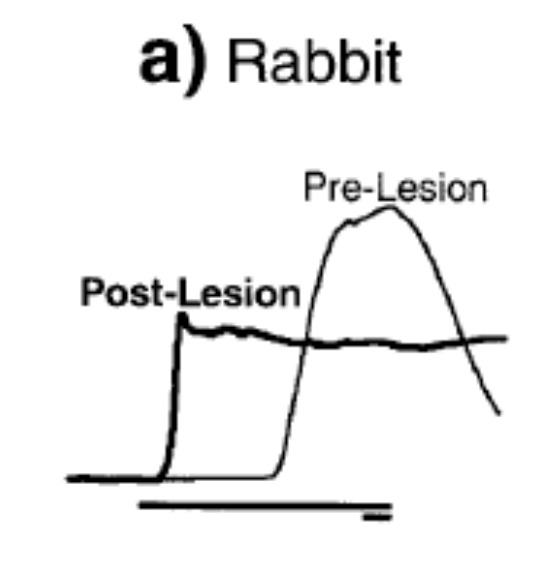
- Lesioning Purkinje cells in the model → timing collapses (matching the rabbit lesion data)
Key statement from Slide 39: “The activity patterns across granule cells serves as a clock and the model reproduces the appropriate timing of the conditioned response.”
Discussion Questions
- What does it mean that the model is forced to make drastic simplifications – does a model that reproduces the data automatically make it a good model?
- Why is the match between simulation and rabbit physiology (Slide 41) a strong argument for the proposed mechanism?
7. Classification: Doya Framework (5 min)
Core Message
The cerebellum is a Supervised Learning machine – driven by motor errors, completely separate from the reward system.
| Brain Region | Learning Type | Signal |
|---|---|---|
| Cerebellum | Supervised Learning | Motor Error (Climbing Fibres) |
| Basal Ganglia | Reinforcement Learning | Dopamine Reward |
| Cerebral Cortex | Unsupervised Learning | Statistical patterns |
For the exam: The cerebellum does not need a reward – it only needs a clear error signal (= US = Inferior Olive).
Discussion Questions
- “The Doya framework says the cerebellum uses supervised learning but the basal ganglia use reinforcement learning. Both help the animal improve its behaviour — what’s the key difference between the two learning algorithms that requires separate brain structures?”
- “If someone has a cerebellar lesion that eliminates climbing fibre input, can they still learn through dopamine-mediated reinforcement learning? What does that tell you about whether these systems can substitute for each other?”
Exam Relevance
- Q8 (Doya): “What does supervised learning mean? Can classical conditioning be considered supervised learning?” — Students must say: there is an explicit teacher signal (climbing fibre = Inferior Olive = the US), the error is directly provided (not inferred from reward), and the timing information is embedded in the granule cell population. Yes, eyeblink conditioning is the canonical biological example of supervised learning.
8. Exam Question Round (15 min)
Question 7: Describe a classical conditioning experiment.
Expected key points:
- US (e.g. air puff) → UR (blink) – already present before training
- CS (tone) initially neutral
- CS + US repeatedly paired (CS precedes US)
- After training: CS alone → CR (blink) – with correct timing
- Key insight: the CR appears with appropriate timing, not immediately at CS onset
Typical mistakes:
- Not distinguishing UR and CR
- Forgetting the timing aspect
- Mixing up US and CS
Question 9: Describe the current hypothesis on physiological effects of classical conditioning the cerebellum.
Expected key points:
- CS arrives via Mossy Fibres (via Pontine Nuclei) to granule cells → parallel fibres → Purkinje cells
- US arrives via Climbing Fibres (via Inferior Olive) to Purkinje cells
- Co-activation of CF and PF → LTD at PF–Purkinje synapse
- Purkinje cells fire less → Deep Cerebellar Nuclei are disinhibited → CR
- Granule cells encode temporal information (clock) → adaptive timing of CR
- Lesion of cerebellar cortex: timing is lost, but rudimentary response remains (DCN)
Typical mistakes:
- Swapping the roles of Mossy and Climbing Fibres
- Confusing LTD with strengthening
- Not explaining why the DCN are the actual output station
Question 11: Make an argument that the cerebellum serves as a feed-forward control for the motor system.
Expected key points:
- Feed-forward: prediction without a feedback loop
- Cerebellum receives: Intent (from cortex) + Reality (from spinal cord) and proactively computes the necessary motor correction
- No recurrent activation → no self-sustaining signal → purely on-demand system
- Excitatory input, inhibitory output (Purkinje → DCN): processes and passes on
- Classical conditioning shows: CR appears before the US → this is proactive, not reactive control
- Prism adaptation: cerebellum learns an internal model of body physics → enables prediction without sensory delay
Typical mistakes:
- Confusing feed-forward with feedback
- Not articulating why feedback is too slow for fast movements
Closing (3 min)
Take-Home Message:
“The cerebellum is the clock of motor learning: it doesn’t just learn that a stimulus is followed by a response – it learns the exact moment. The key is the error signal from the climbing fibres, which acts like a teacher saying: ‘Now! That was unexpected – learn this exact moment.‘”
Preview of next week: Basal Ganglia – also a learning system, but with one fundamental difference: reward instead of error. We’ll see how reinforcement learning differs from supervised learning – and why one handles habits while the other drives motivation.