Tutorial Script – Lecture 5: Mirror Neurons
Date: Wednesday, 13 May 2026
Duration: 90 minutes
Lecture slides: AC_MS_5_MirrorNeurons.pdf (old lecture version — verify against new slides)
⚠️ Built from previous year’s lecture PDF — verify against new slides once available
0. Before the Tutorial (prep, not spoken)
Concepts students are most likely confused about:
- The difference between visual hypothesis and direct matching hypothesis — these sound similar but have very different implications for how the brain works
- What “goal-selective” means for mirror neurons (not any movement — a purposeful act)
- The evidence gap: monkey = single-unit recording; human = fMRI/TMS only (no single-unit, ethical constraint)
- The distinction between “mirror neurons exist in humans” and “mirror neurons explain empathy/autism/language” — the latter is NOT established
Things to double-check before class:
- Rizzolatti et al. (2001) Nature Rev Neurosci — the key monkey paper with the grasping figure
- Iacoboni et al. (1999) Science — fMRI finger imitation showing BA44 + PPC
- Buccino et al. (2004) — human/monkey/dog biting study
- Wicker et al. (2002) — disgust insula study
- Mukamel et al. (2010) — single-unit recordings in humans (SMA, entorhinal cortex, amygdala — NOT IFG/PPC)
- Lingnau et al. (2009) PNAS — the fMRI adaptation study that FAILED to support direct matching
Images available for reference:
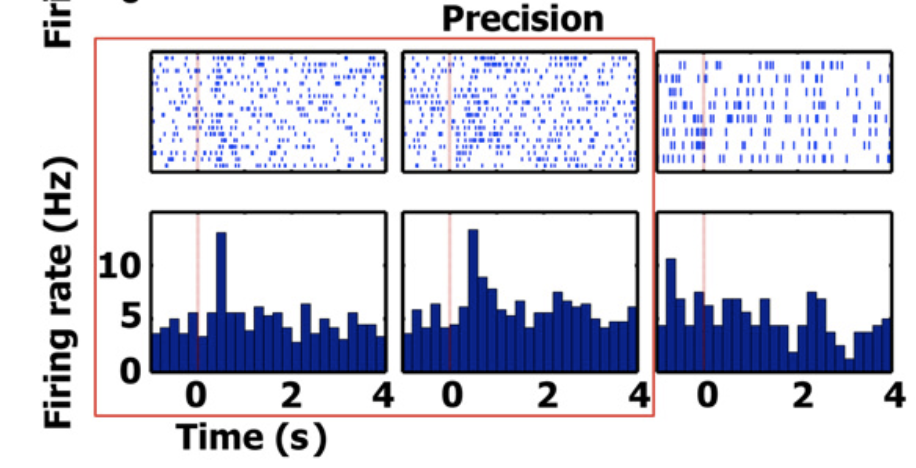
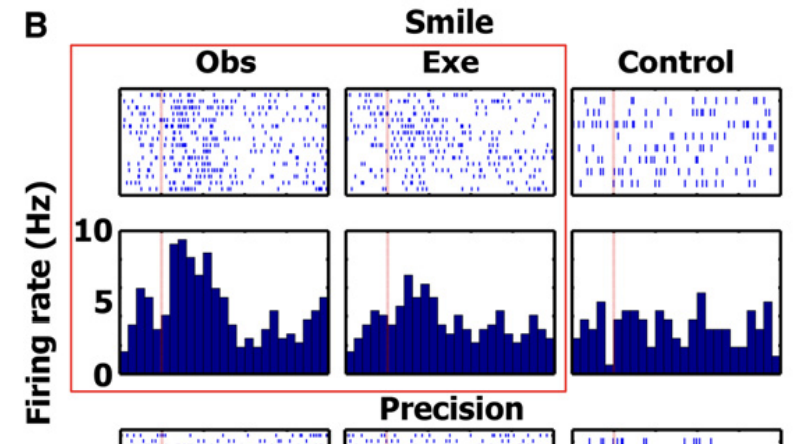
1. Opening & Hook (5 min)
Opening question for the group:
“You’re watching someone bite into a lemon. What happens in your body? And why do you think your motor system would be involved in simply watching?”
Let them answer. Lead into: the fact that observing an action activates the motor system is the whole puzzle this lecture addresses.
Alternative hook: Ask them to clench their fist while watching someone else clench theirs — TMS studies show the MEP (motor evoked potential) is larger during observation. Their motor cortex is already responding to what they see.
2. Link to Last Week (5 min)
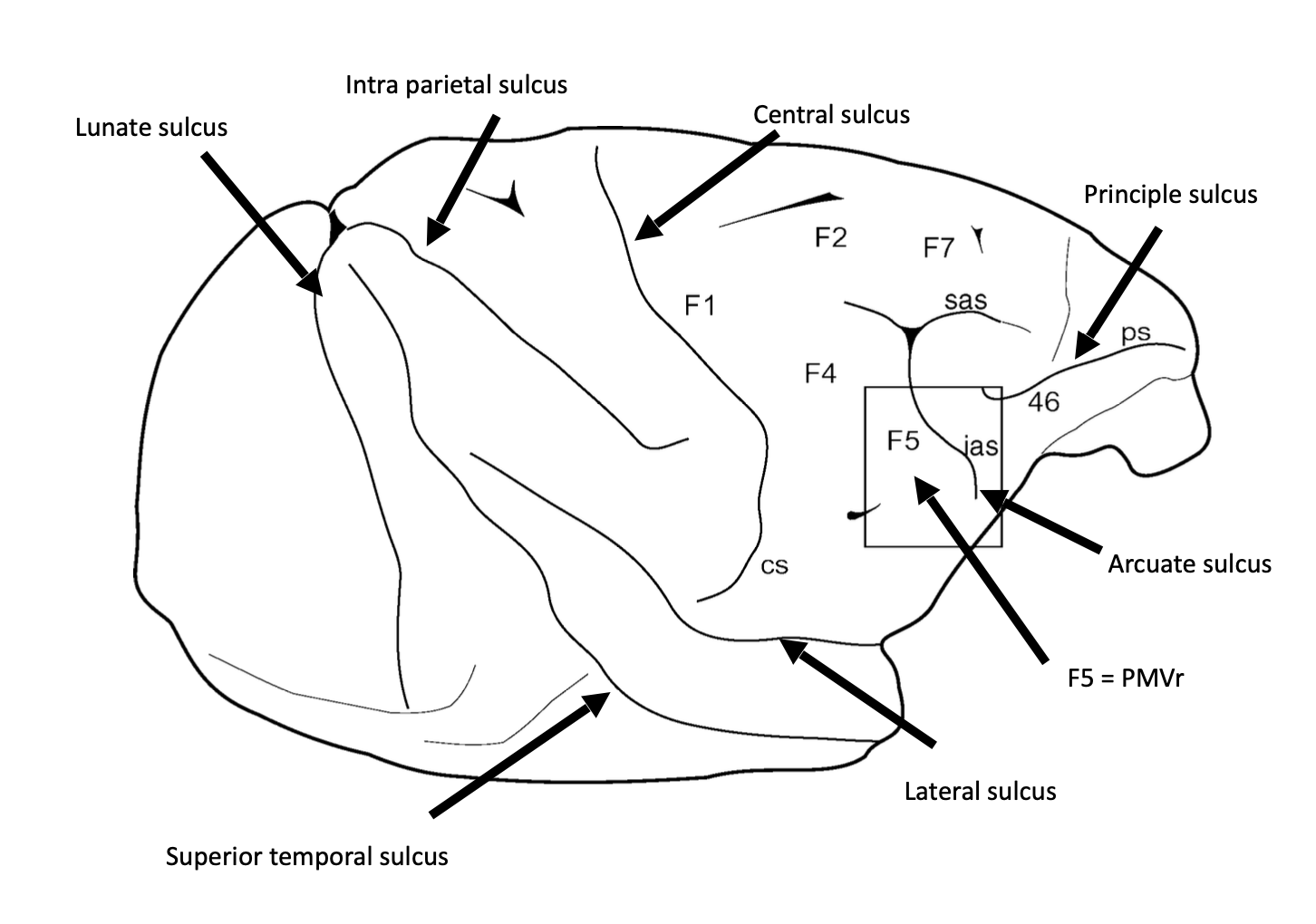
Last week (Lecture 4: Motor Cortex) we saw that M1 is the output stage — population vectors, corticospinal tract, direct control of movement. Area F5 (premotor ventral) is upstream of M1 and represents motor acts, not individual movements.
The key bridge: F5 does not fire for single muscle contractions — it fires for goal-directed acts (grasping, mouth movements). Mirror neurons were found precisely there. This week we ask: what does the motor system do when you are not the one acting?
3. Understanding Others: Theory of Mind Context (10 min)
Core Message
Before getting to mirror neurons, ground students in why understanding others’ actions matters. The lecture opens with Theory of Mind and the Sally-Anne false belief task — not because MNs explain it, but to set the problem space.
Explanation Approach
The Sally-Anne task: Sally puts a ball in a basket, leaves. Anne moves the ball to a box. Where does Sally think the ball is? Children under ~4 years fail (say “the box”) — they cannot represent another person’s false belief.
Key point: Around age 4, children pass the false belief task. This is a landmark in social cognition development.
ℹ️ Note: The Sally-Anne task is in this lecture to motivate the “understanding others” problem. Mirror neurons are proposed as part of the mechanism — but ToM and mirror neurons are not the same thing. Do not conflate them.
Discussion Questions
- What is the difference between knowing what someone did and knowing what they believe? Why does that distinction matter for social life?
- If a child fails the false belief task, does that mean they have no empathy? What are they still able to do?
- How does theory of mind relate to the idea that the motor system might be involved in understanding others?
Two Competing Hypotheses — Set Up Here
- Visual hypothesis / Theory theory: Action understanding is based on visual analysis of the elements of an action. Top-down, cognitive, no motor involvement needed.
- Direct matching hypothesis / Simulation theory: Visual input is directly mapped onto the motor system — the brain simulates the observed action. Bottom-up, embodied, motor system is required.
ℹ️ Note: “Theory theory” is aligned with Good Old-Fashioned AI (GOFAI); direct matching is aligned with embodied cognition. König makes this explicit in the slides.
4. Mirror Neurons in Monkeys (20 min)
Core Message
Mirror neurons were discovered in macaque area F5 (ventral premotor cortex) by the Rizzolatti group. They fire both when the monkey performs a goal-directed act (grasping) AND when it observes another agent perform the same act.
Anatomy Quick Reference
- F5 = PMVr (rostral ventral premotor cortex)
- Located in the posterior bank of the inferior limb of the arcuate sulcus
- Reciprocally connected with the hand field of M1
- Has direct (limited) projections to upper cervical spinal cord
- Activity correlated with motor acts (goal-directed), not individual muscle contractions
Key Properties — Work Through These Systematically
1. Goal-selectivity, not movement-selectivity
F5 neurons fire for grasping (as a goal-directed act), not for any hand movement. This is the core insight.
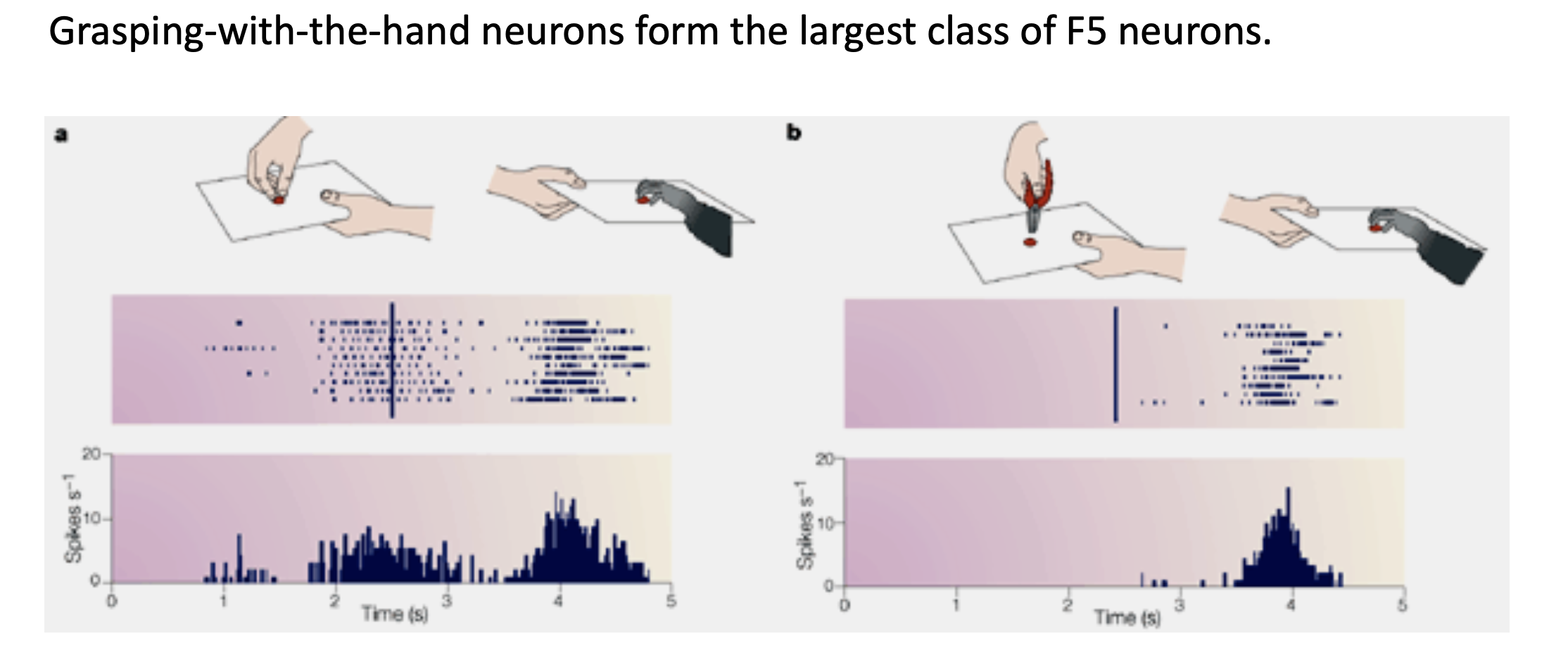
2. The grasping result (Rizzolatti et al. 2001 — Most Important Slide)
- Monkey watches human grasp food by hand → mirror neurons fire
- Monkey watches human grasp food with a tool the monkey has never used → mirror neurons do NOT fire
- Monkey performs grasping itself → mirror neurons fire regardless
→ Conclusion: MNs code the motor act the observer could themselves perform, not just any observed action.
3. Tool use nuance (Ferrari et al. 2005)
Despite the above, some F5 neurons DO respond to tool use. The rule is: if the tool belongs to the monkey’s own motor repertoire (e.g., a stick it has used), mirror neurons can fire. If the action is completely foreign (tongs), they don’t.
⚠️ Fact-check: The vault note says “tool use only if monkey knows the tool (stick yes, tongs no — unless trained)” — this matches the lecture (Ferrari et al. 2005). The initial Rizzolatti 2001 finding was that tool use generally did NOT activate MNs; Ferrari 2005 revised this. Both are correct in their context.
4. Action type specificity
Mirror neurons distinguish between precision grip vs. whole-hand grip during observation. During execution by the monkey, the same neuron may fire for both. This shows visual selectivity in the input.
5. Inferred actions (hidden conditions)
Mirror neurons fire even when the grasp is hidden (monkey knows grasping is happening but cannot see it). The inferred action matters, not just the physical stimulus. This rules out pure visual explanation.
6. Multimodal mirror neurons (Kohler et al. 2002, Science)
Some F5 neurons respond to:
- Sight of peanut breaking
- Sound of peanut breaking alone
- Monkey’s own action of breaking
→ These are audiovisual mirror neurons. The neuron codes the event across modalities.
7. Mouth mirror neurons (Ferrari et al. 2003)
~1/3 of mouth motor neurons in F5 also fire when observing mouth actions in others. Includes:
- Ingestive mouth actions (lip smacking mirrored)
- Communicative gestures (lip smacking of another individual)
→ Triggers speculation about F5 ↔ Broca’s area and the evolution of language.
8. Gaze modulation (Coudé et al. 2016)
47% of mirror neurons in PMv are modulated by the observed agent’s gaze direction. Social context (where the agent is looking) modulates MN activity. This shows MNs are not purely sensorimotor — they carry social information.
Discussion Questions
- Why is the “inferred action” experiment (hidden grasping) important for distinguishing visual vs. direct matching hypotheses?
- The tool-use result says: MNs don’t fire for actions outside the monkey’s motor repertoire. What does this tell us about what the mirror system represents?
- If a human musician watches another musician play piano, do you expect more or less mirror activation compared to a non-musician watching? What would that tell us?
Common Misconceptions
- “Mirror neurons just respond to any movement” → Correction: they are goal-selective — they respond to motor acts, not to any visual movement. A random hand wave doesn’t cut it.
- “Tool use completely blocks mirror neurons” → Correction: the original finding (Rizzolatti 2001) showed no response to unfamiliar tools, but Ferrari (2005) showed some neurons DO respond to tools within the monkey’s repertoire. Both are correct for different conditions.
- “MNs only exist in F5” → Correction: MNs are also found in the intraparietal sulcus region (area AIP/pAIP) and in humans in IFG + PPC.
Exam Relevance
- “What are the basic response properties of mirror neurons observed in monkey cortex?” — This is a direct exam question. Students must cover: fires for own action AND observed action, goal-selective, F5 location, tool-use specificity, multimodal.
- “Describe experimental evidence on mirror neuron properties regarding tool use” — Stick to the Ferrari (2005) nuance: depends on whether the tool is in the observer’s motor repertoire.
5. Mirror Activity in Humans (20 min)
Core Message
We cannot do single-unit recordings in healthy humans for ethical reasons. Evidence for a human mirror neuron system comes from fMRI, TMS, EEG, and (exceptionally) from patients with implanted electrodes.
Evidence Hierarchy — Walk Through This
fMRI evidence (Iacoboni et al. 1999, Science)
Participants observe or imitate finger movements. Two areas show the “mirror pattern” (higher for imitation than observation or execution alone):
- Inferior frontal cortex (IFG, Brodmann Area 44) — homolog of monkey F5; BA44 = pars opercularis of Broca’s area
- Rostral posterior parietal cortex (PPC)
→ These are “mirror voxels” — we can’t confirm they contain single mirror neurons.
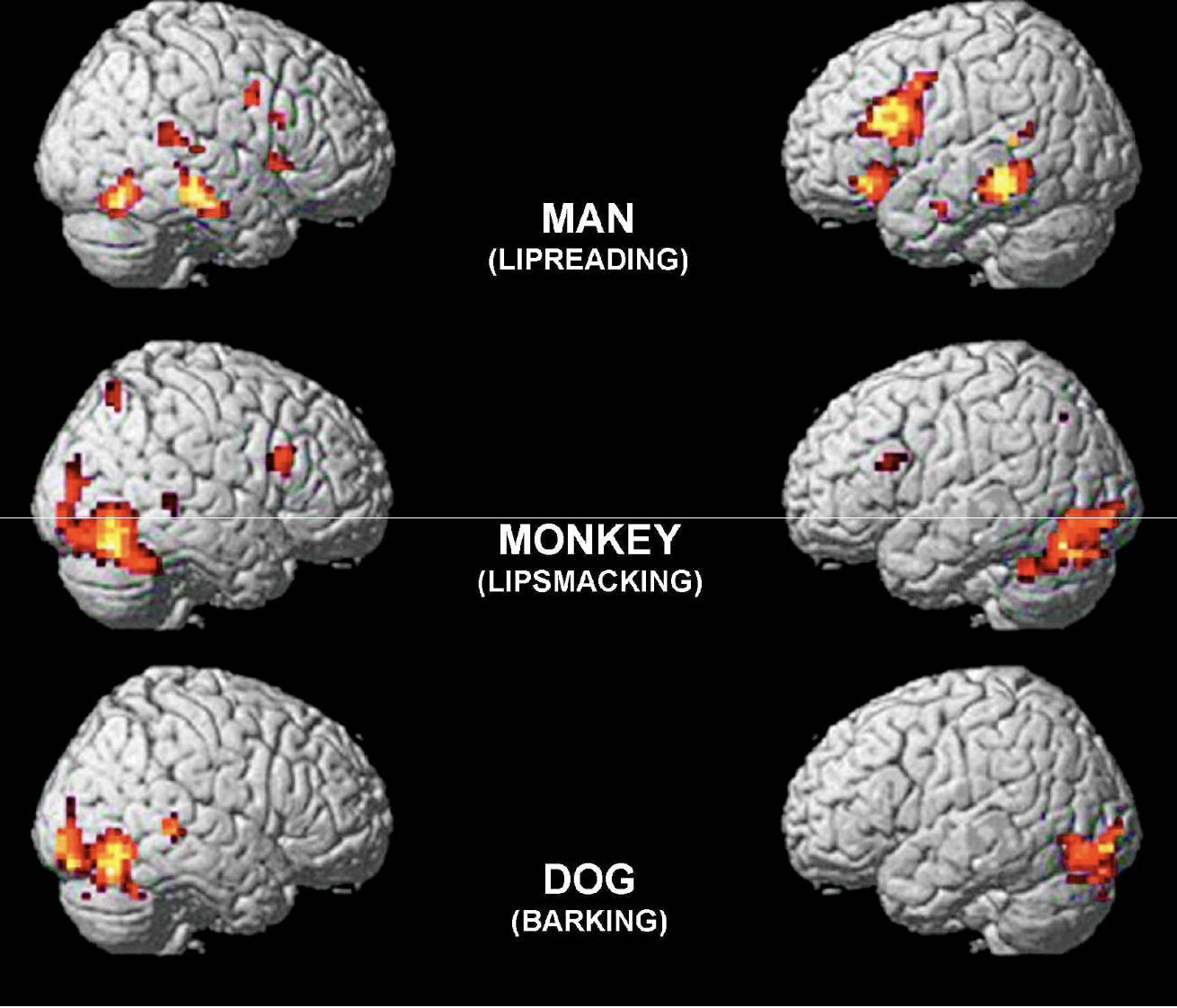
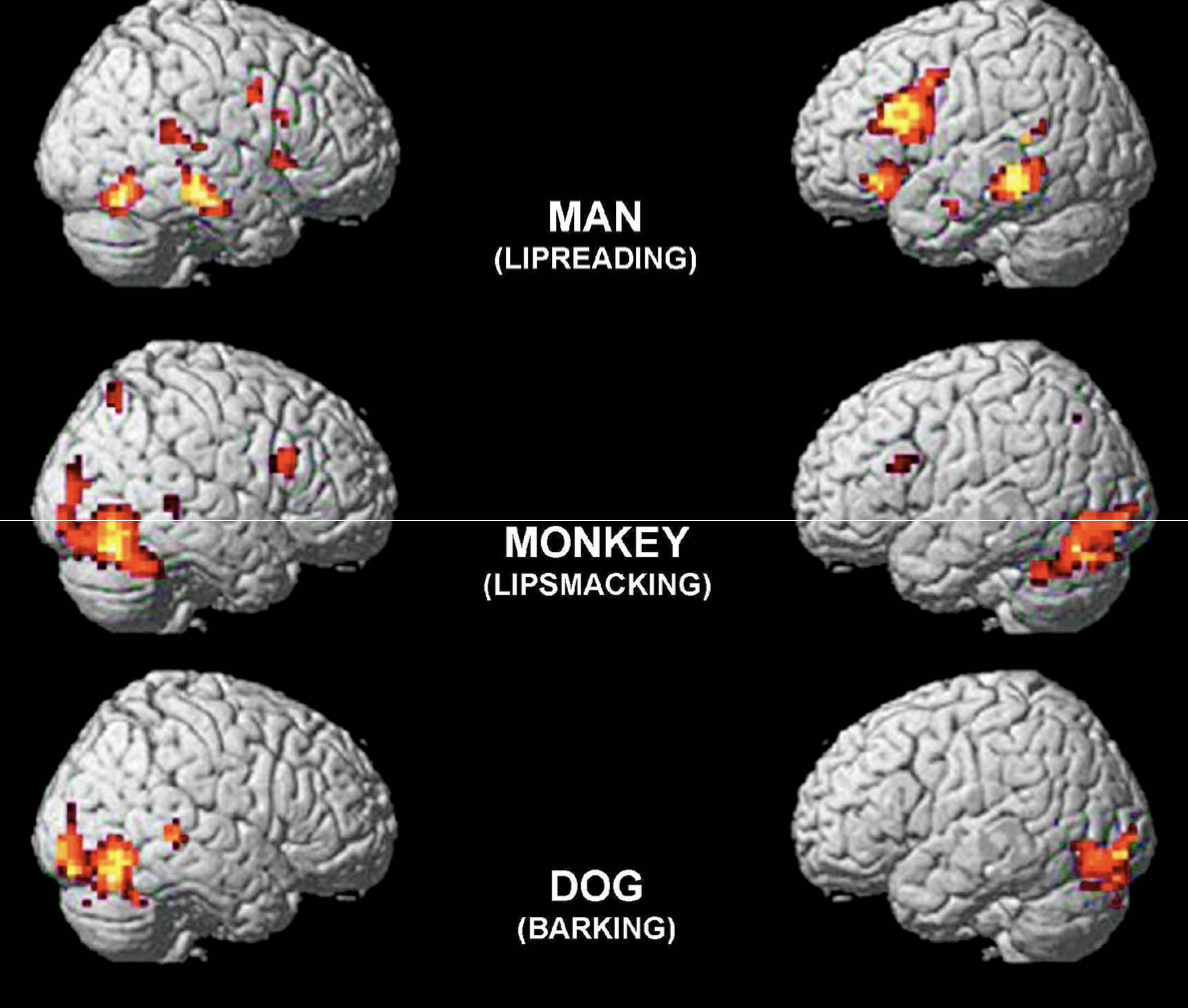
Species comparison (Buccino et al. 2004)
Humans watch humans/monkeys/dogs biting or producing communicative sounds.
- Human biting → strong activation in motor/premotor cortex
- Monkey lip-smacking → moderate motor activation (overlaps human motor repertoire partially)
- Dog barking → primarily visual cortex activation, minimal motor activation
→ Actions within the observer’s motor repertoire activate the mirror system; actions outside it rely on visual processing only.
Robot observation (Tai et al. 2004)
Left premotor cortex activates for human grasping but NOT for robot grasping — suggesting biological agents specifically trigger the mirror system.
Intention encoding (Iacoboni et al. 2005, PLoS Biology)
Participants see a grasping action in two contexts: “before tea” (implies drinking intention) vs. “after tea” (implies cleaning intention). The dorsal sector of pars opercularis (BA44, a mirror area) is the ONLY area that differentiates intention, not just the action.
→ Mirror neurons may encode the why of an action, not just the what.
Disgust mirroring (Wicker et al. 2002, Neuron)
Watching someone experience disgust → activates the insula (same region as experiencing disgust yourself). This extends “mirroring” beyond motor acts to emotional states.
→ Core message: “understanding by simulation” extends to emotions.
Action word somatotopy (Hauk et al. 2004, Neuron)
Reading action verbs (“lick”, “pick”, “kick”) activates somatotopically appropriate motor/premotor areas. Face-related action words → face motor cortex; arm words → arm motor cortex, etc.
→ Embodied semantics: even language understanding may involve motor simulation.
Single-unit evidence (Mukamel et al. 2010)
Rare: single-unit recordings from patients with depth electrodes for epilepsy monitoring. Found mirror neurons in:
- SMA (supplementary motor area)
- Pre-SMA
- Amygdala
- Entorhinal cortex
- Hippocampus
NOT in IFG/PPC — where fMRI studies point. This is likely because the patients’ electrodes weren’t placed there (clinical, not scientific placement).
ℹ️ Note: The fact that single-unit MN evidence in humans comes from non-canonical areas (SMA, amygdala) does NOT disprove MNs in IFG/PPC — it only means we lack direct evidence there due to clinical constraints.
Problems demonstrating MNs in humans — Exam List
- Ethical constraints — invasive single-unit recording not permissible in healthy subjects
- fMRI resolution — BOLD signal reflects hundreds of thousands of neurons; can’t see single-cell properties → “mirror voxels” not “mirror neurons”
- Correlation ≠ causation — co-activation of motor areas during observation doesn’t prove those areas are necessary for action understanding
- Individual variability — harder to find consistent patterns across subjects
- Interpreting complex activity — other confounds (attention, prediction, familiarity) could explain motor area activation
Discussion Questions
- If you couldn’t do invasive recordings in humans, what would be the single most convincing non-invasive experiment you would design to test the direct matching hypothesis?
- The robot study shows that biological agents specifically activate the mirror system. What does “biological” mean here — is it appearance, movement kinematics, or goal-directedness?
- If reading action words activates the motor system (Hauk 2004), does this mean language comprehension requires a motor system? What would happen to understanding action words after motor cortex damage?
Common Misconceptions
- “We’ve confirmed mirror neurons in humans” → Correction: we have confirmed mirror voxels in fMRI and some single-unit mirror responses in SMA/amygdala — but NOT direct single-unit recordings in IFG/PPC as predicted.
- “IFG = Broca’s area = mirror neurons” → Correction: BA44 is in Broca’s area and overlaps with mirror voxels, but Broca’s area has many functions; mirror activity is one of them.
Exam Relevance
- “Which problems make it hard to demonstrate mirror neurons in the human brain?” — students must give multiple methods-based reasons.
- “Describe characteristic differences of cortical activation in humans viewing humans, monkeys and dogs eating or producing communicative sounds” — Buccino 2004, focus on motor repertoire principle.
6. Quo Vadis — Critical Assessment (15 min)
Core Message
Mirror neurons are real and important. The hype around them has been substantially overstated. Several popular claims (neonatal imitation, autism, language origin) are either unsupported or contested.
Do mirror neurons explain imitation?
Oostenbroek et al. (2016, Current Biology) — large longitudinal study (n=106 infants, 1–9 weeks):
- Infants do NOT imitate selectively — they produce gestures in response to control models as readily as to matching models.
- Suggests earlier “neonatal imitation” findings were methodological artifacts.
→ Does NOT rule out MNs in later imitation, but undermines the idea of an innate imitation module.
Is mirror activity causal for mental state attribution?
Saxe (2009) — critical review:
- There IS evidence for co-opted mechanisms (observer’s state matches target’s state)
- But there is NO evidence that this matching output serves as the basis for attributing mental states
- Attribution mechanisms (TPJ, medial PFC) do not seem to receive input from motor simulation
→ The MN theory of mental state attribution is incomplete — correlation between mirroring and understanding does not prove causation.
Mirror neurons and autism?
Hamilton (2014), systematic review:
- 25 fMRI/EEG/TMS/EMG studies reviewed
- Data are very mixed
- fMRI studies using emotional stimuli show group differences; studies using hand action stimuli do NOT
- Little evidence for a global dysfunction of the mirror system in autism
- Better explained by abnormal social top-down response modulation
⚠️ Fact-check: The popular “broken mirror theory of autism” (Ramachandran et al.) is NOT supported by current evidence. The vault note does not make this claim explicitly, but students may arrive with this misconception.
The reverse inference problem
fMRI shows: area X activates during action observation. Conclusion: area X “does” mirror matching.
This is reverse inference — we cannot conclude function from activation patterns alone without additional causal evidence.
Discussion Questions
- What would it take to definitively prove that mirror neurons are necessary (not just present) for understanding others’ intentions? What experiment would you design?
- The Saxe (2009) argument is that even if your motor system activates when you see pain, that activation doesn’t necessarily cause you to attribute pain to the other person. How would you test this?
- V.S. Ramachandran called mirror neurons “the neurons that shaped civilization.” Is that claim scientifically justified? What’s the difference between a hypothesis and scientific fact in this context?
Common Misconceptions
- “Mirror neurons explain empathy” → Correction: they may correlate with empathic responses (disgust insula), but the causal chain from MN firing to empathic understanding is not established
- “Autism is caused by broken mirror neurons” → Correction: current systematic evidence does not support global mirror system dysfunction in autism
- “Mirror neurons explain language evolution” → Correction: it’s speculative, based on F5 ↔ Broca’s area homology, but the link is not empirically established
Exam Relevance
- “Give a critical assessment of the status of mirror neurons for our understanding of the human brain” — this is a direct exam question. Students must mention: real phenomenon in monkeys, human evidence indirect, hype not matched by evidence, autism claim weak, imitation claim questioned.
7. Exam Question Round (15 min)
Question 1 (Direct exam Q — from lecture questions slide)
“What are the basic response properties of mirror neurons observed in monkey cortex?”
Expected key points:
- Discovered in macaque area F5 (ventral premotor cortex) by Rizzolatti group
- Fire during execution of goal-directed motor acts (grasping, mouth movements)
- Fire also during observation of the same acts performed by another agent (human or monkey)
- Goal-selective, not movement-selective: a random hand wave doesn’t trigger them
- Type-specific: some distinguish precision grip vs. whole-hand grip
- Tool-use caveat: only if tool is in observer’s motor repertoire
- Multimodal: some fire to visual AND auditory input of the same action
- Inferred actions: fire even when the action is hidden (monkey infers grasping is occurring)
Typical mistakes:
- Saying they fire for “any movement” — they are goal-selective
- Forgetting the bidirectionality (execution AND observation)
- Confusing F5 with F4 or primary motor cortex (M1)
Question 2 (Direct exam Q)
“Discuss the visual hypothesis vs. the direct matching hypothesis, which try to explain understanding the action of others. Give pros and cons for one of the two views.”
Expected key points (for direct matching hypothesis):
- Core claim: visual input is directly mapped onto the observer’s motor system; the brain simulates the observed action
- Evidence FOR: TMS of motor cortex during observation facilitates corresponding muscle MEP; fMRI mirror voxels in IFG/PPC; inferred-action MN firing (not just visual)
- Evidence AGAINST / limitations: Lingnau et al. (2009) — fMRI adaptation paradigm failed to find execution→observation adaptation; Saxe (2009) — no causal link to attribution; visual features alone can explain many “mirror” findings; non-biological MN areas (SMA, amygdala) don’t fit the motor-simulation story neatly
Typical mistakes:
- Treating the two hypotheses as mutually exclusive (they might both contribute)
- Forgetting that the debate is about mechanism, not about whether social cognition exists
- Not giving any specific study as evidence
Question 3 (Exam-adjacent — from general question list)
“What makes mirror neurons so fascinating?” (Q#119) / “Do humans have mirror neurons as well?” (Q#120) / “What can be mirrored by mirror neurons?” (Q#121)
Expected key points for “what can be mirrored”:
- Motor acts (grasping — both hands and mouth)
- Actions inferred from context (not just visually present)
- Auditory stimuli corresponding to actions (multimodal MNs)
- Emotions: disgust (insula), but also fear (amygdala connections)
- Action words (motor somatotopy in reading)
- Intentional context of actions (Iacoboni 2005 — drinking vs. cleaning intention)
8. Closing (3 min)
Take-Home Message:
“The motor system is not just for moving — it is also a simulation engine for understanding others. Mirror neurons in monkeys are real and goal-selective. In humans, the evidence points in the same direction but remains indirect. The exciting question is not just whether MNs exist, but what exactly they contribute to social cognition — and that question is still open.”
Preview of next week (Lecture 6: Decisions):
We move from understanding others’ actions to deciding on our own actions. How does the brain accumulate sensory evidence and convert it into a motor decision? Key brain areas: MT (motion processing), LIP (evidence accumulation). The random dot motion paradigm. This is a completely different motor system function — not execution, not mirroring, but choosing what to do.
Appendix: Key Studies Reference Card
| Study | Method | Key Finding |
|---|---|---|
| Rizzolatti et al. 2001 (Nat Rev Neurosci) | Single-unit, monkey | MNs in F5, grasping, goal-selective |
| Ferrari et al. 2005 (J Cogn Neurosci) | Single-unit, monkey | Some MNs DO respond to tool use |
| Kohler et al. 2002 (Science) | Single-unit, monkey | Audiovisual MNs (peanut breaking) |
| Ferrari et al. 2003 (Eur J Neurosci) | Single-unit, monkey | Mouth mirror neurons, communicative gestures |
| Coudé et al. 2016 (J Neurosci) | Single-unit, monkey | MNs modulated by observed agent’s gaze direction |
| Iacoboni et al. 1999 (Science) | fMRI, human | Mirror voxels in BA44 (IFG) + PPC |
| Buccino et al. 2004 (J Cogn Neurosci) | fMRI, human | Motor repertoire principle: human>monkey>dog |
| Iacoboni et al. 2005 (PLoS Biol) | fMRI, human | IFG encodes action intention from context |
| Wicker et al. 2002 (Neuron) | fMRI, human | Disgust insula activates for observed AND felt disgust |
| Hauk et al. 2004 (Neuron) | fMRI, human | Action words activate somatotopic motor areas |
| Mukamel et al. 2010 (Curr Biol) | Single-unit, human | MNs in SMA, amygdala, entorhinal cortex |
| Lingnau et al. 2009 (PNAS) | fMRI adaptation, human | No exec→obs adaptation: challenges direct matching |
| Saxe 2009 (Philos Studs) | Review | No evidence MN output causes mental state attribution |
| Oostenbroek et al. 2016 (Curr Biol) | Longitudinal, infants | Neonatal imitation not supported (n=106) |
| Hamilton 2014 (Dev Cog Neurosci) | Systematic review | Little evidence for global MN dysfunction in autism |
Tags: motorsystem tutor