Stress and the Autonomic Nervous System
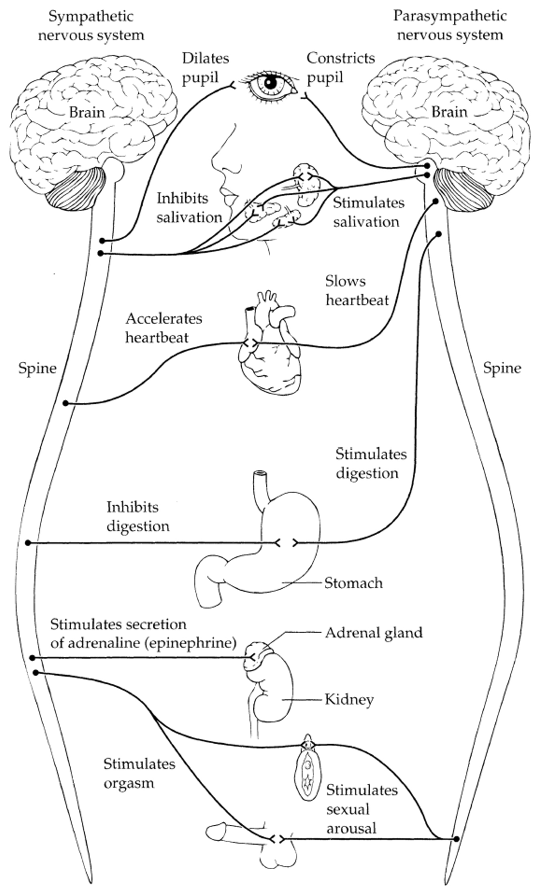
The voluntary nervous system is a conscious one. You decide to move a muscle and it happens. (Location 448)
- The half of the autonomic nervous system that is turned on is called the Sympathetic Nervous System (SNS).* Originating in the brain, sympathetic projections exit your spine and branch out to nearly every organ, every blood vessel, and every sweat gland in your body. They even project to the scads of tiny little muscles attached to hairs on your body. If you are truly terrified by something and activate those projections, your hair stands on end; gooseflesh results when the parts of your body are activated where those muscles exist but lack hairs attached to them. The sympathetic nervous system kicks into action during emergencies, or what you think are emergencies. It helps mediate vigilance, arousal, activation, mobilization. (Location 457)
⇒ Stress - The nerve endings of this system release Adrenaline. (Location 464)
- Sympathetic nerve endings also release the closely related substance Noradrenaline. (Adrenaline and noradrenaline are actually British designations; the American terms, which will be used from now on, are epinephrine and Norepinephrine.) Epinephrine is secreted as a result of the actions of the sympathetic nerve endings in your adrenal glands (located just above your kidneys); norepinephrine is secreted by all the other sympathetic nerve endings throughout the body. These are the chemical messengers that kick various organs into gear, within seconds. (Location 466)
- The other half of the autonomic nervous system plays an opposing role. This parasympathetic component mediates calm, vegetative activities—everything but the four F’s. If you are a growing kid and you have gone to sleep, your Parasympathetic Nervous System (PNS) is activated. It promotes growth, energy storage, and other optimistic processes. Have a huge meal, sit there bloated and happily drowsy, and the parasympathetic is going like gangbusters. Sprint for your life across the savanna, gasping and trying to control the panic, and you’ve turned the parasympathetic component down. Thus, the autonomic system works in opposition: sympathetic and parasympathetic projections from the brain course their way out to a particular organ where, when activated, they bring about opposite results. (Location 470)
see also
Tags: neurobiology science
Superlink: 051 ☣Neurobiology 050 🧠Neuroscience
Quellen
2 Glands Gooseflesh and Hormones
Erstellt: 29-08-22 22:04