Transmembrane Segment
Transmembrane Segments
Transmembrane segments are hydrophobic regions within protein structures that enable proteins to span the lipid bilayer of cell membranes. These segments are crucial for various cellular functions, including ion transport, signal transmission, and cell adhesion. The number and arrangement of transmembrane segments are characteristic of specific protein families and determine their functions.
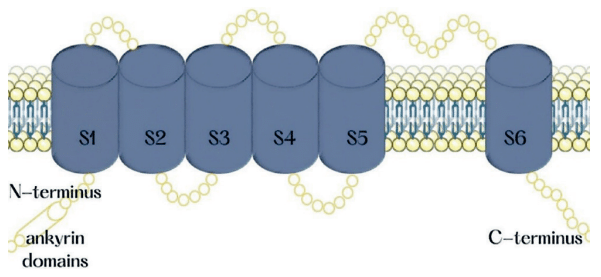
Types of Proteins with Transmembrane Segments
Ion Channels
-
Voltage-Gated Sodium Channels
- Structure: α-subunit with four domains, each containing six transmembrane segments (S1-S6).
- Function: Rapid depolarization during an action potential.
- Key Features: S4 segment acts as a voltage sensor; loop between S5 and S6 forms the selectivity filter.
-
Voltage-Gated Potassium Channels
- Structure: Four subunits forming a pore complex, each with six transmembrane segments.
- Function: Repolarization following an action potential.
- Key Features: S4 segment as a voltage sensor; pore loop between S5 and S6 forms the selectivity filter.
-
Voltage-Gated Calcium Channels
- Structure: Similar to sodium channels, with an α-subunit having four domains and six transmembrane segments each.
- Function: Involved in neurotransmitter release.
-
Ligand-Gated Ion Channels
-
Nicotinic Acetylcholine Receptor (nAChR)
- Structure: Pentamer with five subunits, each having four transmembrane segments (M1-M4).
- Function: Cation channel.
- Key Features: M2 segment forms the ion pore.
-
GABA-A Receptor
- Structure: Five subunits, each with four transmembrane segments.
- Function: Chloride channel.
-
Ionotropic Glutamate Receptors (non-NMDA)
- Structure: Three transmembrane segments connected by a pore loop.
-
Transporters
- Sodium-Potassium Pump (Na+/K+-ATPase)
- Structure: Ten transmembrane segments.
- Function: Active transporter moving sodium ions out and potassium ions into the cell.
- Key Features: Intracellular ATP binding site for energy supply.
Receptors
-
Muscarinic Acetylcholine Receptor (mAChR)
- Structure: Single subunit with seven transmembrane segments.
- Function: Metabotropic receptor coupled to G-proteins.
-
Metabotropic Glutamate Receptors (mGluR)
- Structure: Seven transmembrane segments.
- Function: G-protein coupled.
-
GABA-B Receptors
- Structure: Seven transmembrane segments.
- Function: Metabotropic receptor.
Other Proteins
-
Connexin
- Structure: Four transmembrane segments per subunit; six subunits form one connexon.
- Function: Forms gap junctions for direct electrical coupling between cells.
-
Proteolipid Protein (PLP)
- Structure: Four transmembrane segments.
- Function: Component of the myelin sheath.
-
P0 Protein
- Structure: One transmembrane segment.
- Function: Component of the myelin sheath in the peripheral nervous system.
-
Glycophorin
- Structure: One transmembrane segment.
Hairpin loops
The sources describe hairpin loops as structural elements within transmembrane proteins located between transmembrane segments and playing a crucial role in the function of these proteins. Here are the key details about hairpin loops in transmembrane segments:
- Definition: Hairpin loops are connectors between two transmembrane segments that are located within the membrane. They form a loop-like structure resembling a hairpin, hence the name.
- Position:
- Hairpin loops are commonly found between the transmembrane segments S5 and S6 of ion channels.
- They also occur in other proteins, such as ionotropic glutamate receptors.
- Structure:
- The hairpin loop consists of a loop of amino acids.
- It is typically hydrophilic, given its placement in the hydrophobic environment of the membrane and its requirement to form a pore through which ions can pass.
- Function:
- Selectivity Filter: The hairpin loop between the S5 and S6 segments is a central component of the selectivity filter of ion channels, determining which ions can pass through the channel and which cannot. The amino acids within the hairpin loop are arranged to bind and allow specific ions to pass while rejecting others.
- Channel Pore: Multiple hairpin loops can aggregate to form the walls of the hydrophilic ion pore.
- Conformational Changes: The hairpin loops can change shape to open or close the channel.
- Examples:
- Voltage-Gated Sodium Channels: Here, four hairpin loops form the pore, with the hairpin loop between the S5 and S6 transmembrane segments constituting the selectivity filter.
- Voltage-Gated Potassium Channels: In these channels, the hairpin loop between the S5 and S6 segments also forms the selectivity filter.
- Ionotropic Glutamate Receptors: These receptors possess a hairpin loop with a function similar to that in potassium channels.
In summary, hairpin loops in transmembrane segments are essential structural elements crucial for the formation of the ion pore, selectivity, and regulation of ion channels and other membrane proteins, enabling these proteins to perform their specific functions in the cell membrane.
Summary
Transmembrane segments are integral to the function of membrane proteins, allowing them to span the cell membrane and participate in essential processes. The specific arrangement and number of these segments are crucial for the proteins’ roles in cellular activities.
Questions
Here are five deep questions about transmembrane segments along with their answers:
-
What role do transmembrane segments play in the function of ion channels?
- Transmembrane segments form the structural basis that allows ion channels to span the lipid bilayer.
- They create a pathway for ions to pass through the membrane, crucial for processes like depolarization and repolarization during action potentials.
- Specific segments, such as the S4 segment in voltage-gated channels, act as voltage sensors, responding to changes in membrane potential.
- The arrangement of these segments determines the selectivity and gating properties of the channel.
-
How do transmembrane segments contribute to the specificity of ligand-gated ion channels?
- Transmembrane segments form the ion pore and determine the channel’s ion selectivity.
- In receptors like the nicotinic acetylcholine receptor, the M2 segment is critical for forming the ion pore.
- The arrangement and composition of these segments influence the receptor’s response to specific ligands.
-
What is the significance of transmembrane segments in active transporters like the sodium-potassium pump?
- Transmembrane segments form the pathway for ion movement across the membrane against their concentration gradients.
- They are involved in the conformational changes necessary for the pump’s function, driven by ATP hydrolysis.
- The specific arrangement of these segments allows for the selective binding and release of sodium and potassium ions.
-
How do transmembrane segments facilitate the function of G-protein coupled receptors (GPCRs)?
- Transmembrane segments in GPCRs form the binding site for ligands and are involved in the receptor’s activation.
- They undergo conformational changes upon ligand binding, which is crucial for G-protein activation.
- The seven transmembrane segments are characteristic of GPCRs and are essential for their signaling function.
-
In what ways do transmembrane segments influence the structural integrity and function of gap junctions?
- Transmembrane segments in connexins form the structural basis of gap junction channels.
- They allow for the direct passage of ions and small molecules between adjacent cells, facilitating electrical coupling.
- The arrangement of these segments in connexons determines the permeability and selectivity of the gap junctions.
see also
Tags: neurobiology science
Superlink: 051 ☣Neurobiology 050 🧠Neuroscience
Source
Created: 12-02-25 15:14