Acetylcholine
Acetylcholine, on the other hand, attaches itself more generally to all important moments.
(p.87) ⇒ Chapter 5 Nuture’s Share
Acetylcholine (ACh) signaling underlies specific aspects of cognitive functions and behaviors, including attention, learning, memory and motivation.
Certainly! Here’s a structured overview of acetylcholine (ACh) based on the provided context:
Overview of Acetylcholine (ACh)
chatbot
Acetylcholine is a Neurotransmitter that plays a crucial role in various physiological functions, including muscle activation and cognitive processes such as attention, learning, memory, and Motivation.
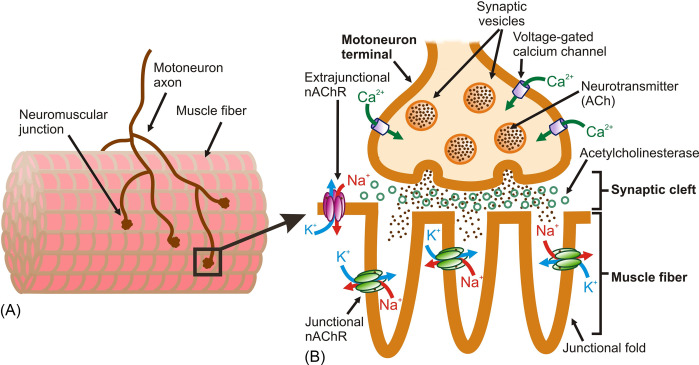
Neurotransmission at the Neuromuscular Junction
- Neuromuscular Junction: A specialized synapse connecting motor nerve endings with skeletal muscle fibers.
- Signal Transfer: An Action Potential arriving at the nerve terminal triggers the release of ACh from synaptic vesicles into the synaptic cleft.
- Receptor Binding: ACh binds to acetylcholine receptors (AChRs) on the postsynaptic muscle membrane, leading to ion channel opening and muscle depolarization.
- Endplate Potential: The binding of ACh generates a graded potential, known as the endplate potential, which can be blocked by curare.
- Action Potential: The endplate potential triggers a muscle action potential via voltage-gated sodium channels.
- Termination: Synaptic transmission is terminated by acetylcholine-esterase (AChE), which degrades ACh in the synaptic cleft.
Acetylcholine Receptors
Nicotinic Acetylcholine Receptors (nAChRs)
- Location: Found in skeletal muscles.
- Agonists and Antagonists: Activated by nicotine (agonist) and blocked by Curare (antagonist).
- Structure: Oligomeric protein consisting of five subunits (2α, β, γ, δ) forming a pentamer.
- Function: Chemically-gated ion channel that opens upon ACh binding, allowing cation influx and muscle depolarization.
Muscarinic Acetylcholine Receptors (mAChRs)
- Location: Found in heart muscles.
- Agonists and Antagonists: Activated by muscarine (agonist) and blocked by Atropine (antagonist).
- Function: Part of a different receptor family compared to nAChRs, involved in various signaling pathways.
Do mAChRs initiate hyperpolarization through chloride channels?
- No, mAChRs (muscarinic acetylcholine receptors) do not initiate hyperpolarization through chloride channels. Instead, they use a different mechanism to generate hyperpolarization, resulting in an inhibitory postsynaptic potential (IPSP).
Here are the details:
-
mAChRs are metabotropic receptors: Unlike nAChRs (nicotinic acetylcholine receptors), which are ion channels, mAChRs belong to the family of G-protein-coupled receptors. This means they do not directly open ion channels but activate an intracellular signaling cascade.
-
G-protein activation: When acetylcholine (ACh) binds to an mAChR, it initiates a conformational change in the receptor protein. This change causes the G-protein complex to dissociate into an alpha and a beta-gamma subunit.
-
Activation of potassium channels: The beta-gamma subunit of the G-protein moves within the membrane until it reaches and binds to a potassium channel.
-
Potassium efflux: Binding of the beta-gamma subunit opens the potassium channel, allowing potassium ions to flow out of the cell.
-
Hyperpolarization: The efflux of positively charged potassium ions leads to hyperpolarization of the postsynaptic membrane. This makes the membrane potential more negative, resulting in an IPSP, which makes the cell less likely to be excited.
In summary, mAChRs cause hyperpolarization by activating potassium channels, not chloride channels.
Activation of chloride channels and the resulting hyperpolarization is more associated with GABA-A receptors or glycine receptors, which are ionotropic receptors that directly open chloride channels, causing chloride ion influx and hyperpolarization.
It’s important to note that mAChRs lead to an IPSP, but not via the same channels as GABA or glycine.
Pharmacological Properties
- Agonists: Drugs that mimic the effect of ACh by activating the receptor.
- Antagonists: Drugs that block the physiological response of the receptor even in the presence of ACh.
- Receptor Subtypes: Two main subtypes are identified based on their agonists—nicotinic (nAChR) and muscarinic (mAChR).
Role in Cognitive Functions
- ACh signaling is crucial for cognitive functions such as attention, learning, memory, and motivation, influencing circuits of attention and emotionally salient behaviors.
This structured overview highlights the key aspects of acetylcholine’s role in neurotransmission, receptor types, pharmacological properties, and cognitive functions.
see also
Tags: neuroscience science
Superlink: 050 🧠Neuroscience
Quellen
- Intro to Neurobiology Script
- Frontiers Illuminating the Role of Cholinergic Signaling in Circuits of Attention and Emotionally Salient Behaviors
Erstellt: 27-04-22 10:33