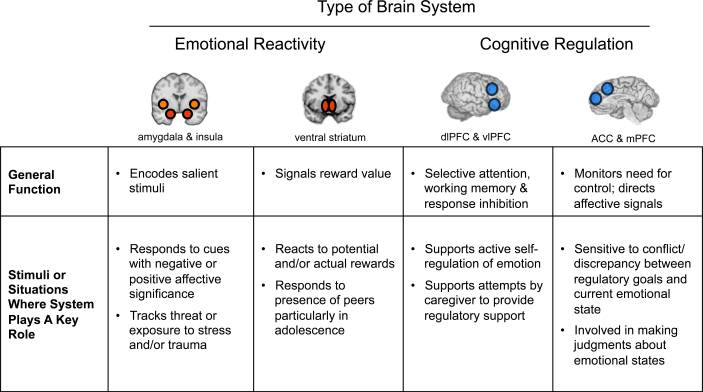
Overview of neural systems supporting emotion reactivity and regulation. Neuroimaging studies identify key brain systems involved in emotional reactivity and regulation along with their proposed function and the environmental stimuli and/or contexts where they may play key roles - affective systems are triggered by the presence of particular stimuli; regulatory systems are being brought online to actively implement strategies for regulating one’s own or others’ emotions.
Also impacted by reappraisal is the ventral striatum, another subcortical structure implicated in signaling the reward value of stimuli [12], and the insula, a cortical region representing information about the body states associated with affective responses [13].
Reappraisal is believed to modulate these regions via recruitment of a network of regions including the dorsolater, posterior parietal cortex (PPC), ventrolateral prefrontal cortex (vlPFC), posterior medial prefrontal cortex (mPFC) and Anterior Cingulate Cortex (ACC) [8,14]. This set of regions is not specific to emotion regulation, but is also commonly activated in tasks involving cognitive control more generally. The dlPFC is commonly active during selective attention and Working Memory tasks, which may aid in holding emotion-regulation strategies in mind [15]. vlPFC is commonly active during response selection and inhibition, which may help with selecting an appropriate reappraisal tactic [16]. Finally, mPFC and ACC are commonly activated in tasks involving selection among competing responses, and may help in identifying when regulation is needed.
While neuroscience research on emotion regulation in adults has exploded over the past 10-15 years, developmental research has emerged only more recently. A popular theory is that prefrontal control regions like dlPFC and vlPFC mature at a slower rate relative to affective response regions like the Amygdala and ventral striatum [18,19]. This imbalance is represented by a pattern of stronger activations in subcortical relative to cortical regions peaking during adolescence, which may contribute to mood instability and greater emotional reactivity in this age group [20]. The imbalance theory may be an oversimplification of a more complex series of interactions between cognition and emotion taking place during development, where they can mutually inform, help, or hinder one another [21–24]. Thus, more studies investigating the maturational patterns of cortical-subcortical circuitry are undoubtedly needed in order to better understand how affect and mood change with age.
see also
Tags: neuroscience science
Superlink: 050 🧠Neuroscience
Emotion
Source
https://www.ncbi.nlm.nih.gov/pmc/articles/PMC5096655/#:~:text=Regulation%20of%20Positive%20Emotions%20Across%20Development&text=The%20role%20of%20ventral%20striatum,20%2C23%2C38%5D.
Martin, R. E., & Ochsner, K. N. (2016). The neuroscience of emotion regulation development: Implications for education. Current opinion in behavioral sciences, 10, 142-148.
Created: 04-05-24 16:25