Neural Aspects of Prediction
Bar suggests that when the signal from the Visual cortex arrives at the temporal lobe, it is met by the higher-level signals, which have already arrived from the PFC (see fig. 2.1), and the information provided by these higher-level signals helps the temporal lobe determine that the object is a particular type of umbrella (in this case, a parasol). Bar calls the process by which the frontal cortex adds top-down information to the bottom-up information arriving from the visual cortex prefrontal modulation.
(p. 105)
When we experiences something that does not match our prediction, we correct our perception to that incident or object. The difference is made by the Prediction Error (P.E.)
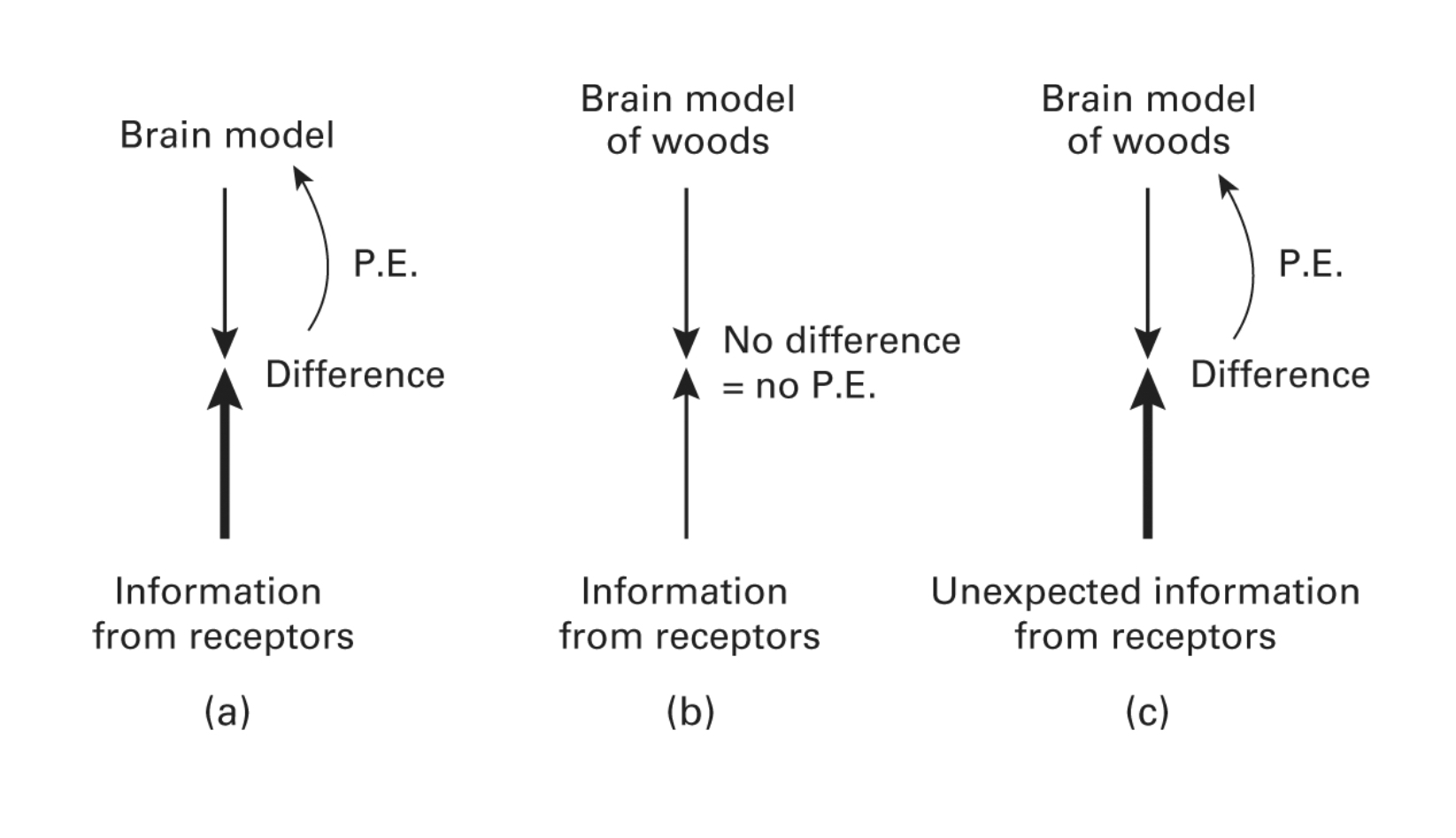
This prediction error is sent up to higher levels to help revise the brain’s model to deal with this new situation.
(p. 106)
It is important to be able to detect the unexpected, because it is more likely to be dangerous.
(p. 106)
“Brains are not fundamentally in the business of processing inputs—they are in the business of predicting their inputs.”
(p. 108) - Andy Clark
see also
How Memories are created
Tags: neuroscience science
Superlink: 050 🧠Neuroscience
Quellen
The Predictive Mind I Perceiving and Acting
Erstellt: 10-05-22 15:55