Pain Perception
The tissue injury also triggers an influx of cells of the Immune System, which are there to scarf up and dispose of those sliced-up Cells. The swelling around the injury site because of this infiltration is what we call inflammation, and those ==inflammatory cells release chemicals that make pain receptors more sensitive.== (Location 3117)
Regardless of the particular type of pain and the particular receptor activated, all these receptors send nerve projections to the spinal cord. This can activate a spinal reflex, where spinal neurons rapidly send commands to your muscles (and thus, for example, you jerk your finger away from the flame). Information about the painful stimulus is also sent up to the brain (a lot more on this later). (Location 3125)
The strength of a pain signal, for example, can depend on what other sensory information is funneled to the spine at the same time. This, it turns out, is why it feels great to have a massage when you have sore muscles. Chronic, throbbing pain can be inhibited by certain types of sharp, brief sensory stimulation. (Location 3131)
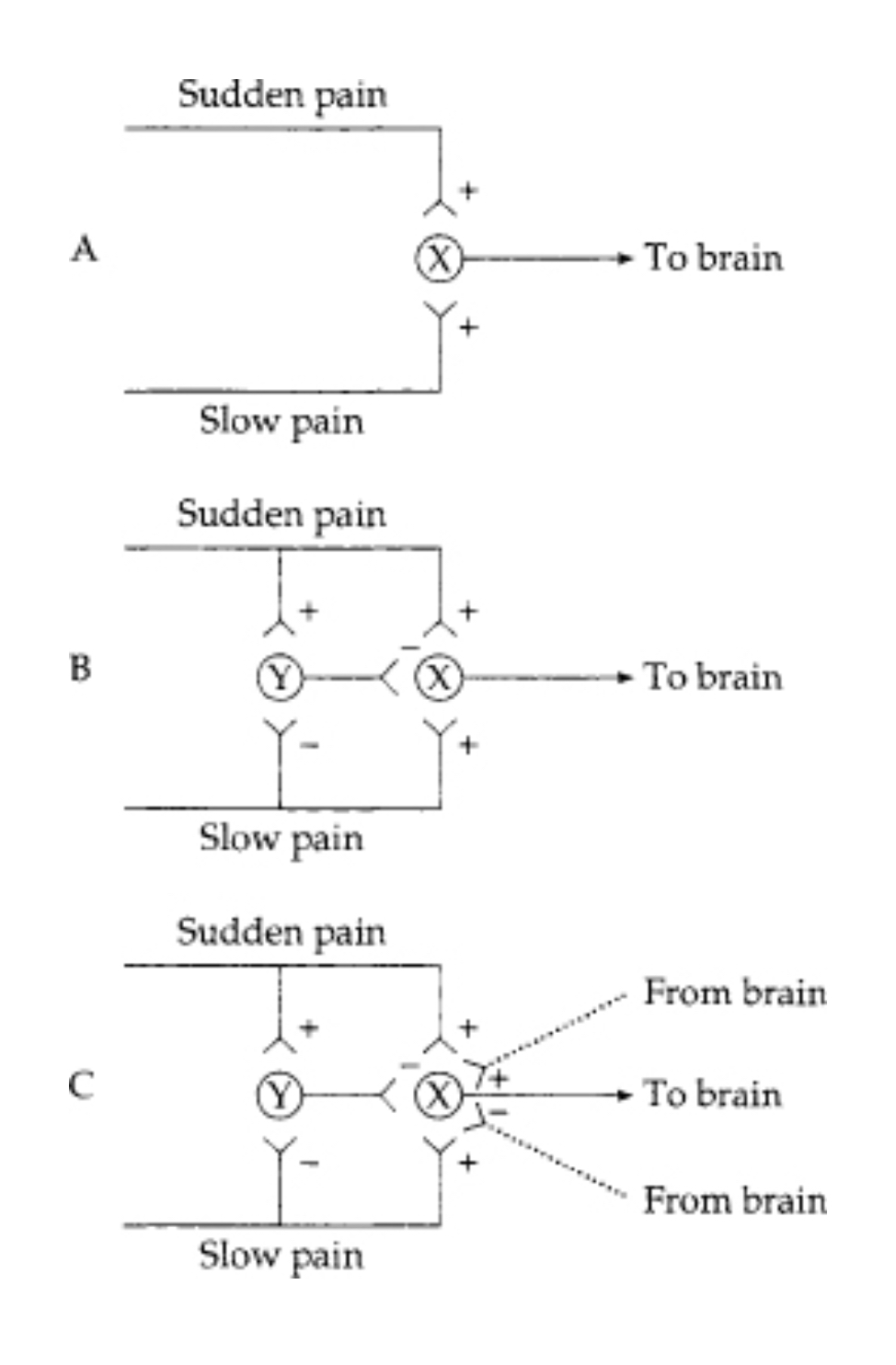
The Wall-Melzack model of how pain information is passed to the brain, and how it can be modulated by the brain. (A) A neuron (X) in the spinal cord sends a signal to the brain that something painful has happened, once it is stimulated by a pain fiber. Such pain fibers can carry information about sudden pain or slow, diffuse pain. (B) A more realistic version of how the system actually works, showing why sudden and slow pain information is differentiated. In the case of sudden pain, the sudden pain fiber stimulates neuron X, causing a pain signal to be relayed to the brain. The sudden pain fiber also stimulates an interneuron (Y) that inhibits neuron X, after a brief delay. Thus, neuron X sends a pain signal to the brain for only a short time. In contrast, the slow pain fiber stimulates neuron X and inhibits interneuron Y. Thus, Y does not inhibit X, and X continues to send a pain signal to the brain, producing a slow, diffuse pain. (C) Both stimulatory and inhibitory fibers come from the brain and send information to neuron X, modulating its sensitivity to incoming pain information. Thus, the brain can sensitize neuron X to a painful signal, or blunt its sensitivity. (Location 3140)
An insect bite throbs and itches unbearably, and we often scratch hard right around it to dull the pain. (Location 3161)
Allodynia, which is feeling pain in response to a normal stimulus. (Location 3171)
Now those inflammatory cells are pretty indiscriminate as to where they dump these chemicals, and some of them can leach over in the direction of receptors outside the area of injury, thereby making them more excitable. And suddenly the perfectly healthy tissue surrounding the injured area starts to hurt as well. (Location 3174)
⇒ Inflammatory Response
elevated levels of Glucose in the bloodstream can increase the risk of atherosclerotic plaques, clogging up blood vessels. As a result, insufficient energy gets through those vessels, potentially damaging nerves that depend on that energy. In general it is the fast fibers, which take more energy to operate than the lower-maintenance slow fibers, that are damaged. Thus, the person loses the ability to shut down the Y interneuron in that pathway, and what would be a transient pain for anyone else becomes a constant throbbing one for a diabetic. (Location 3182)
see also
Tags: neuroscience science
Superlink: 050 🧠Neuroscience
Quellen
Erstellt: 15-05-22 07:42