Assignment 2 fMRI Resting State Analysis
by Maximilian Herrmann, 23.05.2025
Assignment Tasks
Introduction (100-200 words)
- What type of MRI/neural signal are you actually measuring? What does it tell us about the brain? What would specific tests we are measuring (e.g. Netflix score →Imagination/Day-Dreamers; functional amnesia→???) be expected to tell us about brain function in these individuals?
Methods (~300-500 words?)
- How/Why was the analysis performed?
- Preprocessing (reseting state one), different types of analyses in simple words.
Results
- Present the results in a comprehensive, succinct and clear way.
- Show overall connectivity/organsiation of any network you look at
- Show modulation by group
- Show modulation by covariate (individual differences)
- What is the interpretation of these two findings? (1-3 sentences for each)
- What are the strengths and weakness of each measure (R2R, S2V, ICA)?
Assignment Abgabe
Introduction
- What type of MRI/neural signal are you actually measuring? What does it tell us about the brain? What would specific tests we are measuring (e.g. Netflix score →Imagination/Day-Dreamers; functional amnesia→???) be expected to tell us about brain function in these individuals?
When doing a fMRI analysis, we use the BOLD (blood oxygen level dependent) signal that is an indirect measure of neural activity. It does not measure neural activity directly, but it tracks the blood flow by measuring the oxygenation of the blood. When neurons fire, they require a lot of oxygen, which can be measured with a delay after the activity. That makes fMRI great for spatial resolution, but bad for temporal.
We investigate two questions. The first considers the effect of watching netflix on imagination/day-dreaming, and the second looking at functional amnesia assessing differences in memory retrieval. The netflix score contrasts periods of high imaginative engagement versus resting state, showing how the Default Mode Network (DMN) interacts with activity in spontaneous imagination. The functional amnesia test contrasts amnestic patients with controls during memory recall, showing how hippocampus and DMN connectivity is disrupted in the patients.
Methods
- How/Why was the analysis performed?
- Preprocessing (reseting state one), different types of analyses in simple words.
I processed all data in the CONN Toolbox using the dataset “GroupData_RS”, then did two different analyses:
Independent Component Analysis (ICA),
Seed-to-Voxel (S2V)
Methods
Preprocessing
- importing the data to CONN
- create covariates (2nd level) for netflix and func_amn
- create conditions for both tests
- denoising data with linear regression in WM/CSF components, with band-pass filter (0.008 -0.09Hz)
ICA (only for Netflix)
Why I chose ICA for the Netflix task:
- data-driven search of networks responding to imagination without a seed bias.
How: - 30 different spatial components to identify the DMN by its MPFC-PCC gyrus topology.
Seed-to-Voxel (S2V)
- Why:
- Hypothesis-driven mapping of network connectivity
- Seeds:
- MPFC and PCC for Netflix
- LHipp+RHipp, MPFC and PCC for functional amnesia
- How:
- correlated each seed’s time-series with all brain voxels and contrasted conditions (Netflix vs. Rest, Patient vs. Control)
Results
- Present the results in a comprehensive, succinct and clear way.
- Show overall connectivity/organsiation of any network you look at
- Show modulation by group
- Show modulation by covariate (individual differences)
- What is the interpretation of these two findings? (1-3 sentences for each)
- What are the strengths and weakness of each measure (R2R, S2V, ICA)?
Netflix
ICA (Netflix DMN component): vmPFC exposed to higher z-scores with few lateral clusters in occipital and parietal cortex. Less so for the occipital lobe and premotor cortex.
It shows that there is a high correlation of the vmPFC to the DMN when exposed to Netflix content suggesting cognitive-emotional processing.
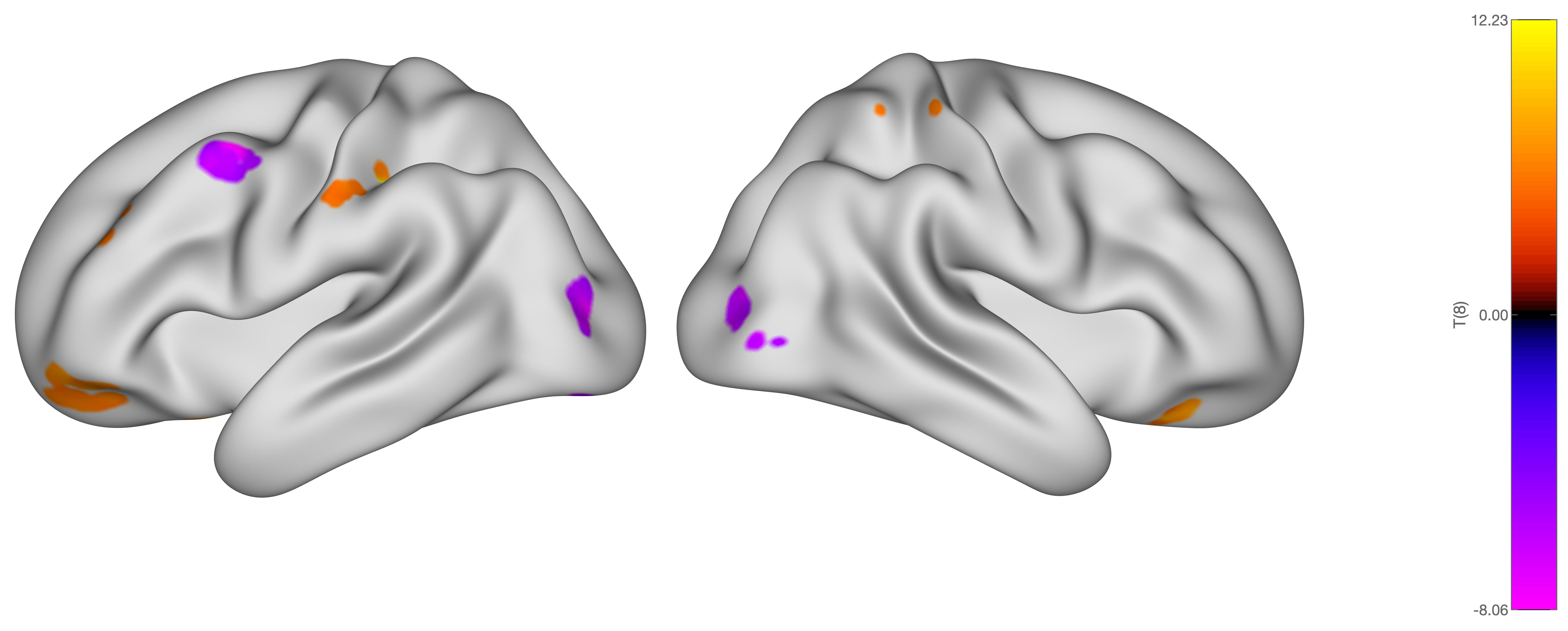
No significant results on R2R in netflix score
Seed-to-Voxel with the effect of Netflix on the DMN MPFC
We observe a medial correlation with the DMN (MPFC seed) in the posterior temporal cortex:
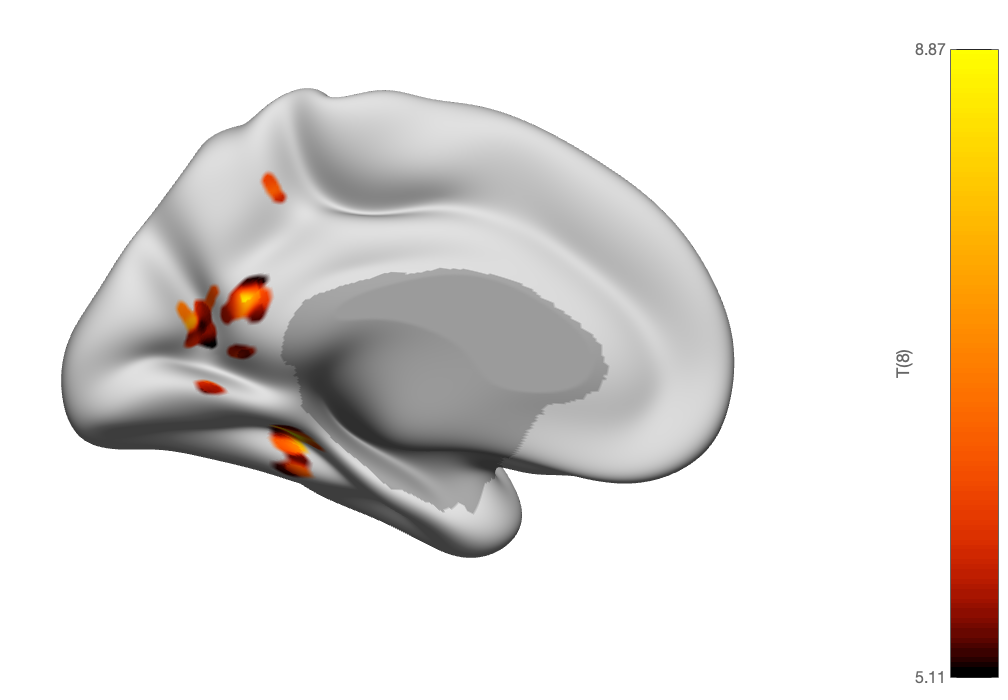
similar in right hemisphere
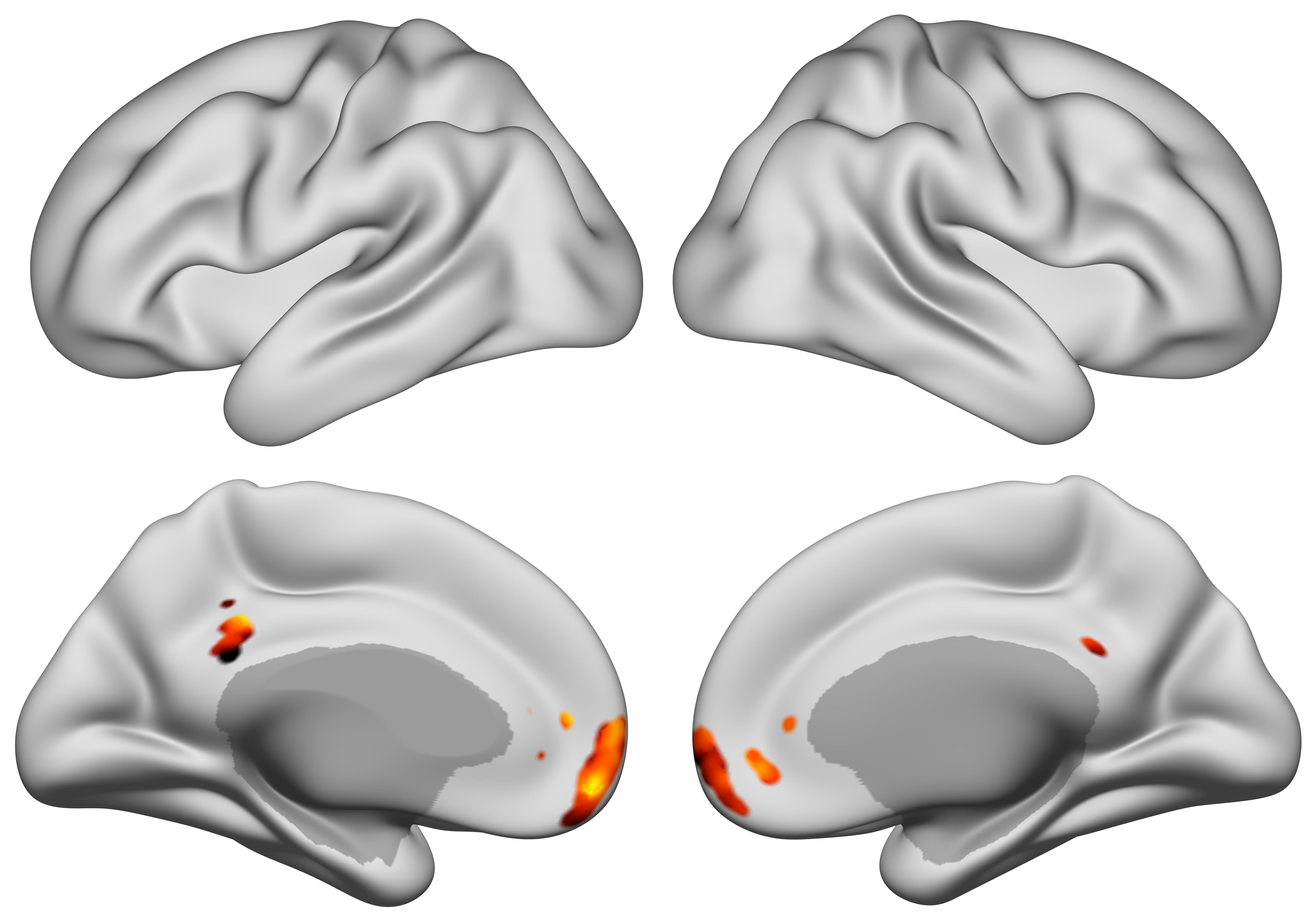
Seed to Voxel analysis PCC with the effect of Netflix:
strong correlation in the ventromedial PFC and a bit in the anterior parietal cortex supporting the ICA analysis
Functional Amnesia
S2V:
We want to compute the differences of control vs. functional amnesia patients in the left and right hippocampal (LHipp, RHipp) seed.
First, we look into RHipp:
strong activity in the ventral temporal lobe and ventromedial and orbitofrontal lobe
but still similar to LHipp.
-Session1-LHipp.png)
But the interesting part is the difference to the control group showing a lot more activity in the MPFC and, anterior Parietal lobe to the LHipp seed.
-Session1-LHipp.png)
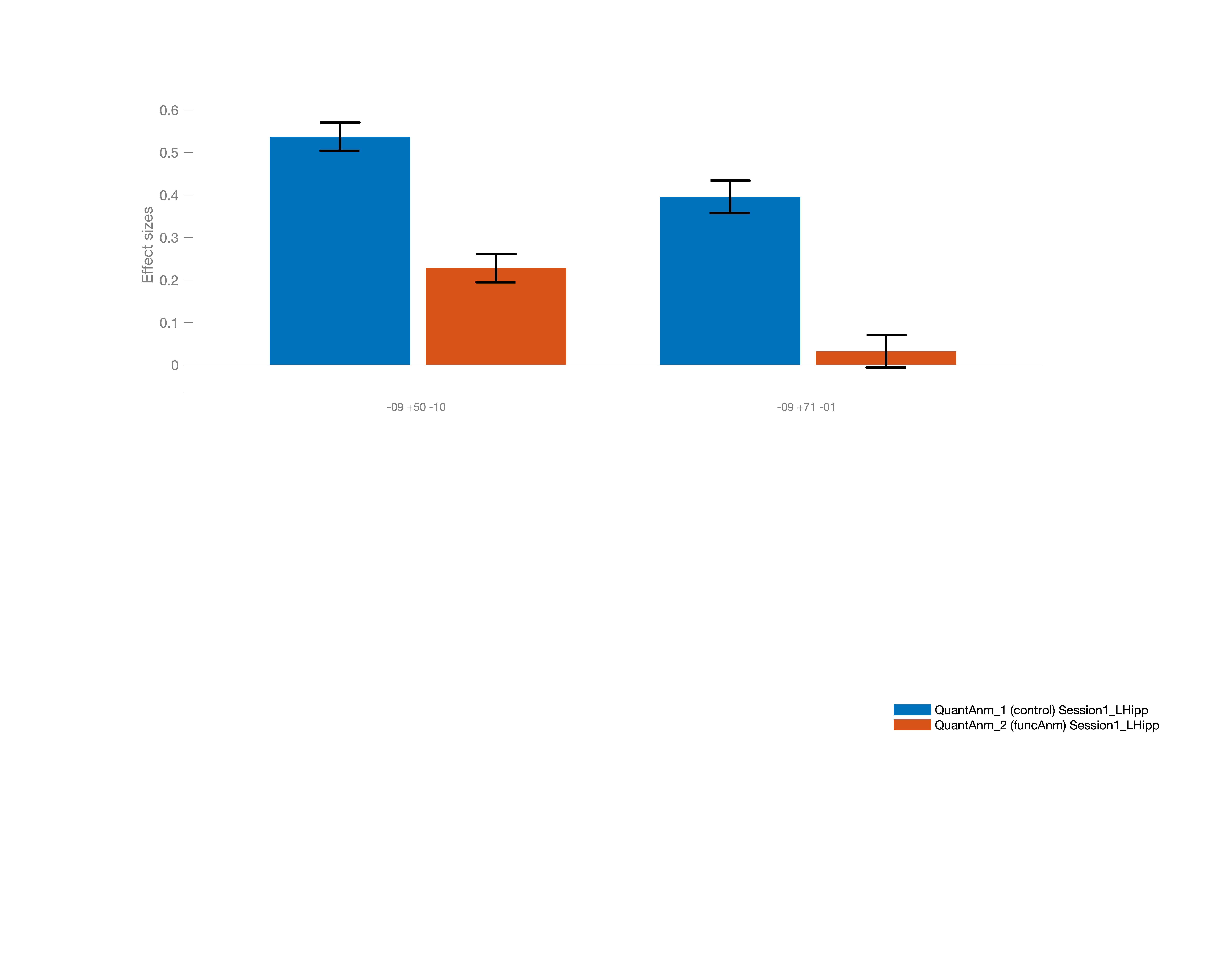
Here I computed the direct effect sizes of both LHipp and RHipp controls vs func_amnesia.
You can see a clear difference in the LHipp, but no significant difference in the RHipp.
Strengths and weaknesses
ICA (Independent Component Analysis):
- data-driven method, independent spatial components based on statistical independence
- identifies networks without prior assumptions about connections of specific regions
- advantages
- it is unbiased and might find unexpected networks
- captures multiple networks at the same time
- disadvantages
- component selection is subjective and based on the numbers of components chosen
- less sensitive to task-related changes unless temporal ICA is used
SBC (Seed-based Analysis):
- hypothesis-driven method, connectivity patterns from predefined seed regions
- based on prior knowledge
- extracts time-series from the seed region and correlates them with the time-series of all other voxels in the brain
- correlation map showing regions that are functionally connected
- advantages
- focuses on specific networks
- easier interpretation
- suitable for hypothesis testing
- disadvantages
- limited to preselected regions
- susceptible to noise in the seed region
- assumes linear correlation, missing potential nonlinear interactions