Nerve Terminal
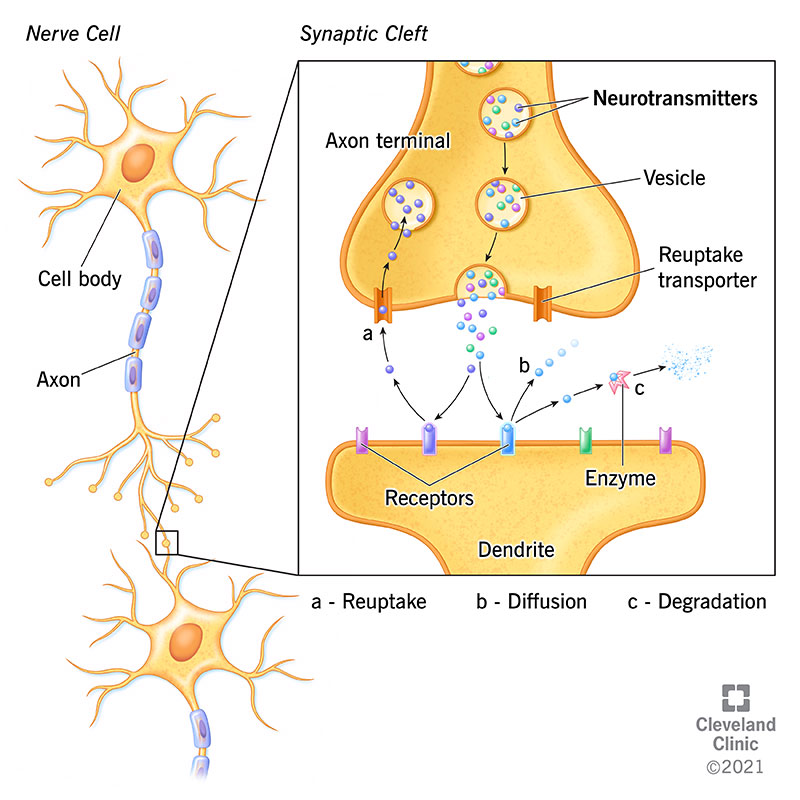
Nerve Terminal Overview
The nerve terminal, also known as the axon terminal, is a crucial component of the neuron responsible for transmitting signals to other neurons or target cells, such as muscle fibers. It plays a vital role in the process of neurotransmission, facilitating the transfer of electrical and chemical signals.
Structure and Function
-
Synaptic Vesicles:
- The nerve terminal contains numerous small vesicles filled with neurotransmitters, such as acetylcholine (ACh).
- These vesicles are crucial for storing and releasing neurotransmitters into the synaptic cleft.
-
Neurotransmitter Release:
- Upon the arrival of an action potential at the nerve terminal, voltage-gated calcium channels open, allowing calcium ions to flow into the terminal.
- This influx of calcium triggers a cascade of molecular events, leading to the fusion of synaptic vesicles with the plasma membrane (exocytosis).
- The neurotransmitter is then released into the synaptic cleft, where it diffuses across to the postsynaptic membrane.
-
Synaptic Cleft and Receptors:
- The synaptic cleft is the extracellular space between the nerve terminal and the target cell.
- Neurotransmitters bind to specific receptors on the postsynaptic membrane, such as the acetylcholine receptor (AChR), which is a chemically gated ion channel.
-
Endplate Potential:
- The binding of neurotransmitters to receptors induces a small membrane depolarization known as the endplate potential.
- This potential can trigger a muscle action potential through the activation of voltage-gated sodium channels in the muscle membrane.
-
Termination of Signal:
- Synaptic transmission is terminated by the enzymatic degradation of neurotransmitters. For example, acetylcholine is broken down by acetylcholine-esterase (AChE) located in the postsynaptic membrane.
Regulation of Exocytosis
- Synapsin and Calcium:
- In the resting state, synaptic vesicles are docked to microfilaments within the nerve terminal via a protein called synapsin.
- The rise in intracellular calcium concentration induces a conformational change in synapsin, allowing vesicles to detach and proceed to fuse with the plasma membrane.
Importance in Neurotransmission
The nerve terminal is essential for the precise and efficient transmission of signals across synapses. It serves as a model system for studying the mechanisms underlying chemo-electrical signal transfer, as demonstrated by pioneering experiments at the neuromuscular junction. Understanding the nerve terminal’s function is crucial for insights into neural communication and potential therapeutic targets for neurological disorders.
see also
Tags: neurobiology science
Superlink: 051 ☣Neurobiology 050 🧠Neuroscience
Feedback signal from dendritic spine to the presynaptic neuron
Source
Created: 30-05-24 18:38