Cortical Column
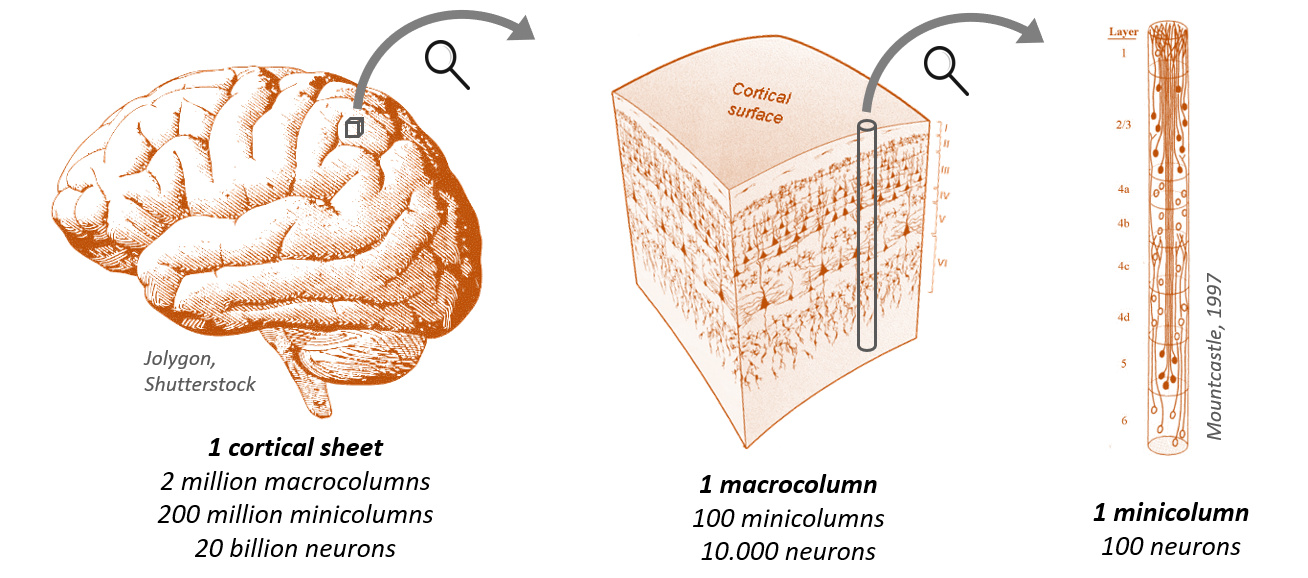
(this information is old (from 1997). There is said to be roughly 150,000 cortical columns now with each 100,000 neruons)
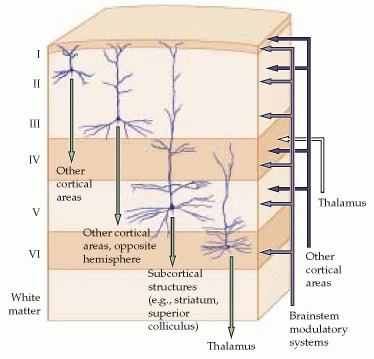
Source: Purves D, Augustine GJ, Fitzpatrick D, et al., editors. Neuroscience. 2nd edition. Sunderland (MA): Sinauer Associates; 2001. An Overview of Cortical Structure. Available from: https://www.ncbi.nlm.nih.gov/books/NBK10870/
Figure 26.3
Canonical neocortical circuitry. Green arrows indicate outputs to the major targets of each of the neocortical layers in humans; white arrow indicates thalamic input (primarily to layer IV); dark purple arrows indicate input from other cortical areas; and light purple arrows indicate input from the brainstem modulatory systems to each layer.
How do cortical columns talk to each other?
chatbot
Cortical columns communicate with each other through intricate networks of excitatory and inhibitory neurons. These interactions are mediated by both local connections within the same cortical area and long-range connections between different cortical areas. The primary modes of communication include:
- Horizontal Connections: Within a single cortical layer, horizontal or lateral connections facilitate communication between neighboring columns. These connections are typically formed by axons of pyramidal neurons that extend parallel to the cortical surface. Horizontal connections are crucial for integrating information across different columns and for processes like contour integration in the visual cortex.
- Feedback and Feedforward Loops: Cortical columns engage in hierarchical processing where lower-level sensory areas send feedforward signals to higher-level processing areas (e.g., from V1 to V2 in the visual cortex). Conversely, higher-level areas send feedback signals to lower-level areas, modulating their activity based on more complex information or contextual factors.
- Inhibitory Interneurons: GABAergic inhibitory interneurons play a key role in modulating the activity of cortical columns. These interneurons can synchronize the activity of excitatory neurons and promote oscillatory activity, such as gamma oscillations, which are thought to facilitate communication between columns.
- Thalamocortical and Corticothalamic Pathways: The thalamus acts as a relay station, with thalamocortical pathways delivering sensory input to the cortex and corticothalamic pathways providing feedback from the cortex to the thalamus. These pathways help coordinate activity across different cortical areas and maintain the balance of excitation and inhibition.
- Synaptic Plasticity: Long-term potentiation (LTP) and long-term depression (LTD) are mechanisms of synaptic plasticity that modify the strength of connections between neurons. These changes can enhance or weaken communication between columns, adapting the cortical network based on experience and learning.
- Oscillatory Synchronization: Cortical columns can synchronize their activity via rhythmic oscillations at various frequencies (e.g., alpha, beta, gamma). These oscillations facilitate the temporal coordination of neuronal firing across different columns, which is essential for effective information processing and cognitive functions.
Understanding these complex communication mechanisms is vital for unraveling how the brain processes information and supports behavior. Ongoing research continues to explore the detailed connectivity and functional significance of these interactions.
References:
-
Mountcastle, V. B. (1997). The columnar organization of the neocortex. Brain, 120(4), 701-722.
-
Douglas, R. J., & Martin, K. A. (2004). Neuronal circuits of the neocortex. Annual Review of Neuroscience, 27, 419-451.
-
Harris, K. D., & Shepherd, G. M. (2015). The neocortical circuit: themes and variations. Nature Neuroscience, 18(2), 170-181.
see also
Tags: neurobiology science
Superlink: 051 ☣Neurobiology 050 🧠Neuroscience
Neocortex
cerebral cortex
Source
Created: 12-09-24 20:29