Nervous system
Wie Impulse weitergeleitet werden
Wie Eindrücke entstehen
Activity in the nervous system creats experiences
Das Nervensystem nimmt durch die Sensoren des Körpers die Umgebung wahr und schafft so die eigene Realität, die man mit keinem anderen Lebewesen (auch keinem Mensch) teilen kann, denn nur wir selbst nehmen es so wahr, wie wir es wahrnehmen.
Versuche mal, einem Menschen, der noch nie im Leben Schokolade gegessen hat, zu beschreiben, wie sie schmeckt. Es geht nicht.
Experience has to be experienced
Apical and Blastoporal Nervous Systems
chatbot
The terms apical nervous system and blastoporal nervous system refer to two distinct types of nervous system organization found in different animal groups, particularly among invertebrates. Here are the key differences between the two:
Apical Nervous System
-
Definition: The apical nervous system is characterized by a concentration of nerve cells (neurons) at one end of the organism, typically the anterior (head) region. This organization is common in more complex organisms.
-
Structure: In organisms with an apical nervous system, there is often a centralized ganglion or nerve ring at the head end, which acts as a control center for the nervous system. This allows for more sophisticated processing of sensory information and coordination of movements.
-
Examples: The apical nervous system is prevalent in many bilateral animals, including vertebrates and some invertebrates, such as cephalopods (like octopuses) and annelids (like earthworms). In these animals, the development of a head region with paired sensory organs and centralization of nervous tissue facilitates more advanced behaviors and responses to the environment.
Blastoporal Nervous System
-
Definition: The blastoporal nervous system is often found in simpler, more primitive organisms and is characterized by a nervous system that develops from the blastopore, which is the opening that forms during early embryonic development. In this system, the nerve network is distributed rather than centralized.
-
Structure: In animals with a blastoporal nervous system, the nervous tissue may be organized in a more decentralized manner, sometimes forming a nerve net without a true central nerve cord or brain. This can lead to more diffuse and less coordinated responses.
-
Examples: The blastoporal nervous system is typical of certain groups of invertebrates, such as cnidarians (like jellyfish and corals) and some echinoderms. These organisms often exhibit simple behaviors and a lack of complex sensory processing compared to animals with an apical nervous system.
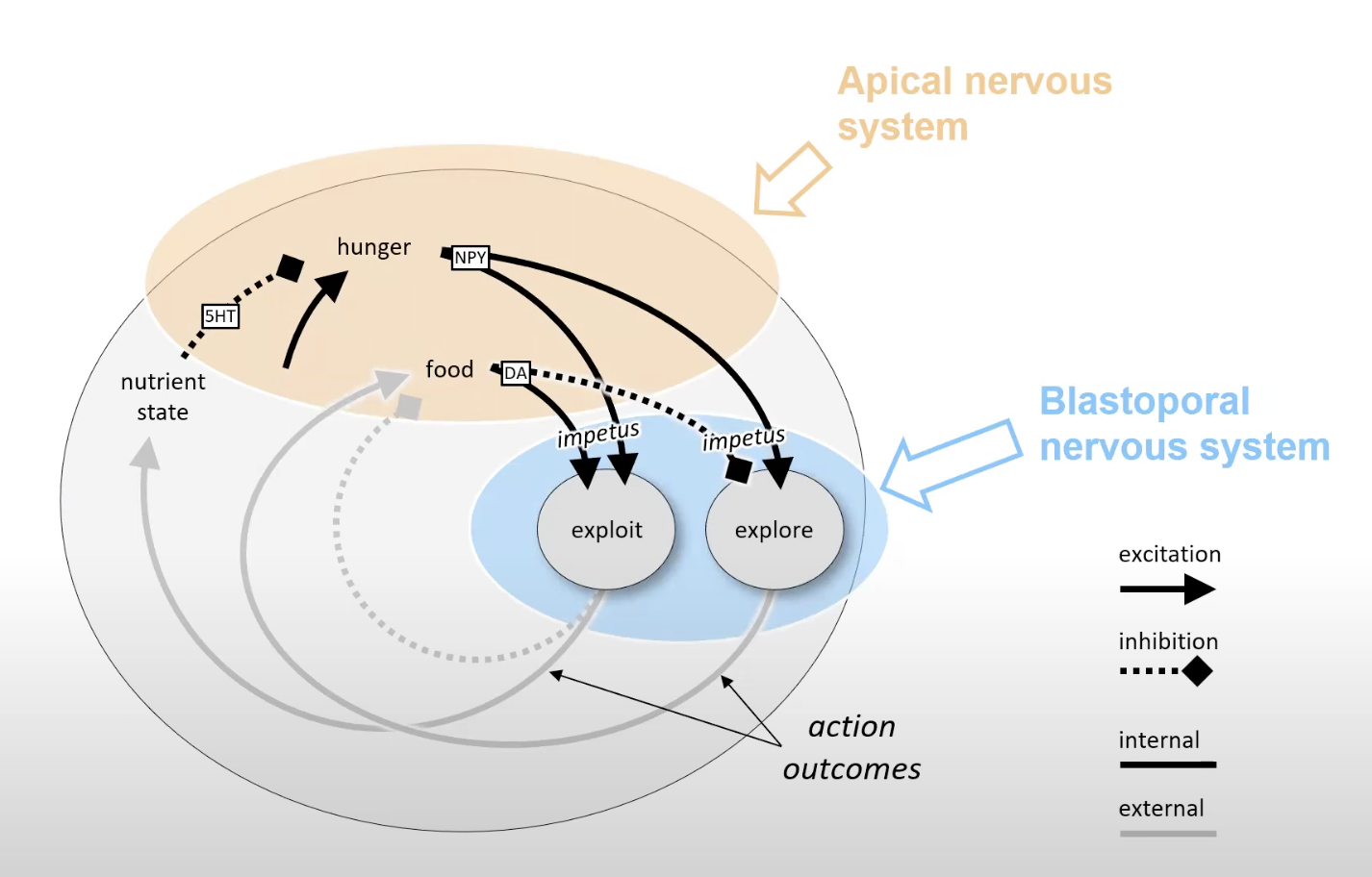
Looking at Levy walks apical and blastoporal nervous system do different tasks in foraging.
apical:
serotonin
NPY
Dopamine
controlling the blastoporal system
Summary
- The apical nervous system is characterized by centralization of nervous tissue at the anterior end, allowing for more complex behaviors and sensory processing, and is commonly found in bilaterally symmetrical animals.
- The blastoporal nervous system is more decentralized and less complex, often found in simpler organisms like cnidarians and echinoderms, reflecting a different evolutionary approach to nervous system organization.
Understanding these differences provides insight into how various animal taxa have evolved to adapt to their environments and perform necessary functions for survival.
see also
Tags:
Superlink: 051 ☣Neurobiology 050 🧠Neuroscience
Sympathetic Nervous System (SNS)
Parasympathetic Nervous System (PNS)
Wie Vision entsteht
Quellen
Erstellt: 19-09-21 09:33