Oligodendrocytes
chatbot
Oligodendrocytes are a type of glial cell found in the central nervous system (CNS), which includes the brain and Spinal cord. They play a crucial role in the Myelination of axons, which is essential for efficient neural signal transmission. Here is a structured overview of oligodendrocytes:
Definition and Function
- Oligodendrocytes are specialized glial cells responsible for forming the myelin sheath around axons in the CNS.
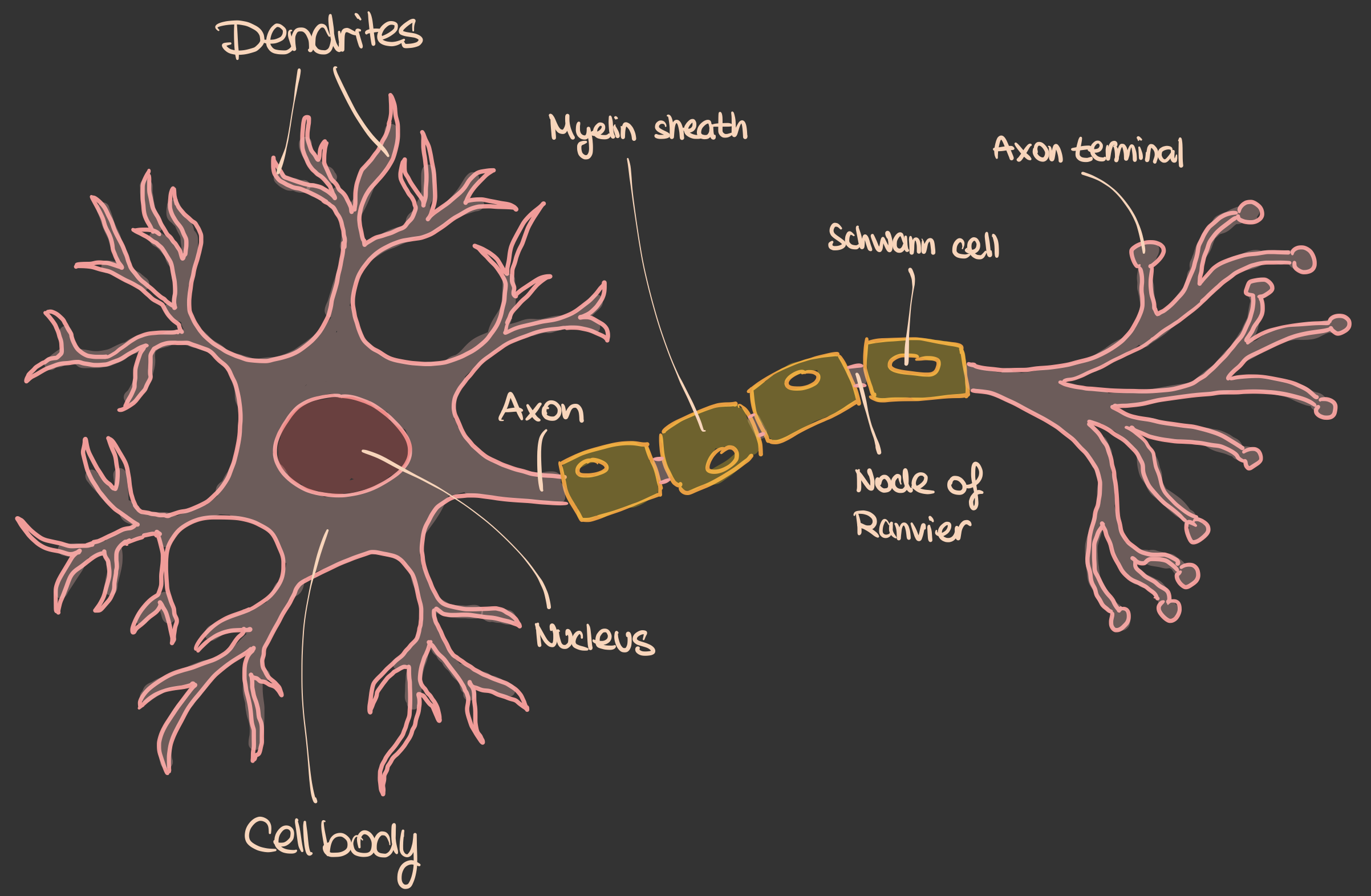
- They facilitate the rapid transmission of electrical impulses by insulating axons, allowing for saltatory conduction, where action potentials jump from one Node of Ranvier to the next.
Myelination Process
- Myelin Sheath Formation: Oligodendrocytes extend their cell processes to wrap around multiple axon segments, forming a compact, multilayered myelin sheath.
- Efficiency: Unlike Schwann cells in the peripheral nervous system (PNS), which myelinate a single axon segment, oligodendrocytes can myelinate multiple segments on different axons simultaneously.
Can oligodendrocytes myelinate multiple axonal processes?
Yes, oligodendrocytes are able to myelinate multiple axonal processes. This is a key difference from Schwann cells, which occur in the peripheral nervous system (PNS) and each myelinate only a single axon segment.
Here are the details:
- Oligodendrocytes in the Central Nervous System (CNS): Oligodendrocytes are a type of glial cell found in the brain and spinal cord. They have multiple cell projections that extend to wrap around different axons.
- Myelination: Oligodendrocytes wrap their cell membranes around axons, forming the myelin sheath. This sheath acts as an insulating layer, enabling faster and more efficient nerve conduction through saltatory conduction.
- Function of the Myelin Sheath: The sheath reduces leakage current across the axon membrane and decreases membrane capacitance, leading to faster propagation of electric potentials and increased nerve conduction speed.
- Comparison with Schwann Cells: In contrast, Schwann cells in the PNS myelinate only one segment of a single axon. Each oligodendrocyte can myelinate several axon segments on different axons.
- Importance: The ability of oligodendrocytes to myelinate multiple axons is essential for efficient signal transmission in the CNS, allowing many neurons to communicate rapidly at the same time.
- Myelin Proteins: The myelin sheath is stabilized by various proteins, with myelin basic protein (MBP) present in both Schwann cells and oligodendrocytes. Proteolipid protein (PLP), however, is found only in the myelin and myelinating cells of the CNS, while in the PNS, it is replaced by the P0 glycoprotein.
In summary, oligodendrocytes have the unique ability to myelinate multiple axonal processes in the CNS simultaneously, which is crucial for fast and efficient signal transmission.
Composition
- Myelin Proteins: The myelin sheath in the CNS contains specific proteins such as myelin basic protein (MBP) and proteolipid protein (PLP). PLP is unique to the CNS and is involved in extracellular membrane apposition.
- Structure: The myelin sheath is composed of the oligodendrocyte’s plasma membrane, tightly wrapped around the axon, with the cytoplasm squeezed out to form a dense, insulating layer.
Role in CNS
- Signal Transmission: By insulating axons, oligodendrocytes increase the speed and efficiency of electrical signal transmission.
- Energy Efficiency: Myelination reduces the need for sodium-potassium ATPase pumps along the axon, making neural transmission less energy-consuming.
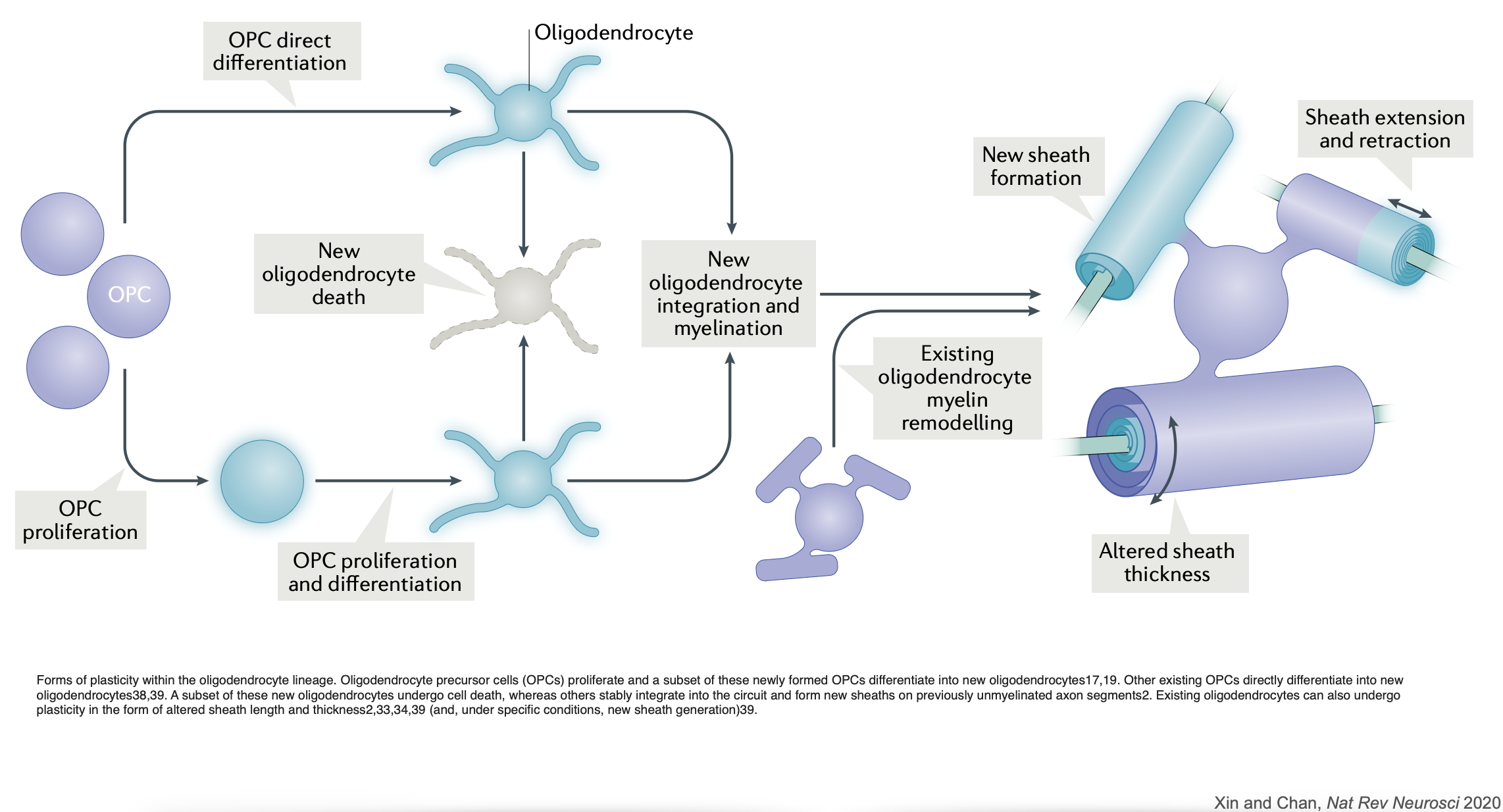
myelin/oligodendrocytes plasticity in learning
- Sensory deprivation affects myelination
- Whisker trimming reduces myelination during development
- Visual deprivation increases myelination in the contralateral side
- Social isolation impacts oligodendrocytes maturation and myelination
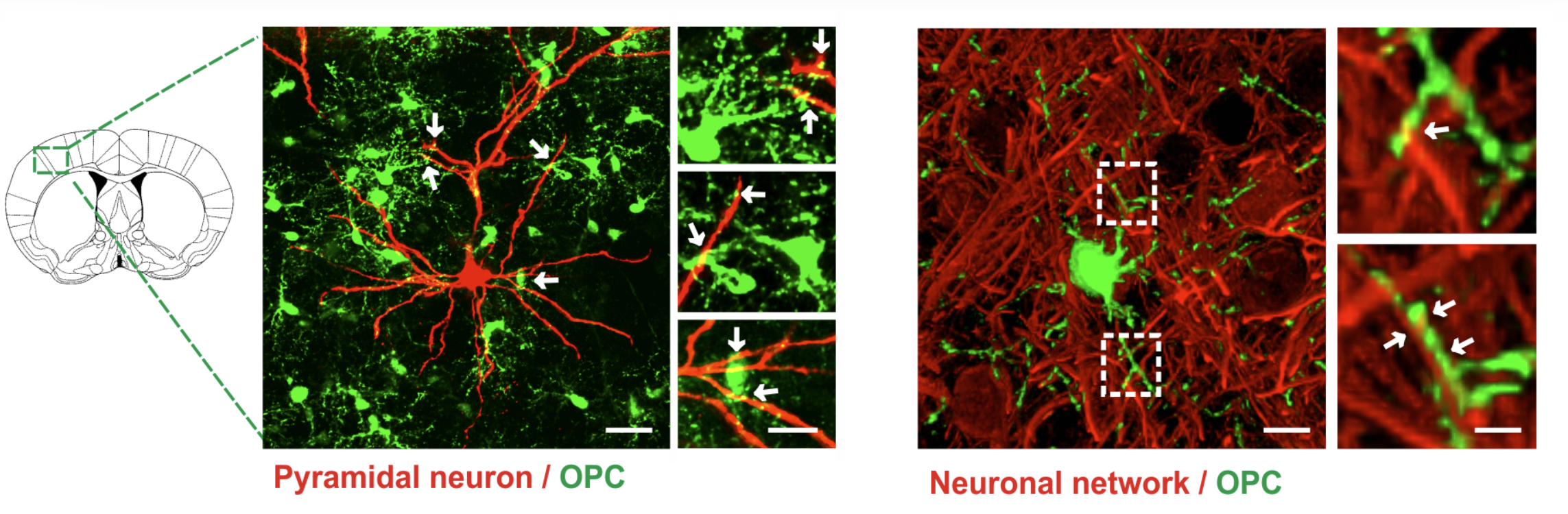
- Motor learning increases OPC production and differentiation
- learning increased the number of retractions of existing myelin sheaths (increased plasticity)
- Spatial learning increases the number of OPCs (Oligodendrocyte precursor cells) and oligodendrocytes
- learning-induced proliferation and differentiation may proceed separately and at different rates in different circuits (more pronounced in areas involved in memory consolidation)
- Environmental enrichment increases the proliferation of OPC in the amygdala and the number of oligodendrocytes in the corpus callosum of middle-aged rats
Clinical Relevance
- Demyelinating Diseases: Damage to oligodendrocytes or the myelin sheath can lead to neurological disorders such as multiple sclerosis, where the immune system attacks myelin proteins, including MBP.
- Regeneration: Unlike Schwann cells in the PNS, oligodendrocytes have limited capacity for regeneration and repair, which poses challenges in CNS recovery after injury.
Summary
Oligodendrocytes are vital for the proper functioning of the CNS by ensuring rapid and efficient neural communication through myelination. Their ability to myelinate multiple axons distinguishes them from Schwann cells, highlighting their importance in maintaining CNS integrity and function.
Sources:
see also
Tags: neurobiology science
Superlink: 051 ☣Neurobiology 050 🧠Neuroscience
Central Nervous System (CNS)
Cell
Source
Created: 11-02-25 13:08