Weber and Weber-Fechner Law
chatbot
The Weber Law and the Weber-Fechner Law are foundational concepts in the field of psychophysics, which studies the relationship between physical stimuli and the sensations and perceptions they produce.
Weber Law
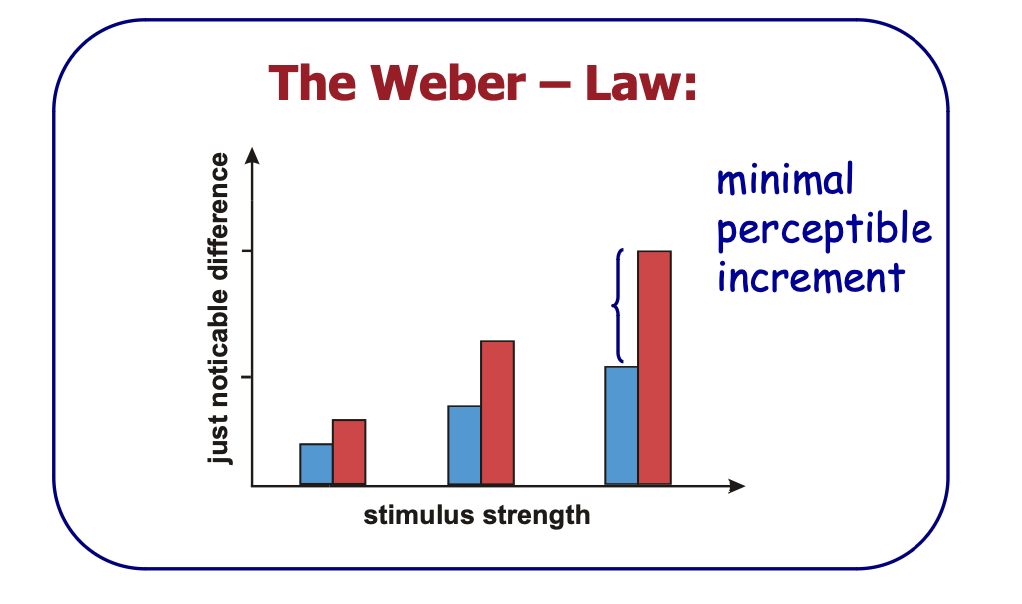
The Weber Law, formulated by Ernst Heinrich Weber in the 19th century, describes a basic principle of perception: the just noticeable difference (JND) between two stimuli is proportional to the magnitude of the stimuli. The JND is the smallest difference that can be perceived between two physical stimuli. According to Weber’s Law, for a difference between two stimuli to be perceptible, the difference must be a constant proportion of the original stimulus value. This means that the larger or more intense the stimulus, the larger the change must be to be noticed by the observer. Mathematically, it can be expressed as:
[ \frac{\Delta I}{I} = k ]
Where:
- ( \Delta I ) is the just noticeable difference,
- ( I ) is the initial stimulus intensity,
- ( k ) is a constant that varies depending on the type of stimulus and sensory modality.
Weber-Fechner Law
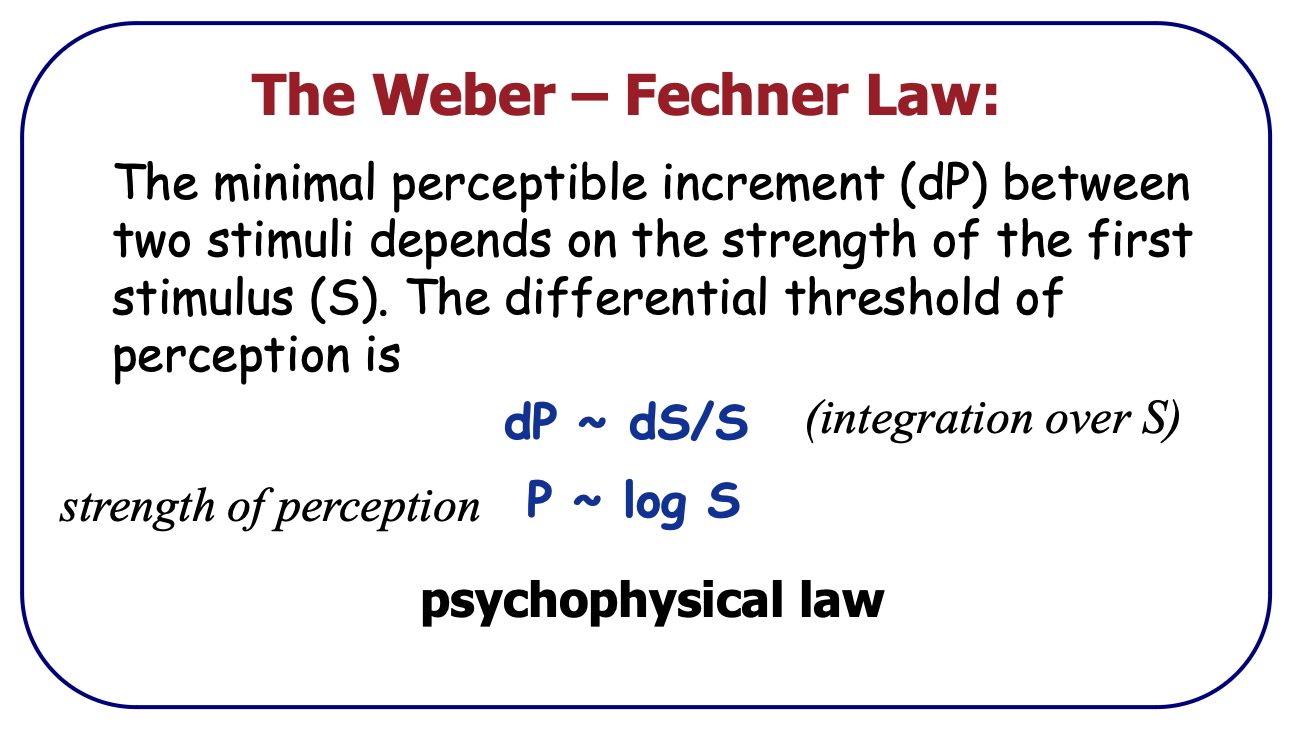
The Weber-Fechner Law expands on Weber’s Law to describe the relationship between the magnitude of a physical stimulus and its perceived intensity or strength. Gustav Fechner, a German psychologist, proposed that each JND represents an equal step in the perception of a stimulus intensity, leading to the concept that the subjective sensation increases proportionally to the logarithm of the stimulus intensity. The Weber-Fechner Law can be mathematically represented as:
[ S = k \log(I) ]
Where:
- ( S ) is the perceived intensity of the stimulus,
- ( I ) is the actual physical intensity of the stimulus,
- ( k ) is a constant that depends on the stimulus and sensory modality,
- ( \log ) denotes the logarithm.
- [ ]
Summary
Both laws are crucial in understanding how humans perceive changes in their environment. The Weber Law highlights the proportional relationship between the just noticeable difference and the initial stimulus magnitude, indicating that our sensory systems are more sensitive to relative differences than to absolute magnitudes. The Weber-Fechner Law further suggests that our perception of stimulus intensity follows a logarithmic scale, meaning that as physical stimuli become stronger, larger changes are required for the differences to be perceptible. However, it’s important to note that the Weber-Fechner Law has limitations and does not accurately describe the perception of stimuli at very low or very high intensities. Modern interpretations of sensory perception, such as Steven’s Power Law, have been proposed to address some of these limitations.
see also
Tags: neurobiology science
Superlink: 051 ☣Neurobiology 050 🧠Neuroscience
Steven’s experiments
Source
Created: 20-09-24 12:48