Females, Lengthened Cycles and Amenorrhea
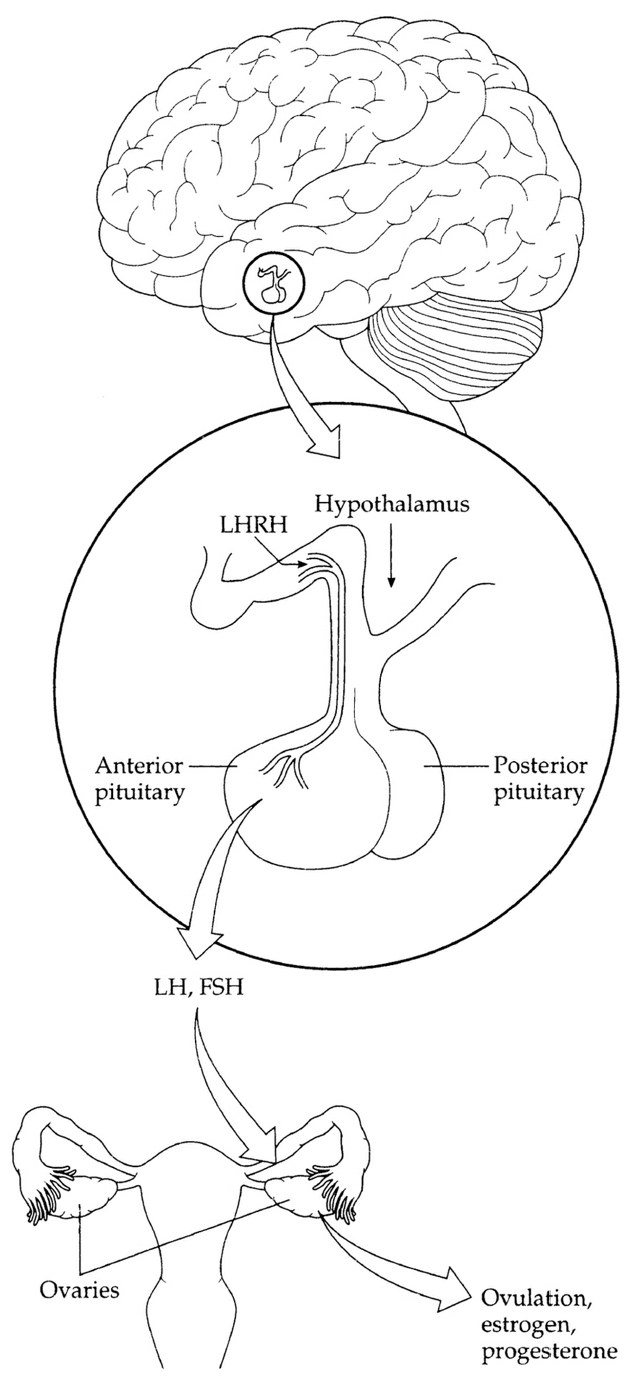
The amount of these “adrenal androgens” is only about 5 percent of that in males, but enough to cause trouble.* An Enzyme in the fat cells of females usually eliminates these androgens by converting them to Estrogens. Problem solved. But what ==if you are starving== because the crops failed this year? Body weight drops, fat stores are depleted, and suddenly there isn’t enough fat around to convert all the androgen to estrogen. Less estrogen, therefore, is produced. More important, androgen concentrations build up, which ==inhibits numerous steps in the reproductive system== (Location 2167)
Reproduction is similarly inhibited if you starve voluntarily. One of the hallmarks of anorexia nervosa is disruption of reproduction in the (typically) young women who are starving themselves. There’s more to the reproduction cessation than just the weight loss, since cycling doesn’t necessarily resume in women when they regain the weight unless the initial psychological stressors have been sorted out. But the weight loss still plays a critical, initiating role. And loss of body fat leading to androgen buildup is one of the mechanisms by which reproduction is impaired in females who are extremely active physically. As noted above, this has been best documented in young girls who are serious dancers or runners, in whom puberty can be delayed for years, and in women who exercise enormous amounts, in whom cycles can become irregular or cease entirely. Overall, this is a logical mechanism. In the human, an average pregnancy costs approximately 50,000 calories, and nursing costs about a thousand calories a day; neither is something that should be gone into without a reasonable amount of fat tucked away. (Location 2172)
Stress can also cause other reproductive problems. Progesterone levels are often inhibited, which disrupts maturation of the uterine walls. The release of Prolactin during stress adds to this effect, interfering with the activity of progesterone. Thus, even if there is still enough hormonal action during the follicular period to cause ovulation, and the egg has become fertilized, it is now much less likely to implant normally. (Location 2185)
amid the controversies discussed in chapter 3 about whether Estrogen protects against cardiovascular disease, it is quite clear that it protects against osteoporosis, and stress-induced declines in estrogen levels have bad effects on bone strength. (Location 2189)
Of all the hormones that inhibit the reproductive system during stress, prolactin is probably the most interesting. It is extremely powerful and versatile; if you don’t want to ovulate, this is the hormone to have lots of in your bloodstream. It not only plays a major role in the suppression of reproduction during stress and exercise, but it also is the main reason that breast feeding is such an effective form of contraception. (Location 2191)
Breast feeding causes prolactin secretion. There is a reflex loop that goes straight from the nipples to the Hypothalamus. If there is nipple stimulation for any reason (in males as well as females), the hypothalamus signals the pituitary to secrete prolactin. And as we now know, ==Prolactin in sufficient quantities causes reproduction to cease.== (Location 2196)
In general, stress suppresses both proceptive and receptive behaviors. (Location 2241)
see also
Tags: science medicine biology
Superlink: 091 🏃Body and Medicine, 090 🌱Biology, 051 ☣Neurobiology
Source
Created: 05-09-22 16:43