Assignment 1 Neurodynamics
Objective: In our recent lecture, we discussed several computational principles inherent in dendrites. Your task is to find four publications that feature computational models for dendrites and analyze them in the context of our course material.
Tasks:
- Literature Review: Select four peer-reviewed papers focusing on computational dendritic models.
- Scientific Summary: For each paper, provide a summary that explicitly links the research to the topics covered in our lecture slides. Discuss existing connections, newly identified insights, or missing links between the literature and the lecture content.
- Critical Evaluation: Evaluate each paper on a scale of 1 to 5 (where 1 is the highest/most and 5 is the lowest/least) based on the following criteria:
Showcase of Principal Understanding: Does the paper demonstrate a deep grasp of dendritic computation?
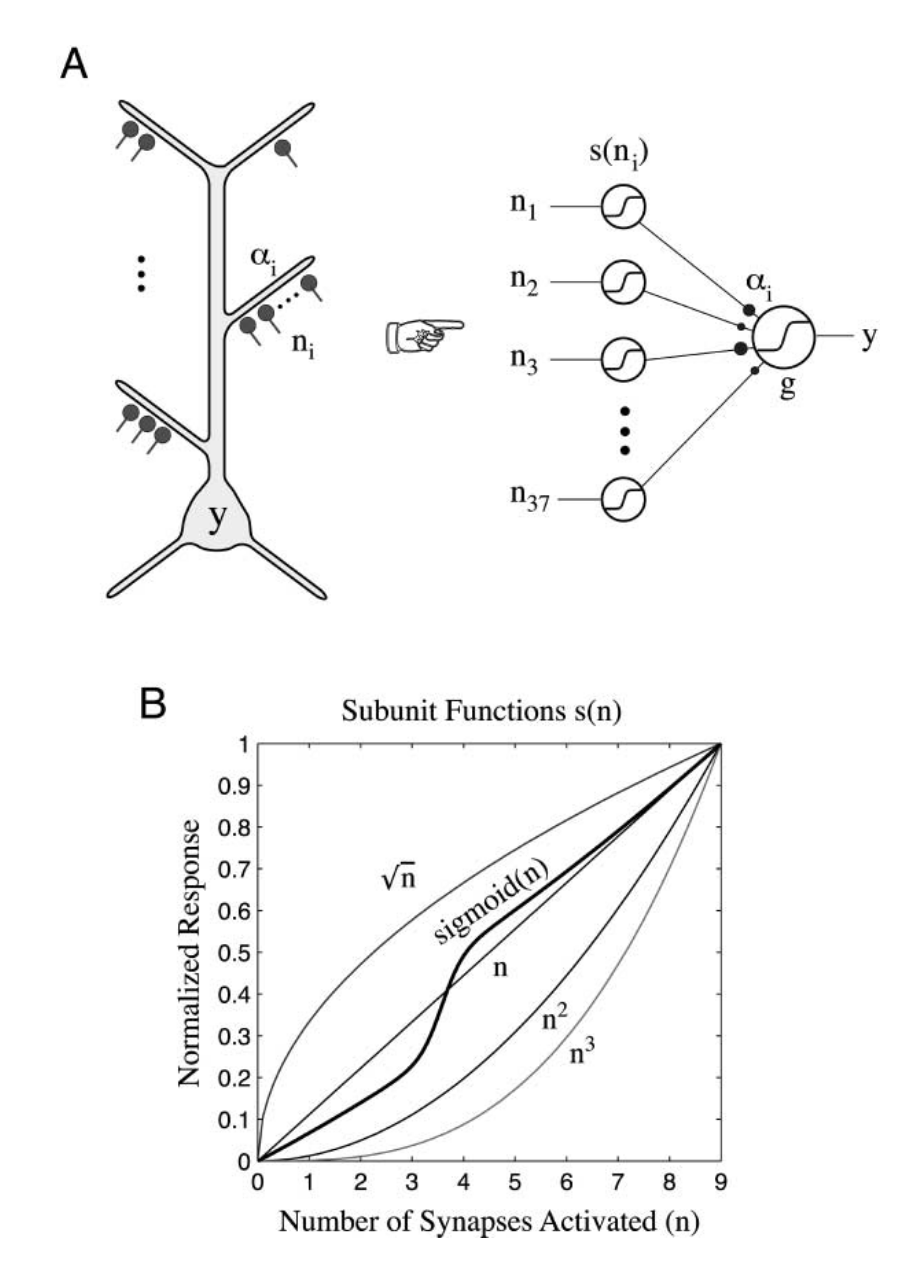
This model shows one of the most detailed compartment biophysiological models of a single cell that existed until 2003 - built with the NEURON simulation environment. It comprises of 17 different types of voltage-gated ion channels and models their non-uniform spatial distribution.
They distinguish between simple power variation and complex configuration variation, so paying attention to the location of the synapses being activated and not simply the number of synapses.
Optimal Simplification: Is the model simplified to a sufficient and functional degree?
Yes, this model is complex, but is simplified to a functional degree at which a useful abstraction is still possible. The authors call their model a simple “paper-and-pencil calculation” relying on just a few parameters.
They reduced the biophysical model of a pyramidal cell in CA1 hippocampus to a two-layer sum-of-sigmoids neural network which is highly accurate and predicts 94% of the spike rate variance generated over 1,000 complex synaptic stimulus patterns - while a simple point-neuron model only captures 82% of the variance.
Testability: Is the presented model empirically testable?
Yes, the present model is empirically testable, even though testing the entire model on living neurons was not feasible due to technical difficulties. But experimental data support the core components by using subthreshold synaptic stimulation in hippocampal slices. This shows empirical support for the independent, non-linear functional subunits that make up the proposed two-layer model.
Predictive Power: Does the model make specific, verifiable predictions?
- The model predicts that dendritic branches act together if the neuron is driven with powerful, synchronous impulses.
- The model predicts how the cell’s computational mechanisms perform under various types of stimulation. It predicts that heavy background noise has little effect on the model’s prediction accuracy.
- Predicts coupling strengths. The first-order thin dendrites have roughly 40% more influence on the cell body than higher-order branches. The strength of the coupling is only marginally correlated to the distance of the dendrite to the soma.
- The model exactly leaves 1/3 of spike rate variance unexplained.
Submission Requirements:
• Format: A PDF document between 4 and 10 pages in length.
• Title Page: Must include the project title, your names, and a Disclosure Statement describing which AI tools were used and how they were applied (e.g., using Google NotebookLM for document synthesis).
• Citations: Include direct links to the four selected papers.
• Tone: The summaries must be written in a formal, scientific style.
See also
Status:
Tags: science
Superlink: 611 📠Machine Learning
610 🤖Artificial Intelligence, Künstliche Intelligenz
050 🧠Neuroscience
Quellen
Poirazi, P., Brannon, T., & Mel, B. W. (2003). Pyramidal Neuron as Two-Layer Neural Network. Neuron, 37(6), 989–999. https://doi.org/10.1016/S0896-6273(03)00149-1
Erstellt: 2026-04-13 15:03