Gabor Filter
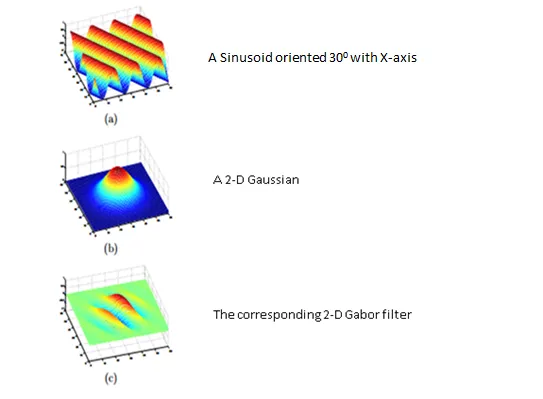
The Gabor filter, named after Dennis Gabor, is a linear filter used in myriad image processing applications for edge detection, texture analysis, feature extraction, etc. The characteristics of certain cells in the visual cortex of some mammals can be approximated by these filters. These filters have been shown to possess optimal localization properties in both spatial and frequency domains and thus are well-suited for texture segmentation problems. Gabor filters are special classes of bandpass filters, i.e., they allow a certain ‘band’ of frequencies and reject the others. A Gabor filter can be viewed as a sinusoidal signal of particular frequency and orientation, modulated by a Gaussian wave. One such 2D Gabor filter is shown in Figure 1.
Examples:
-
Edge Detection: A Gabor filter with a certain orientation and frequency can be applied to an image to detect edges along that orientation.
-
Visual Perception Research: A Gabor patch oriented at 45 degrees with a certain spatial frequency might be flashed on a screen, and subjects would report their ability to perceive its orientation, helping researchers understand orientation and frequency sensitivity of the visual system.
see also
Type:
Tags:
Status:
Location:
Created: 10-12-24 13:28
611 📠Machine Learning
050 🧠Neuroscience
Source
Gabor Filter demo:
https://andreas-aeschlimann.github.io/gabor/#/demo
Other Sources:
https://medium.com/@anuj_shah/through-the-eyes-of-gabor-filter-17d1fdb3ac97