Neocognitron
- Arguably the first multi-layer feedforward conv-like neural network
- Inspired by findings of Hubel and Wiesel
- Very important starting point and proof-of-principle (yet often ignored in ML lectures)
- Performance was hard to quantify performance (pre-MNIST), largely qualitative results.
- Local unsupervised learning, not end-to-end training
- Inspiration from brain to artificial networks, but never used to predict brain data or behaviour.
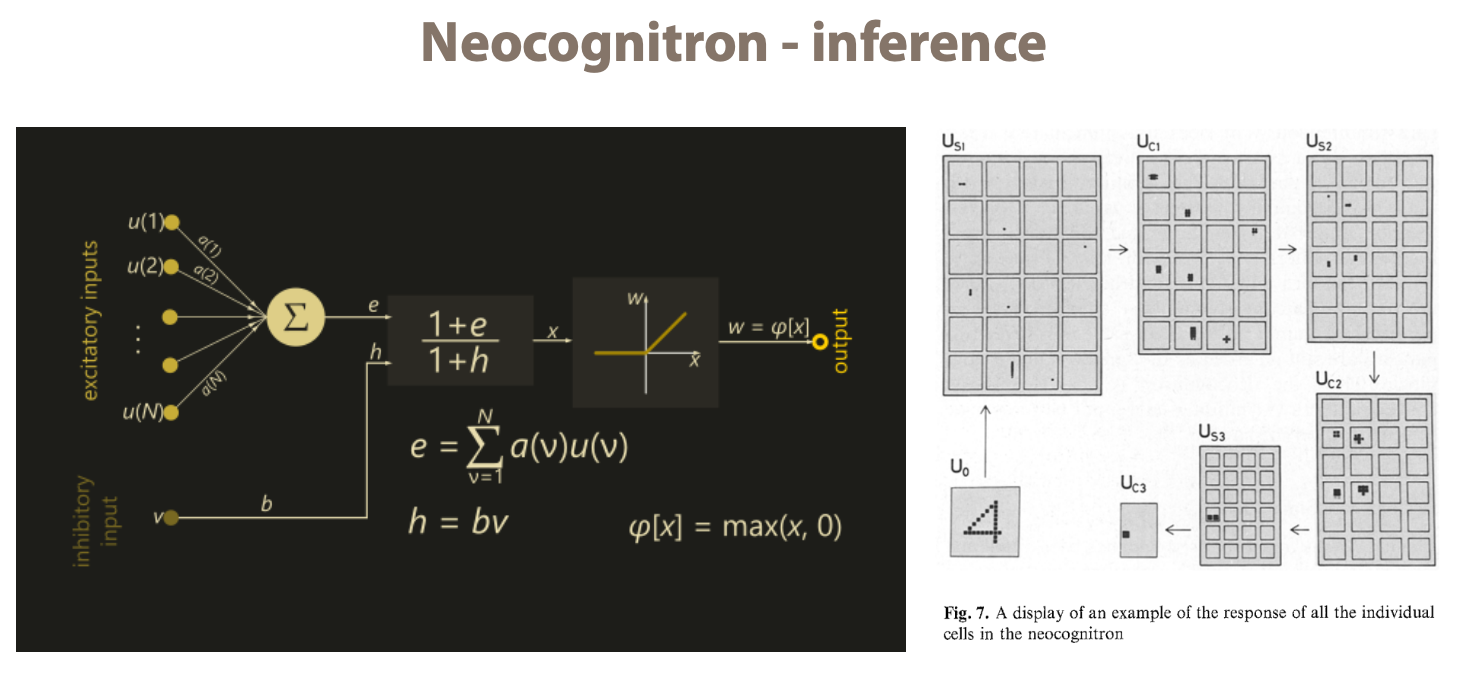
- S-cell receives excitatory connections from a group of C-cells and a variable inhibitory connection (V-cell, receiving fixed input from C-cells, responding with the average intensity of the C-cells’ output).
- Activity is computed via a scalar product between weights and activity, followed by a nonlinearity. This is a feature detector.
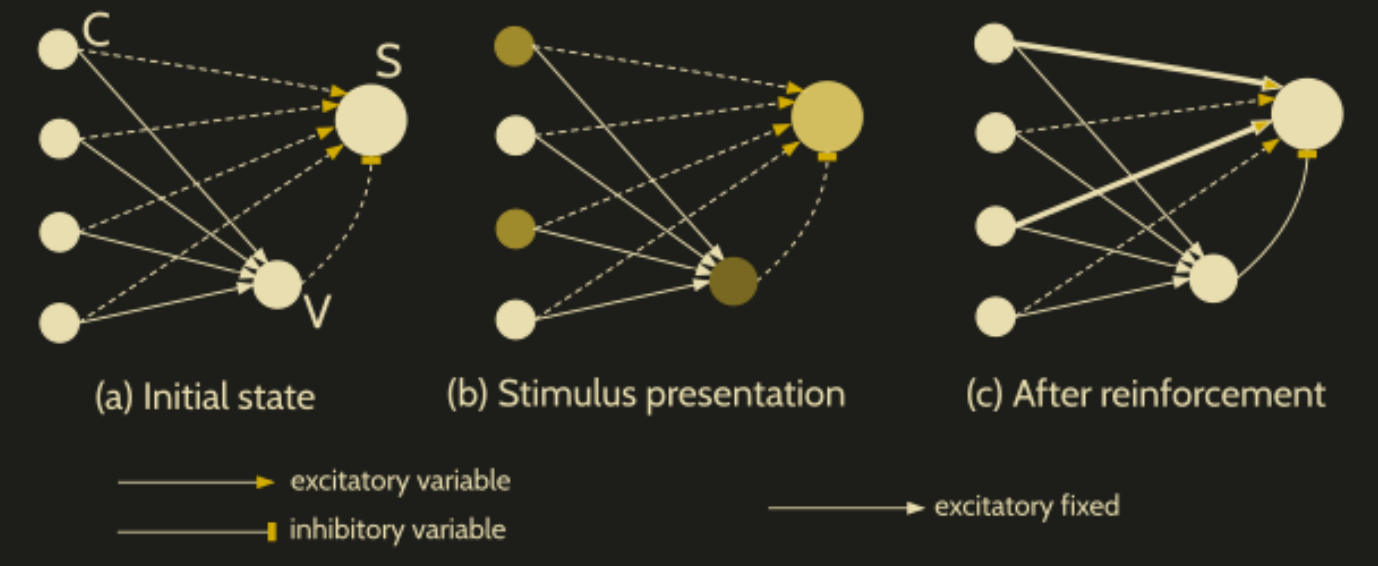
- S-cells in the first layer are initialised to be weakly orientation selective.
- Among the S cells situated in an area, only some are selected (max 1 per S plane). These are reinforced and the learned weight vectors are copied over to the others.
- This is a form of unsupervised training (mildly related to template matching).
see also
Tags: neuroscience science
Superlink: 050 🧠Neuroscience
Machine Learning for Cognitive Computational Neuroscience
Source
Created: 30-01-25 13:54