Imagine a world where no one had mirror neurons.
Humans would basically run around like zombies, not caring what others are doing. Dancing in a club, you would be completely oblivious to the rhythm and moves of those around you.
Dancing with friends? Oh, forget about synchronizing in a flash mob or choreography for TikTok.
You would not be able to read the emotions or intentions of others. You would not correctly assess the aggression of the dude you bumped into in the club. That can get you into serious trouble!
And imagine navigating through life without empathy or smiling when others smile at you.
You would need to learn empathy by reading books and studying emotions like you would learn engineering at university.
The way you would learn something is not by watching others. Fixing your tyre is much harder since you cannot simply imitate others how they do it. It would be only by being explained to you and you doing it with trial and error.
Diving into The Human Brain
Let’s look at two studies on mirror neurons.
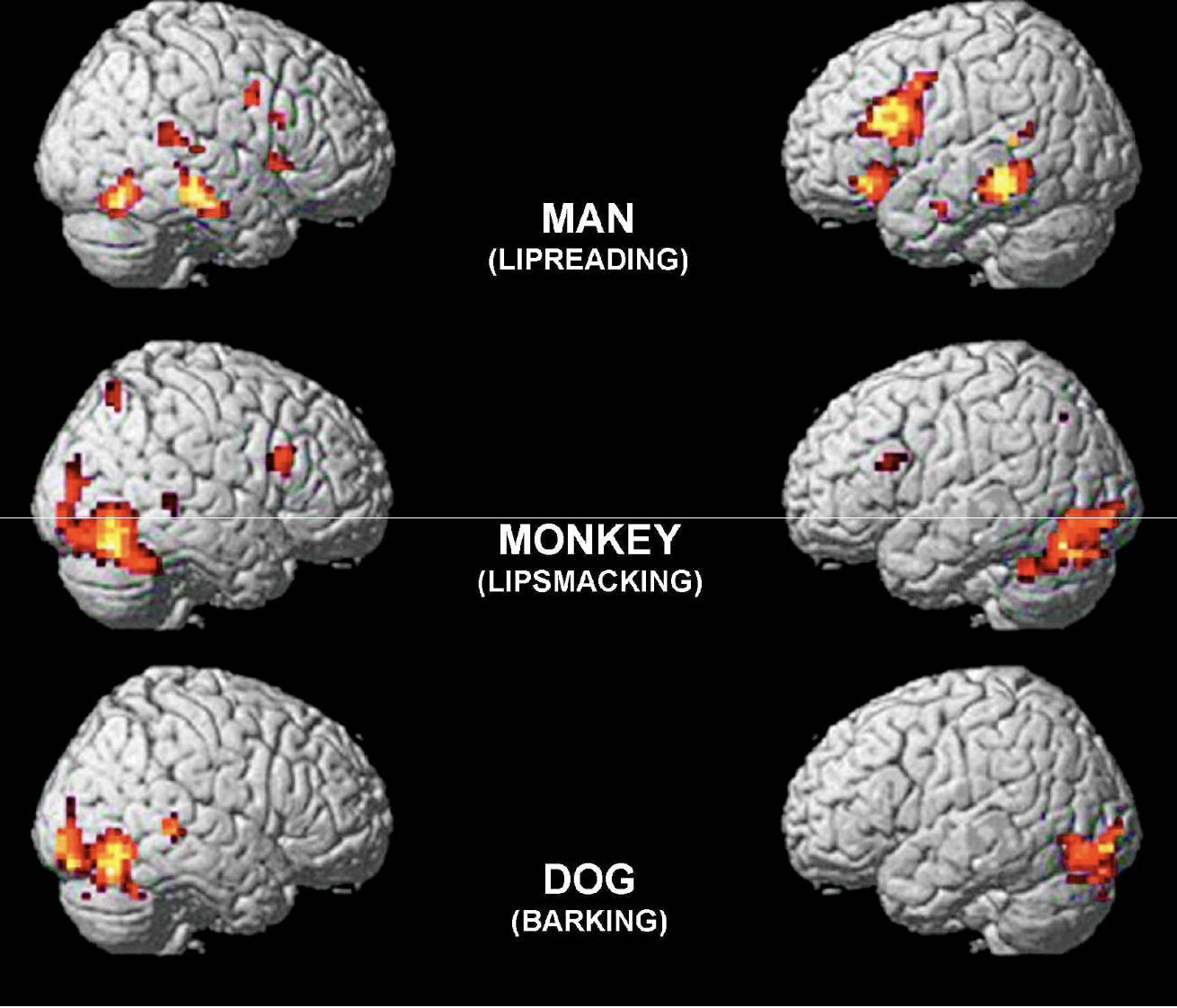
Picture a basic movement of lips, and you try to guess what has been said.
In the right-top picture, you see the premotor cortex highly activated, as well as the Broca area for producing language.
What happens when you watch a monkey who indulges in some lip-smacking? Or a dog decides to join the conversation with a bark?
We get different outcomes in the human brain. What will be more active? The monkey’s lip-smacking, for sure! It is more human-like. We can do the same.
But the dog? Have you seen a human properly barking on the lawn of your neighbours? I doubt that!
That’s why we only see the visual cortex activated when the dog is barking, as the brain cannot relate to this behaviour.
The closer a behaviour is to human behaviour, the higher the activation. We need to be able to relate to and copy the behaviour.
Buccino at al. (2004)
What does this tell us?
Mirror neurons are like hidden treasures scattered throughout the brain. They light up like Christmas trees when we watch others performing activities we can perform as well.
When we look at single neurons in areas where we would not typically expect mirror neurons, we still find them as in the amygdala or in the entorhinal cortex. As an example: These are neurons in the Supplementary motor area (SMA) and entorhinal cortex.
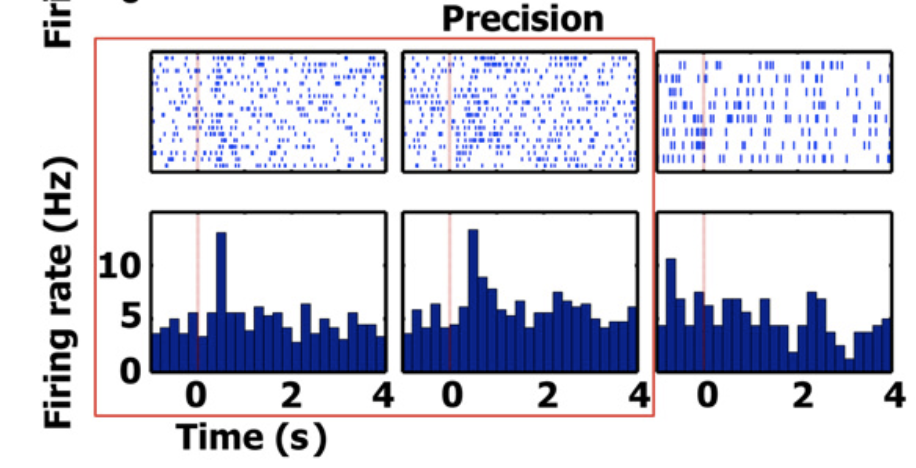
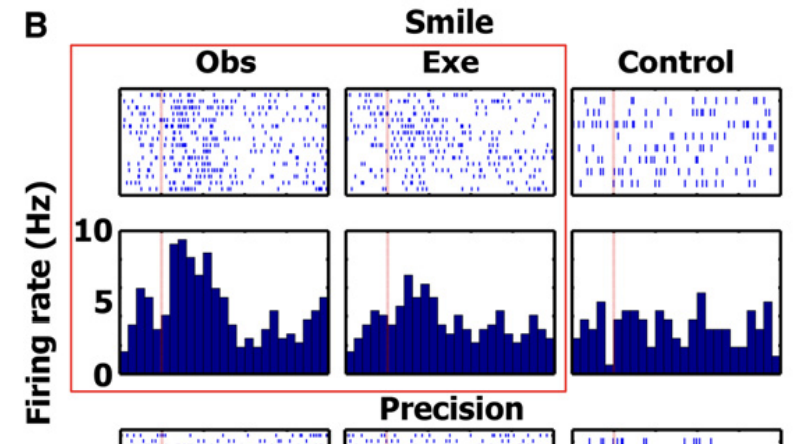
Source: Mukamel, R., Ekstrom, A. D., Kaplan, J., Iacoboni, M., & Fried, I. (2010). Single-neuron responses in humans during execution and observation of actions. Current biology, 20(8), 750-756.
This suggests that multiple systems exist even in non-motor areas, specially designed to respond to the actions of other humans, animals, and yourself.
From the earliest days of childhood, we’re like sponges, absorbing the world around us and learning through the simple act of observation. This silent, implicit learning plays a crucial role in our development and the evolution of social behaviours across many species, from the loyal dog at your feet to the curious monkey swinging through the trees.
These are the wonderful mechanisms nature gave us to make us empathetic and social animals!
Give this article a clap, and see you next time :)
see also
Tags: neuroscience science
Superlink: 050 🧠Neuroscience
Source
Created: 09-06-24 10:18