Biomembrane
#chatbot
Biomembranes are essential components of cells, serving as barriers and functional interfaces between the cell and its environment. Here’s a structured overview of biomembranes:
Main Components
-
Lipids:
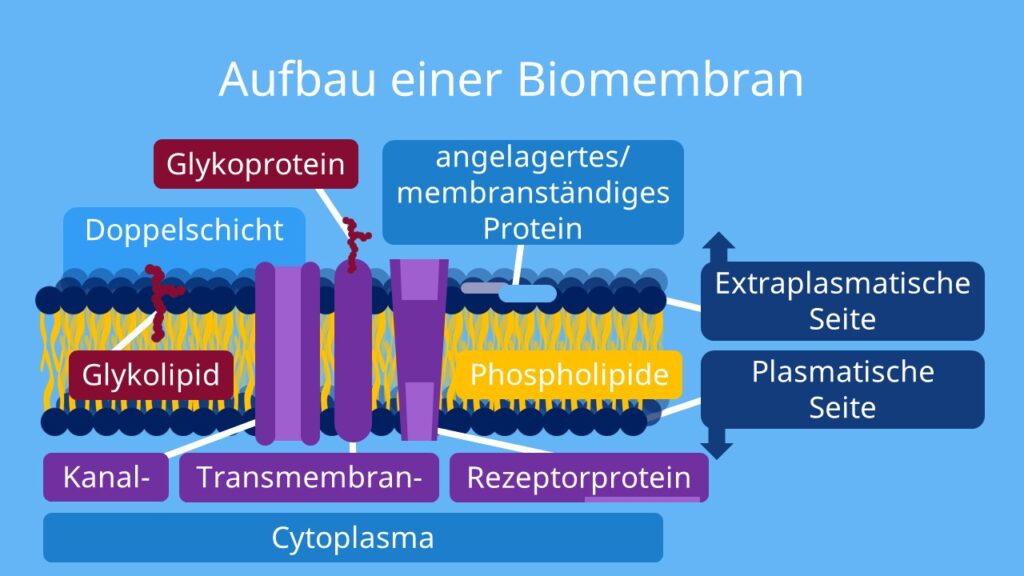
- Phospholipids: The primary lipid component, forming a bilayer. Each phospholipid molecule has a hydrophilic head (composed of choline, ethanolamine, phosphate, and glycerol) and hydrophobic tails (fatty acids).
- Lipid Content: The myelin sheath, for example, has about 70% lipid content.
-
Proteins:
- Integral Membrane Proteins: Embedded within the lipid bilayer, often spanning the membrane.
- Peripheral Membrane Proteins: Attached to the surface of the membrane.
- Protein Content: The inner mitochondrial membrane has about 70% protein content.
Structure
- Phospholipid Bilayer: Forms the basic structure of biomembranes, with hydrophilic heads facing the aqueous environment and hydrophobic tails facing inward, creating a barrier to hydrophilic molecules.
- Fluid Mosaic Model: Describes the dynamic nature of the membrane, where lipids and proteins can move laterally within the layer, allowing for flexibility and functionality.
Functions
-
Barrier Function:
- Acts as a diffusion barrier against hydrophilic molecules, maintaining the internal environment of the cell.
- Provides separation and insulation, crucial for cellular integrity and function.
-
Transport and Signaling:
- Membrane proteins facilitate the transport of ions and molecules across the membrane through channels and carriers.
- Involved in cell signaling, allowing cells to communicate and respond to external stimuli.
-
Structural Support:
- Provides a framework for the attachment of the cytoskeleton, maintaining cell shape and facilitating cellular movements.
Types of Membranes
- Plasma Membrane: Encloses the entire cell, controlling the movement of substances in and out.
- Organelle Membranes: Surround organelles like mitochondria, endoplasmic reticulum, and Golgi apparatus, compartmentalizing cellular functions.
Examples of biomembranes
Biomembranes are diverse and can be found in various cellular structures. Some examples of biomembranes include:
-
Plasma Membrane: This is the outer membrane of the cell that encloses the entire cell, controlling the movement of substances in and out of the cell.
-
Organelle Membranes: These include membranes surrounding organelles such as:
- Mitochondrial Membrane: Encloses the mitochondria, the powerhouse of the cell.
- Endoplasmic Reticulum Membrane: Surrounds the endoplasmic reticulum, involved in protein and lipid synthesis.
- Golgi Apparatus Membrane: Encloses the Golgi apparatus, responsible for modifying and sorting proteins.
- Nuclear Membrane: Encloses the nucleus, storing most of the cell’s genetic material.
- myelin sheath
Additional Features
- Membrane Proteins: Play roles in enzymatic activity, signal transduction, and cell recognition.
- Protein Structure: Proteins in the membrane can have various structures, including alpha-helices and beta-sheets, contributing to their specific functions.
Biomembranes are vital for maintaining cellular homeostasis, enabling communication, and facilitating various biochemical processes essential for life.
see also
Tags: neurobiology science
Superlink: 051 ☣Neurobiology 050 🧠Neuroscience
Transmembrane Segment
Cell
Mitochondria
Cytoskeletons
Source
Created: 12-02-25 18:23