Cytoskeletons
all cytoskeletons are produced inside the cell
#chatbot
connections between the cytoskeletons
Microtubules, microfilaments, intermediate filaments, and neurofilaments are all integral components of the cytoskeleton, each playing distinct yet complementary roles in maintaining cellular structure and function:
- Microtubules:
- Structure: Composed of tubulin dimers forming 13 protofilaments into a hollow cylindrical tube with a diameter of approximately 20 nm.
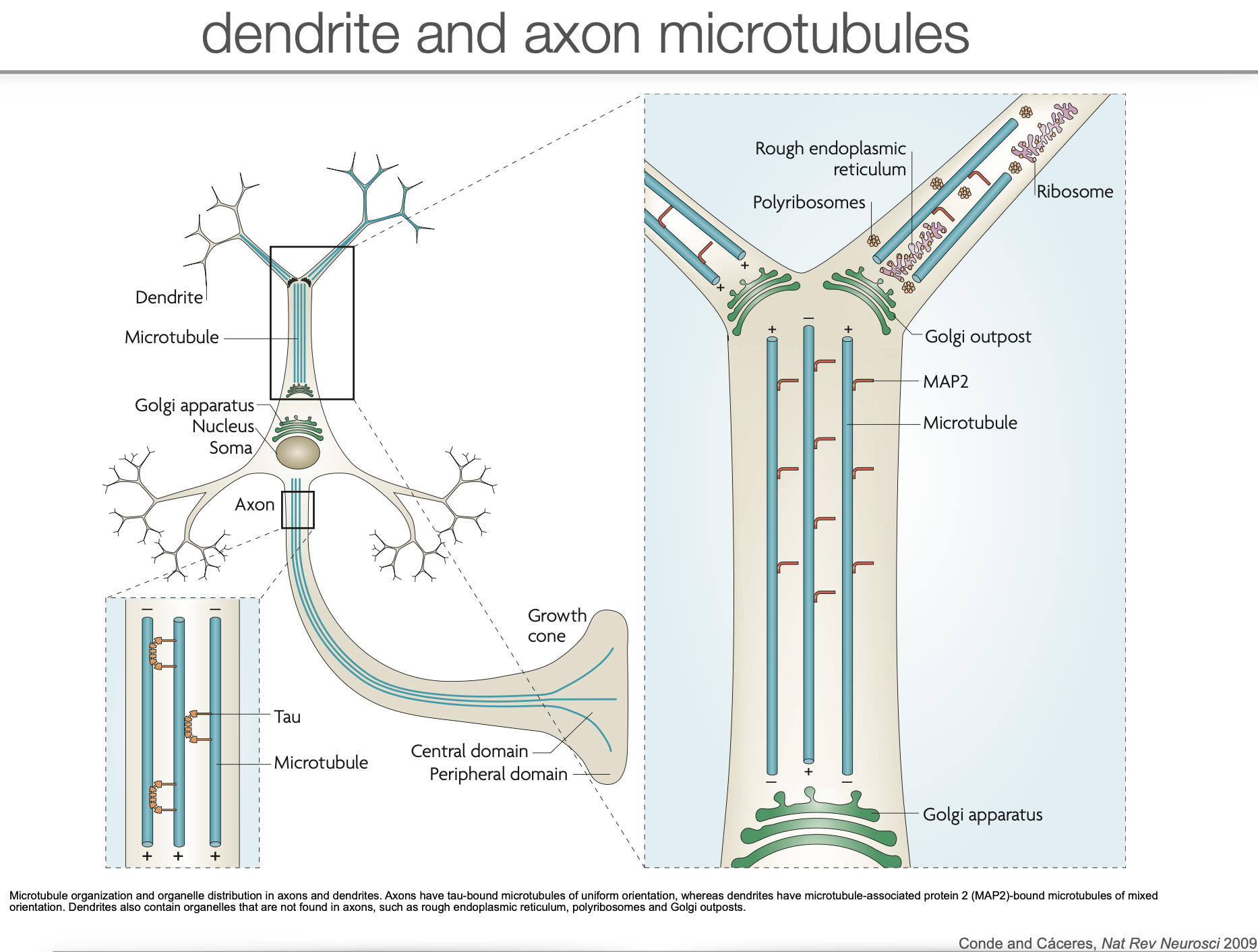
- Function: They provide structural support, facilitate intracellular transport, and are involved in cell division. In neurons, they are crucial for axonal transport, serving as tracks for motor proteins like kinesin and dynein to transport materials along the axon.
-
Microfilaments:
- Structure: Composed of actin monomers, forming thin, flexible fibers with a diameter of about 5 nm.
- Function: They are involved in muscle contraction, cell movement, and maintaining cell shape. Microfilaments also play a role in cellular processes like cytokinesis and the formation of cellular extensions such as filopodia and lamellipodia.
-
Intermediate Filaments:
- Structure: Composed of various fibrous proteins, providing a diameter of about 10 nm.
- Function: They provide mechanical strength to cells, helping them withstand stress. Intermediate filaments are more stable than microtubules and microfilaments and are involved in maintaining cell integrity and shape.
-
Neurofilaments:
- Structure: A type of intermediate filament specific to neurons, composed of three neuron-specific proteins.
- Function: They are crucial for maintaining the structural integrity of neurons, particularly in determining the diameter of axons, which affects nerve conduction velocity. Neurofilaments provide structural support and stability to the neuron’s highly branched architecture.
Together, these cytoskeletal elements form a dynamic network that supports cellular architecture, facilitates intracellular transport, and allows cells to adapt to mechanical stress and environmental changes. In neurons, this network is essential for maintaining the complex shapes and functions necessary for neural communication.
Sources:
see also
Tags: neurobiology science
Superlink: 051 ☣Neurobiology 050 🧠Neuroscience
Microtubules
Microfilaments
Neurofilaments
Source
Created: 12-02-25 18:02