NMDA
NMDA stands for N-methyl-D-aspartate, a specific agonist that binds to a particular class of Glutamate receptors, known as NMDA receptors. These receptors are a type of ionotropic glutamate receptor that plays a crucial role in the central nervous system. Unlike other glutamate-gated ion channels, NMDA receptors are unique because they are both chemically-gated and voltage-gated ion channels. This dual gating mechanism means that NMDA receptors require not only the binding of glutamate (or NMDA) but also a preceding or simultaneous depolarization of the postsynaptic membrane to remove a magnesium block that otherwise prevents ion flow through the receptor.
NMDA Receptors
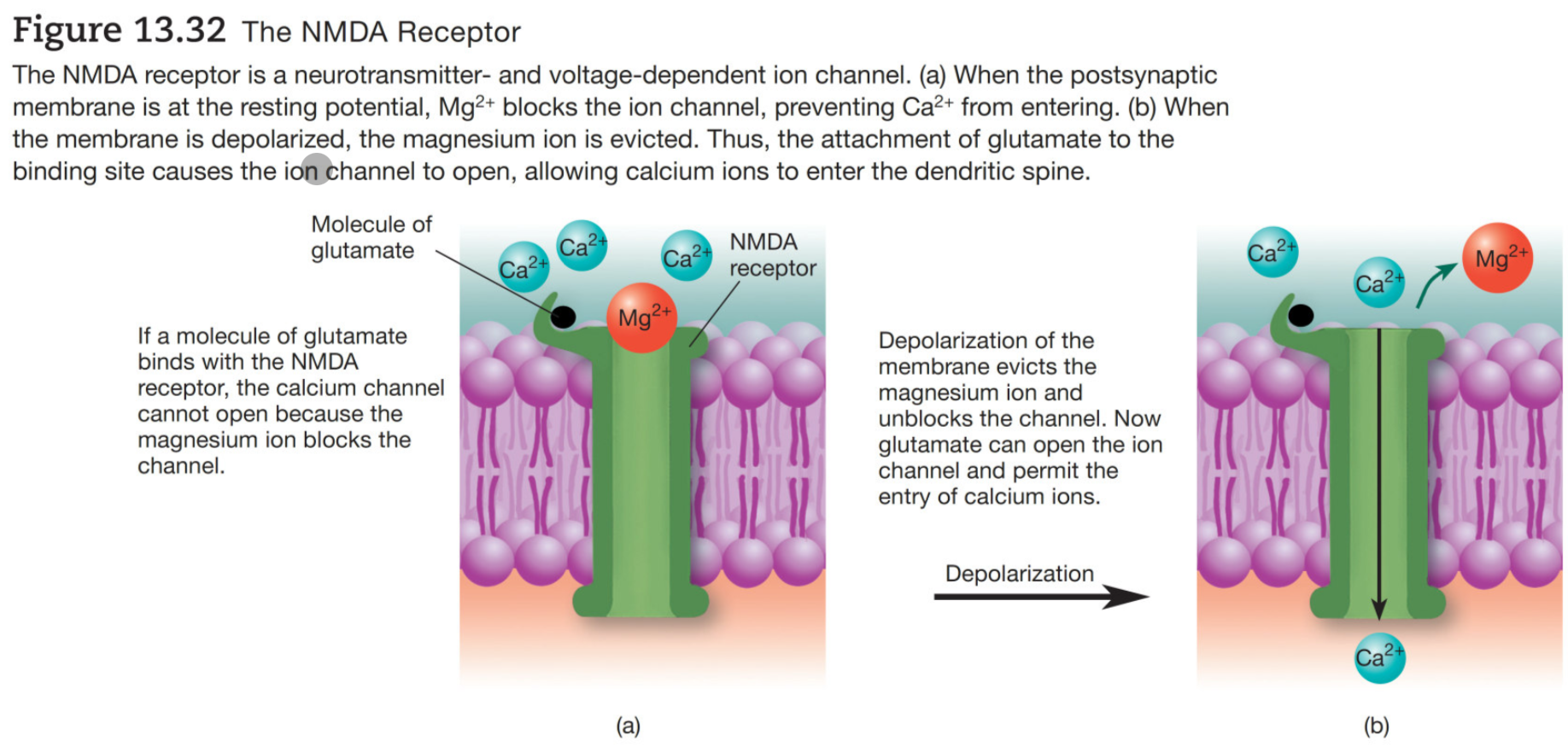
Source: Der NMDA-Rezeptor . Aus Carlson & Birkett(2022), Fig. 13.33, p. 449
Structurally, ionotropic glutamate receptors, including NMDA receptors, deviate slightly from other ionotropic receptors like the nicotinic acetylcholine receptor (nAChR) in their membrane topology. They possess three transmembrane segments connected by a hairpin loop, which is a feature resembling those found in voltage-gated potassium channels.
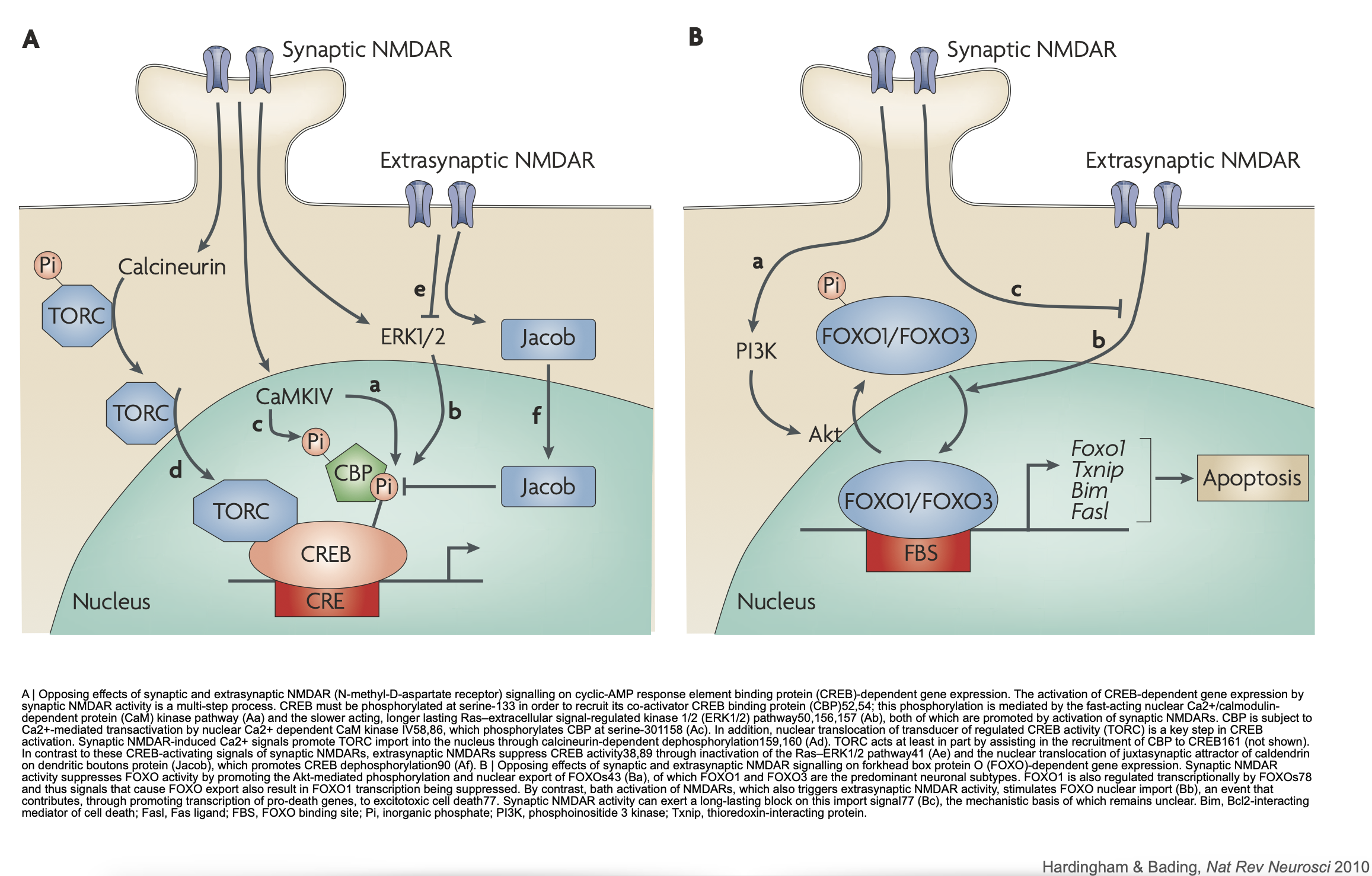
Functionally, NMDA receptors are critically involved in synaptic plasticity, which is the ability of synapses to strengthen or weaken over time, in response to increases or decreases in their activity. This property of NMDA receptors is essential for learning and memory processes. The high permeability of NMDA receptors to calcium (Ca^2+) ions upon activation plays a pivotal role in initiating intracellular signaling cascades that lead to synaptic plasticity. For instance, the influx of calcium through NMDA receptors can trigger a range of postsynaptic activities, including changes in synaptic efficiency observed during learning processes.
In summary, NMDA receptors are critical for the regulation of synaptic transmission and plasticity in the brain, mediating learning and memory formation through their unique requirement for both ligand binding and membrane depolarization to activate, and their high permeability to calcium ions which initiates downstream signaling events essential for these cognitive processes.
LTP in NMDA-Receptors
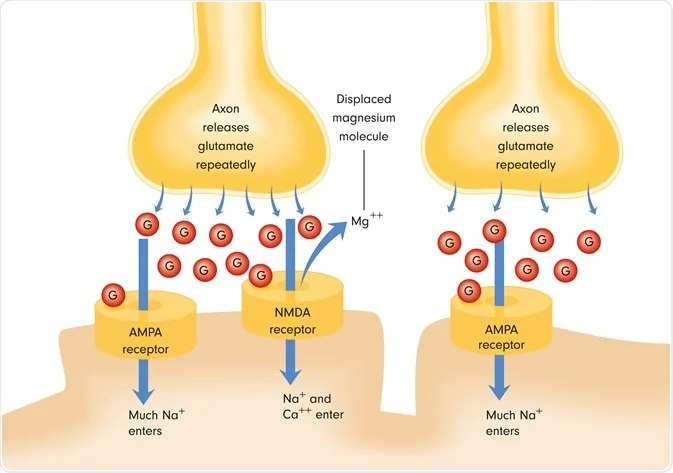
With weak stimulation at the AMPA receptor (no LTP):
- AMPA receptor (ionotropic): fires
- NMDA receptor remains blocked by Mg2+
Opening the NMDA receptor requires two events:
- Glutamate must bind to the receptor and Mg2+ must be removed
(which is facilitated by strongly stimulated AMPA receptor)
NMDA receptor controls calcium channel:
- When Mg2+ is removed → Ca2+ can enter the cell → Depolarization
- The ion channel at the NMDA receptor is thus ligand- and voltage-dependent
How do AMPA receptors elicit opening of the NMDA receptor?
AMPA
#chatbot
The sources explain that AMPA receptors play a crucial role in activating NMDA receptors by providing the necessary depolarization of the postsynaptic membrane. NMDA receptors are both ligand- and voltage-gated, meaning they require both glutamate binding and membrane depolarization to become active.
Here is a detailed mechanism of how AMPA receptors enable the opening of NMDA receptors:
- Glutamate Release: When an action potential reaches the presynaptic cell, the neurotransmitter glutamate is released into the synaptic cleft.
- Activation of AMPA Receptors: Glutamate binds to AMPA receptors, which are ionotropic receptors causing an influx of sodium ions into the postsynaptic cell.
- Membrane Depolarization: The influx of sodium ions leads to depolarization of the postsynaptic membrane. This depolarization is crucial for activating NMDA receptors.
- Removal of Magnesium Block: NMDA receptors have a magnesium ion (Mg2+) block in the ion channel that blocks it at rest. The depolarization caused by AMPA receptors removes this block by displacing the magnesium ion from the channel.
- Activation of NMDA Receptors: After removing the magnesium block, NMDA receptors can be activated when glutamate binds to them, allowing sodium, potassium, and calcium ions to flow through the channel. The calcium ion influx is particularly important for subsequent cellular processes, especially in long-term potentiation (LTP).
- Coincidence Detector: Because NMDA receptors need to be activated by both glutamate (ligand-dependent) and depolarization (voltage-dependent), they act as coincidence detectors that recognize simultaneous presynaptic (glutamate release) and postsynaptic activity (depolarization).
In summary, AMPA receptors initiate the first phase of the postsynaptic response to glutamate by depolarizing the membrane. This depolarization is necessary to remove the magnesium block from NMDA receptors and activate them. The cooperation between AMPA and NMDA receptors is particularly important for synaptic plasticity and learning processes.
Questions
What do NMDA1, 2, 3, and 4 do differently?
see also
Tags: neurobiology science
Superlink: 051 ☣Neurobiology 050 🧠Neuroscience
LTP - long term potentiation
Source
Created: 14-10-24 16:39