Stevens’ experiments
chatbot
Stanley Smith Stevens, an American psychologist, conducted influential research in psychophysics, which led to the development of Stevens’ Power Law. This was a significant advancement over the earlier Weber-Fechner Law. Stevens’ experiments, conducted in the mid-20th century, focused on quantifying the relationship between the intensity of physical stimuli and the perceived magnitude of those stimuli by observers. His work aimed to provide a more accurate description of how sensory systems respond to varying levels of stimulus intensity across different sensory modalities.
Stevens’ Power Law
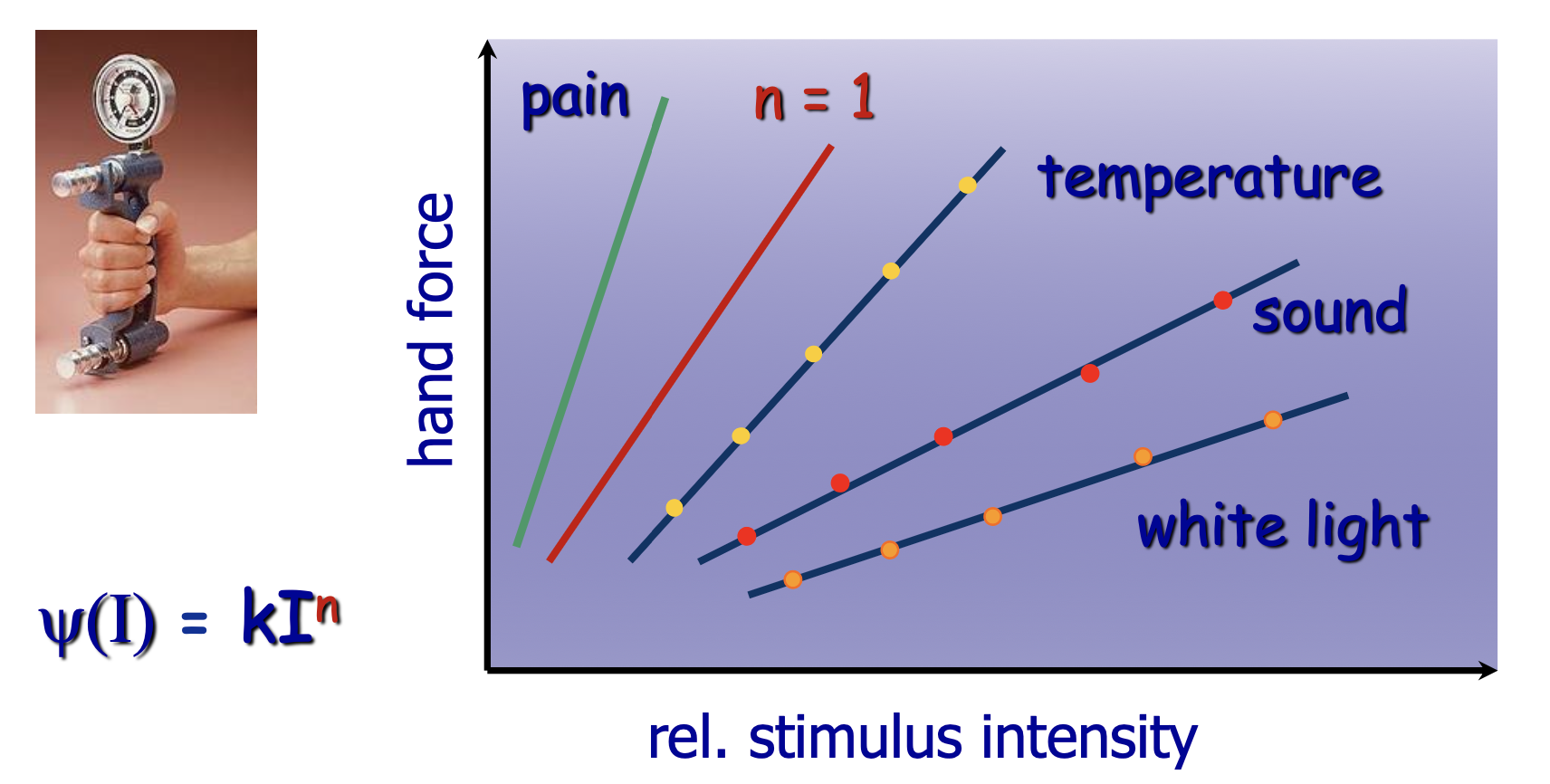
Stevens proposed that the perceived strength (P) of a stimulus is related to its physical intensity (I) by a power function, rather than a logarithmic function as suggested by the Weber-Fechner Law. Stevens’ Power Law can be mathematically represented as:
[ P = kI^n ]
Where:
- (P) is the perceived magnitude of the stimulus,
- (I) is the physical intensity of the stimulus,
- (k) is a constant that varies with the type of stimulus,
- (n) is an exponent that varies with the sensory modality and type of stimulus, indicating how the perception of the stimulus intensity scales with its physical intensity.
Experiments and Findings
Stevens conducted a wide range of experiments across various sensory modalities, including hearing, vision, taste, and touch. He used a method called “magnitude estimation,” where participants were asked to assign numerical values to perceived intensities of stimuli relative to a standard reference stimulus. For example, if a sound was perceived to be twice as loud as a reference sound, it might be assigned a value of 2, and so on. These experiments covered stimuli such as tones of varying loudness, lights of different brightness, and objects of different weights.
One of Stevens’ key findings was that the exponent (n) in his power law varies significantly across different types of stimuli and sensory modalities. For instance, the exponent for electric shock is quite high, indicating a rapid increase in perceived intensity with a small increase in physical intensity. In contrast, the exponent for light intensity is lower, suggesting a more gradual increase in perceived brightness as the physical intensity of light increases.
Impact
Stevens’ Power Law has had a profound impact on the field of psychophysics and our understanding of sensory perception. It suggests that the relationship between the physical world and our subjective experience of it is more complex than previously thought. The law has been applied in various fields, including auditory science, vision research, and ergonomics, to better understand and predict how humans perceive changes in their environment.
While Stevens’ Power Law provides a better fit for many types of sensory data than the Weber-Fechner Law, it’s important to note that no single law perfectly describes all aspects of sensory perception. The choice between using Stevens’ Power Law, the Weber-Fechner Law, or other models often depends on the specific characteristics of the stimulus and the context of the research or application.
How does Stevens’ power law differ from the Weber-Fechner law?
-
Weber-Fechner Law:
- Proposes a logarithmic relationship between stimulus intensity and the subjective experience of its magnitude.
- Suggests that the perceptible increment in stimulus intensity required for detection is proportional to the background intensity of the stimulus.
- Indicates that as stimulus intensity increases, larger changes are needed for the changes to be perceptible.
- Focuses on the lower range of stimulus intensities, where the logarithmic relationship is more apparent.
-
Stevens’ Power Law:
- Proposes a power function relationship between stimulus intensity and the subjective sensation of its magnitude.
- Suggests that the perceived intensity of a stimulus is a power function of its actual physical intensity, with different exponents for different types of stimuli.
- Indicates that the relationship between physical stimulus and perception can vary significantly across different sensory modalities.
- Incorporates a wider range of intensities, including low and high intensity ranges, providing a more comprehensive model for understanding sensory perception.
-
Key Differences:
- Mathematical Relationship: Weber-Fechner law uses a logarithmic model, while Stevens’ power law uses a power function.
- Range of Application: Stevens’ power law is considered more versatile across different intensities and modalities, compared to the more limited scope of the Weber-Fechner law in capturing the nuances of sensory experiences.
- Perceptual Sensitivity: Stevens’ power law accounts for variable sensitivity across different senses and stimuli types, whereas the Weber-Fechner law implies a more uniform sensitivity across the board.
- Interpretation of Sensory Input: Stevens’ power law provides a direct relationship between stimulus intensity and perceived intensity, making it easier to predict subjective experiences across a broader spectrum of sensory inputs.
see also
Tags: neurobiology science
Superlink: 051 ☣Neurobiology 050 🧠Neuroscience
Source
Created: 20-09-24 16:07