Attention Mechanism
The attention mechanism lets every token in a sequence look at every other token and pull in the information it needs. Each token produces a Query, a Key, and a Value (via learned matrices); the attention weight from one token to another is a deterministic function of how well its query matches the other’s key. It is the core of the Transformer (Transformers) — and, in the exam paper, the operation that implements exponential path-merging.
No randomness
Attention does not pick partners by chance. Given the input and the (trained) weights, the whole computation is deterministic — same input → same attention pattern every time. (The random rollouts you may be thinking of belong to Monte Carlo Tree Search, not attention.)
The idea: Query · Key · Value
Each token’s embedding is projected three ways through learned weight matrices W_Q, W_K, W_V:
| Meaning | Question it answers | |
|---|---|---|
| Query Q | what this token is looking for | ”what do I need?” |
| Key K | what this token offers | ”what do I have?” |
| Value V | the content it passes on if attended to | ”what I hand over” |
Q = X · W_Q K = X · W_K V = X · W_V
where X = the matrix of token embeddings (one row per token).
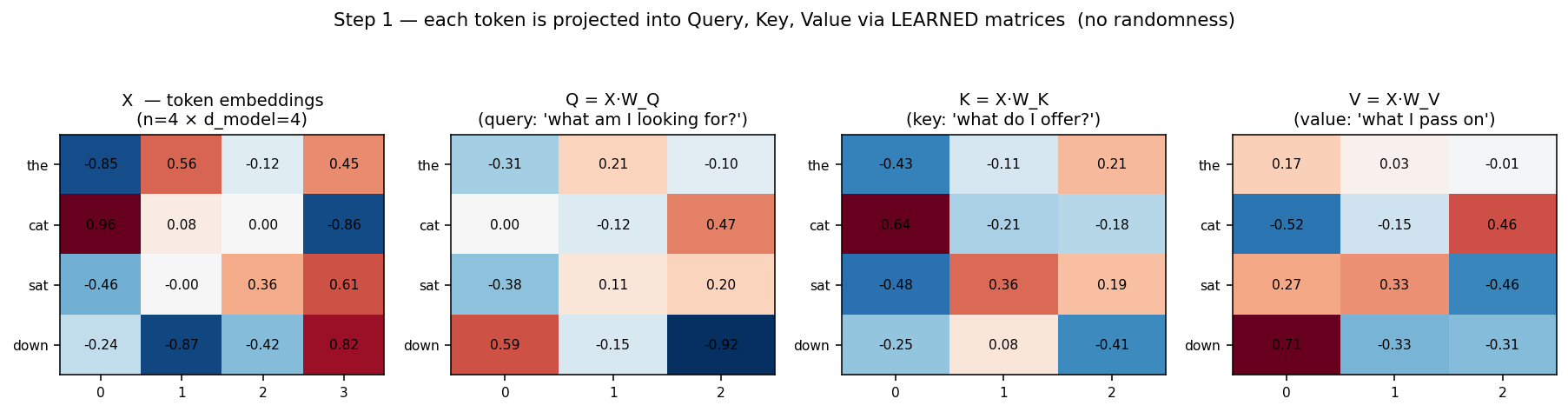
Each of the 4 tokens (“the”, “cat”, “sat”, “down”) becomes a row; multiplying by the learned matrices gives the Q, K, V matrices. The weights are fixed after training — this projection is pure linear algebra, no chance involved.
The formula
Step by step:
- Scores
= Q·Kᵀ— dot product of every query with every key → ann × nmatrix of “match strengths.” - Scale by
1/√d_k— keeps the numbers from blowing up as dimension grows (stops softmax from saturating). - Softmax over each row → the attention weights
A. Each row sums to 1 (a probability distribution over “where this token looks”). - Multiply by V → each token’s output is a weighted blend of all values, weighted by attention.
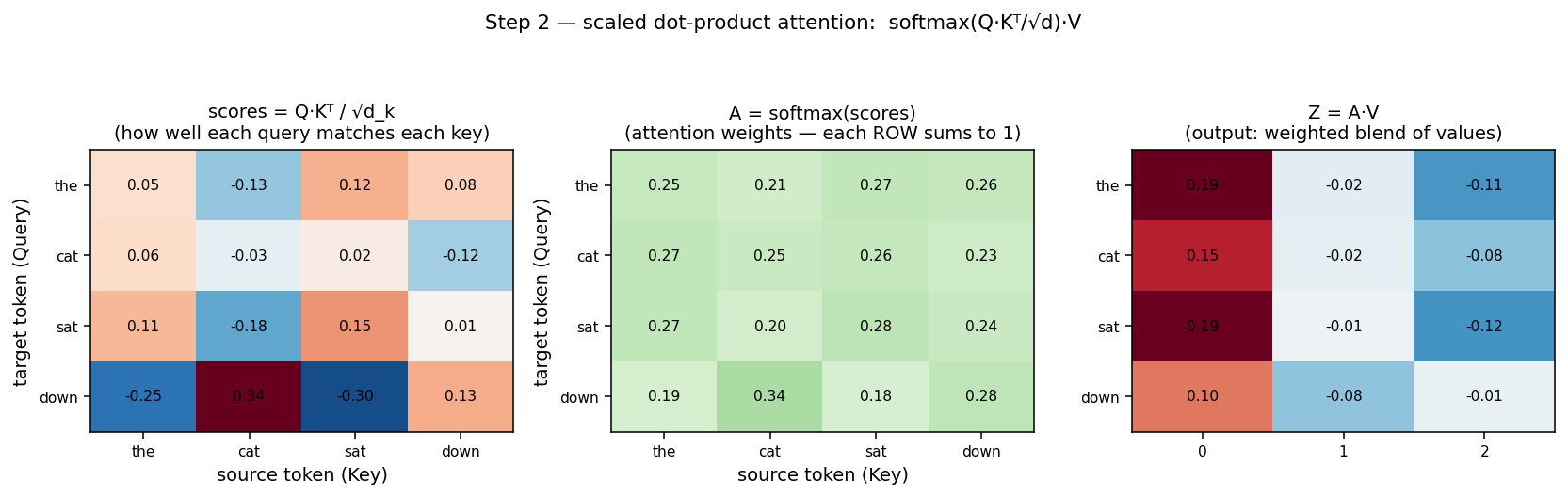
Left: raw match scores
Q·Kᵀ/√d(red = strong match, blue = weak). Middle: after softmax, each row is a distribution summing to 1 — e.g. “down” attends most to “cat” (0.34). Right: the outputZ = A·V, each token now a blend of the values it attended to.
Reading the attention matrix
The n × n matrix A is the heart of it: row i = how token i spreads its attention over all tokens (including itself).
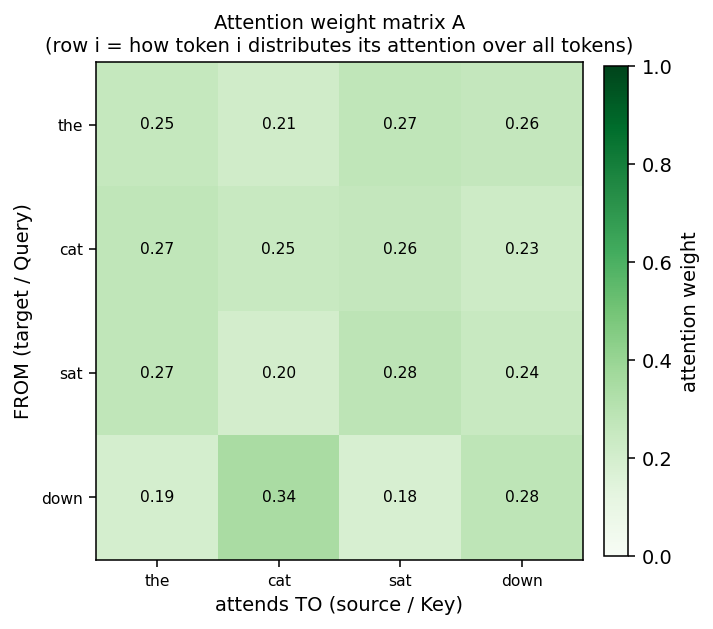
Row = the target (the token doing the querying, “FROM”); column = the source (the token being attended to, “TO”). Bright = strong attention. In the paper’s terms, an attention operation is one bright cell: source token
i→ target tokenj.
(Here the embeddings were random, so attention is near-uniform — in a trained model these rows become sharply peaked on the relevant tokens. See the next example for what “trained” looks like.)
Example 2 — sharp, interpretable attention
The example above was random → near-uniform. A trained model learns Q/K so that each token attends almost entirely to the one token it needs. Here Q, K, V are hand-designed to encode a little syntactic story:
| Token | attends to | (why) |
|---|---|---|
| the → cat | 94.8 % | determiner → its noun |
| cat → sat | 94.8 % | subject → its verb |
| sat → cat | 94.8 % | verb → its subject |
| down → sat | 94.8 % | adverb → its verb |
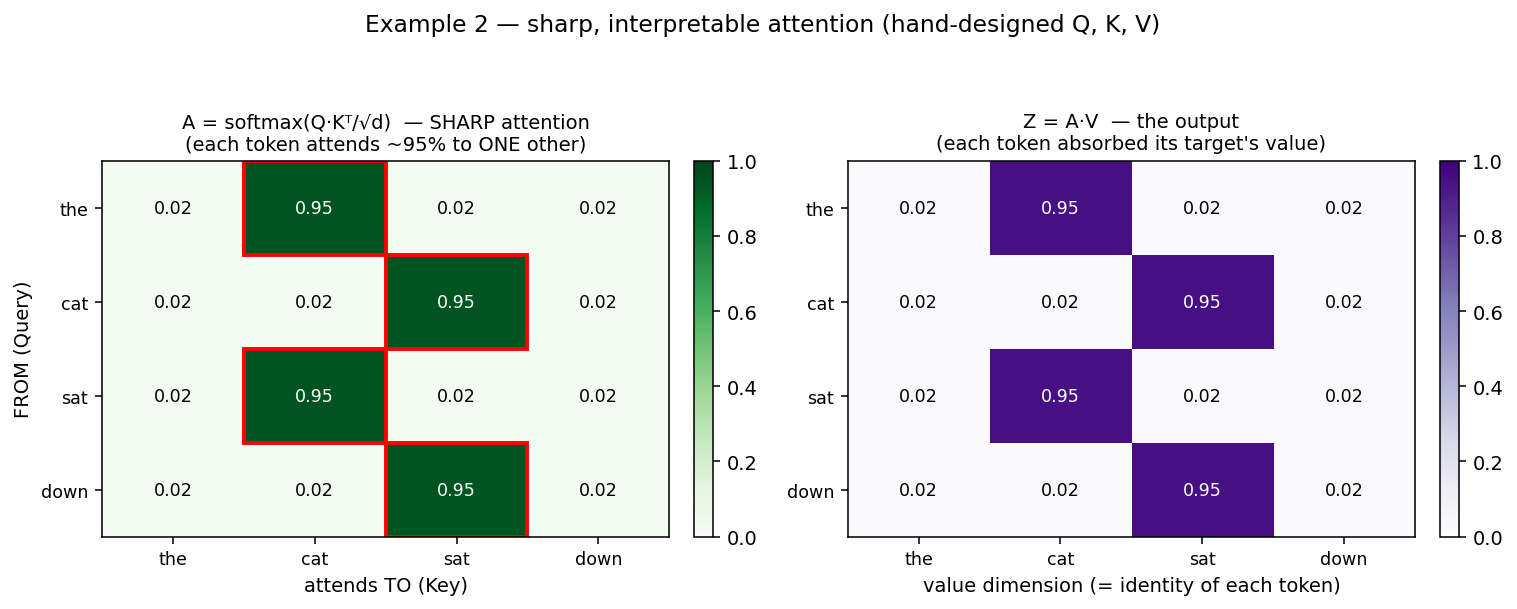
Left (A): each row is now sharply peaked — ~95 % of the attention goes to one token (red boxes = the learned dependency), only ~1.7 % leaks to each other token. Right (Z = A·V): since each token’s value was set to its own identity, the output shows each token has absorbed the value of the token it attended to — e.g. “the” ‘s output row is ~95 % the cat dimension. That’s the whole point of attention: information flows from the attended token into the attending one.
How it’s engineered (so you can see there’s no magic): make each token’s Key a distinct strong direction (K = 8·I), and each token’s Query point exactly at its target’s key direction. Then Q·Kᵀ is large only at the target → softmax concentrates there. A real model learns W_Q/W_K to do this.
targets = {0:1, 1:2, 2:1, 3:2}        # the->cat, cat->sat, sat->cat, down->sat
K = 8 * np.eye(4)                      # distinct, strong keys  -> sharp softmax
Q = np.zeros((4,4))
for i,t in targets.items(): Q[i,t] = 1 # each query points at its target's key
V = np.eye(4)                          # value = identity, so output shows what was absorbed
A = softmax(Q @ K.T / np.sqrt(4))      # -> 94.8% on the target, 1.7% elsewhere
The contrast in one glance
Random weights → flat attention (~0.25 everywhere, useless). Trained/structured weights → peaked attention (~0.95 on the right token). Learning attention is learning to make the right Q·K dot products large. In the paper, “learning to search” = learning W_Q/W_K so a vertex’s query matches the key of the right frontier vertex.
The runnable core (Python)
import numpy as np
def softmax(z):
    e = np.exp(z - z.max(axis=1, keepdims=True))
    return e / e.sum(axis=1, keepdims=True)

X   = np.random.uniform(-1, 1, (4, 4))     # 4 tokens, d_model = 4
W_Q = np.random.uniform(-1, 1, (4, 3))     # project to d_k = 3
W_K = np.random.uniform(-1, 1, (4, 3))
W_V = np.random.uniform(-1, 1, (4, 3))

Q, K, V = X @ W_Q, X @ W_K, X @ W_V
scores  = Q @ K.T / np.sqrt(3)             # n x n match scores
A       = softmax(scores)                  # attention weights, rows sum to 1
Z       = A @ V                            # output: n x d_k
assert np.allclose(A.sum(axis=1), 1)       # every row is a distribution
Matrix shapes (the bit that’s easy to lose)
For n tokens, model dim d_model, projected dim d_k:
| Object | Shape |
|---|---|
X (embeddings) | n × d_model |
W_Q, W_K, W_V | d_model × d_k |
Q, K, V | n × d_k |
scores = Q·Kᵀ | n × n |
A = softmax(scores) | n × n |
output Z = A·V | n × d_k |
⚠️ The n × n score matrix is why attention is O(n²) in sequence length — the well-known cost that motivates long-context tricks.
Multi-head attention (one line)
Instead of one attention, run h of them in parallel with separate W_Q/W_K/W_V (“heads”), then concatenate. Each head can specialise on a different relation (syntax, position, coreference…). The paper’s models use 1 head per layer deliberately, to make the circuit easy to reverse-engineer.
Connection to the exam paper — attention as path-merging
In Saparov et al., each vertex token stores the set of vertices reachable from it, and one attention operation per layer performs a path-merge:
- Q of vertex
j: “give me the reachable set of a vertex I can reach.” - K of vertex
i: “I am vertex v.” - High
Q·K→jattends toi→ copiesi’s reachable set (the V) into its own.
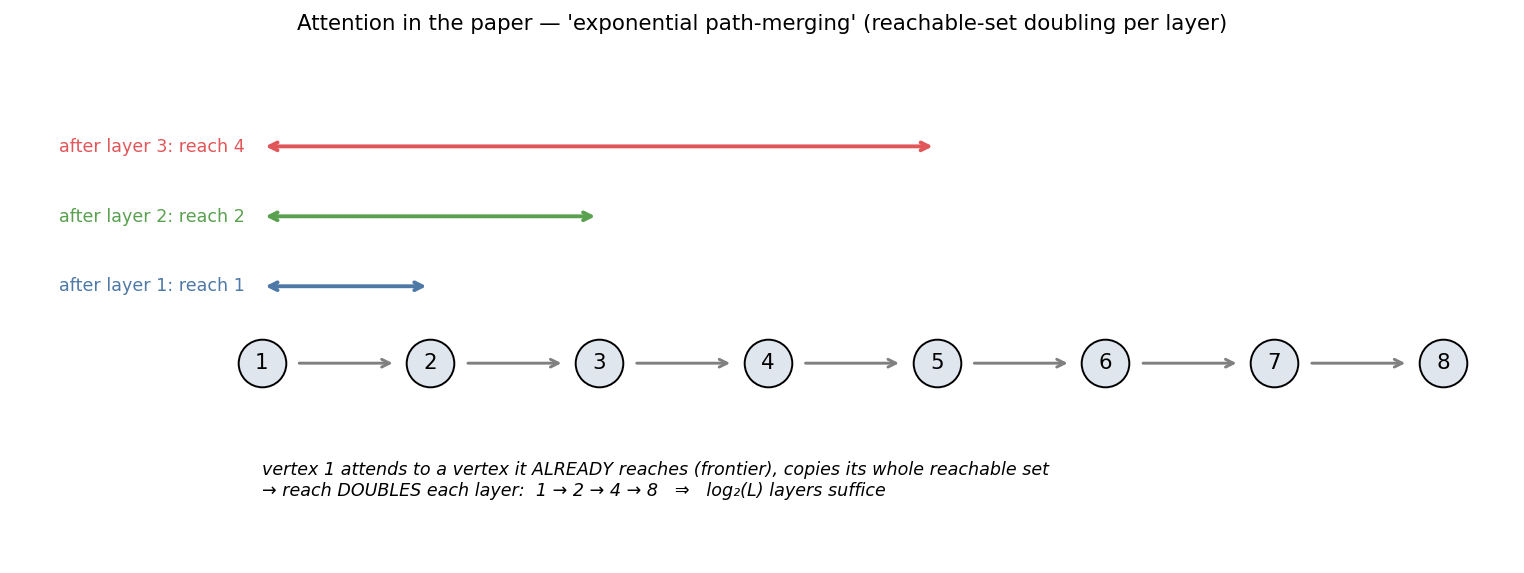
Layer 1: a vertex matches along direct edges (finds its children). Deeper layers: it matches along reachability — it attends to a vertex it already reaches (possibly far away) and absorbs that vertex’s whole reachable set. So the reach doubles per layer (1→2→4→8) instead of growing by 1 → only log₂(L) layers are needed. (This edge-vs-reachability distinction is exactly why it’s log-depth, not linear.)
One-liner for the oral
“Attention: each token makes a Query, Key, Value via learned matrices; the weight from token j to token i is softmax(Qⱼ·Kᵢ/√d) — deterministic, not random. In the paper, a vertex’s query matches the key of a frontier vertex it already reaches, copying that vertex’s reachable set (the value) — and because it merges with far vertices, the reach doubles per layer, giving log-depth path-merging.”
See also
- Transformers · exponential path-merging · Selection-Inference · Monte Carlo Tree Search
- pruefung_paper-transformers-search_25-05-26 (exam dossier — §4 path-merging, §3 mechanistic method)
- Neural Networks & Deep Learning
- Superlink: Methods of AI Lecture
Created: 01/06/26