The hidden Mind and Blindsight
The Visual cortex communicates through the dorsal and the ventral pathway with other structures.
The Temporal lobe defines the object and its shape. The Parietal lobe defines ones position and angle towards that object.
10% of our visual information travels so Layer 1 and is processed even when we are not able to see (e.g. due to a damage to the visual cortex)
about 10 percent of these signals reach a subcortical structure called the superior colliculus (SC). Signals from the SC are then sent to structures in the how pathway, which serve normal motion perception.
(p. 73)
So even blind people are able to detect light flashes in an area of blindsight.
People suffering of visual neglect (capable of visual sight but not detecting things on one side of the field of vision. But testing them, they can differentiate a spider from a ring in the ignored part of the field of vision.
So it’s always a matter of attention. We are seeing the objects, but our brain ignores them for the sake of current attention. Is the threat outside our attention big enough, we switch our attention towards the new threat.
- This is called preattentive processing. It scans the environment subconsciously before attention is assigned.
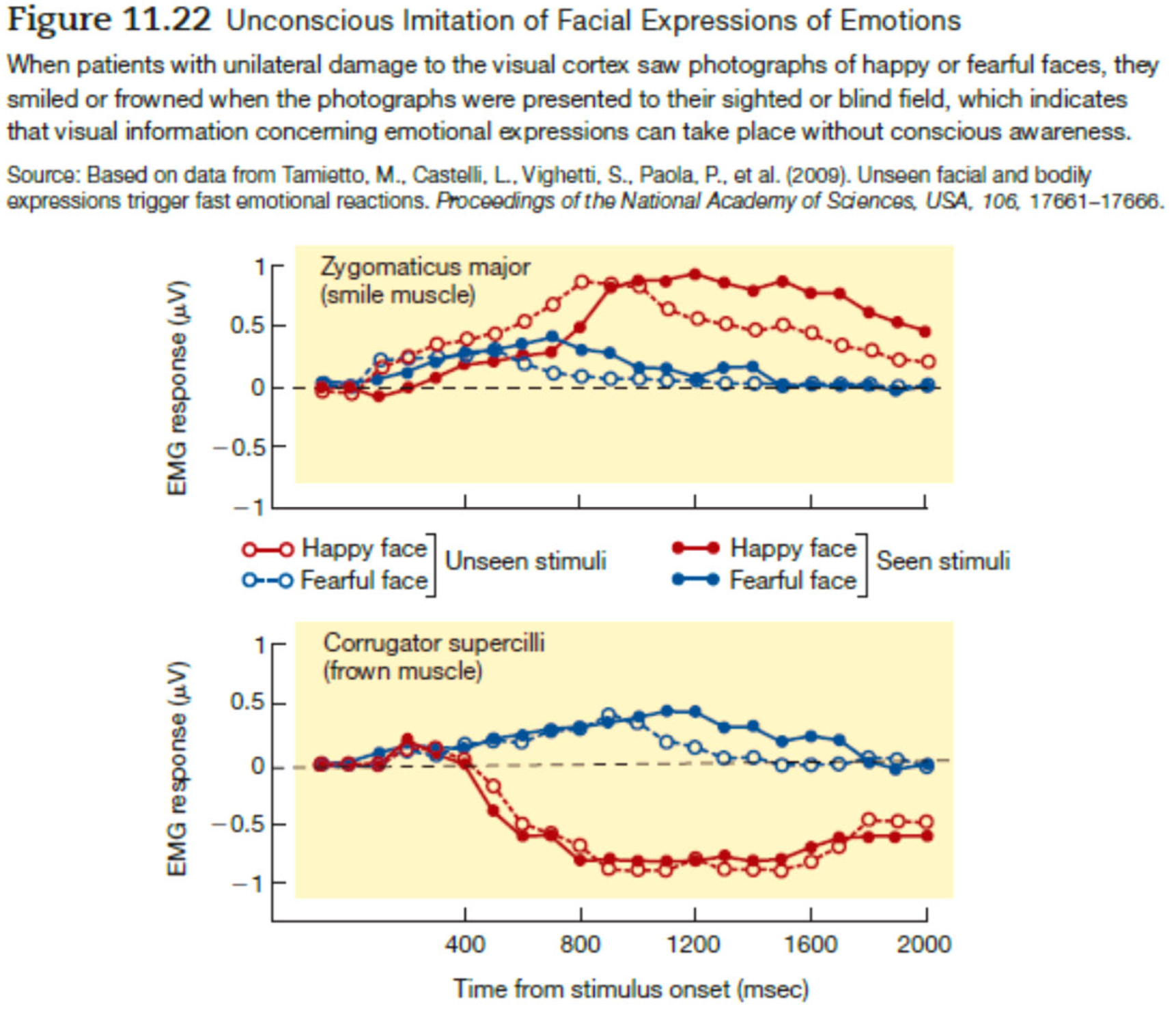
Source: Carlson & Birkett (2022). Fig.11.22, p. 361
see also
Tags: neuroscience science
Superlink: 050 🧠Neuroscience
Quellen
Erstellt: 05-05-22 19:05