Microfilaments
Microfilaments, also known as actin filaments, are one of the three main components of the cytoskeleton in eukaryotic cells. They play a crucial role in various cellular processes, including maintaining cell shape, enabling cell movement, and facilitating muscle contraction. Here’s a detailed overview of microfilaments:
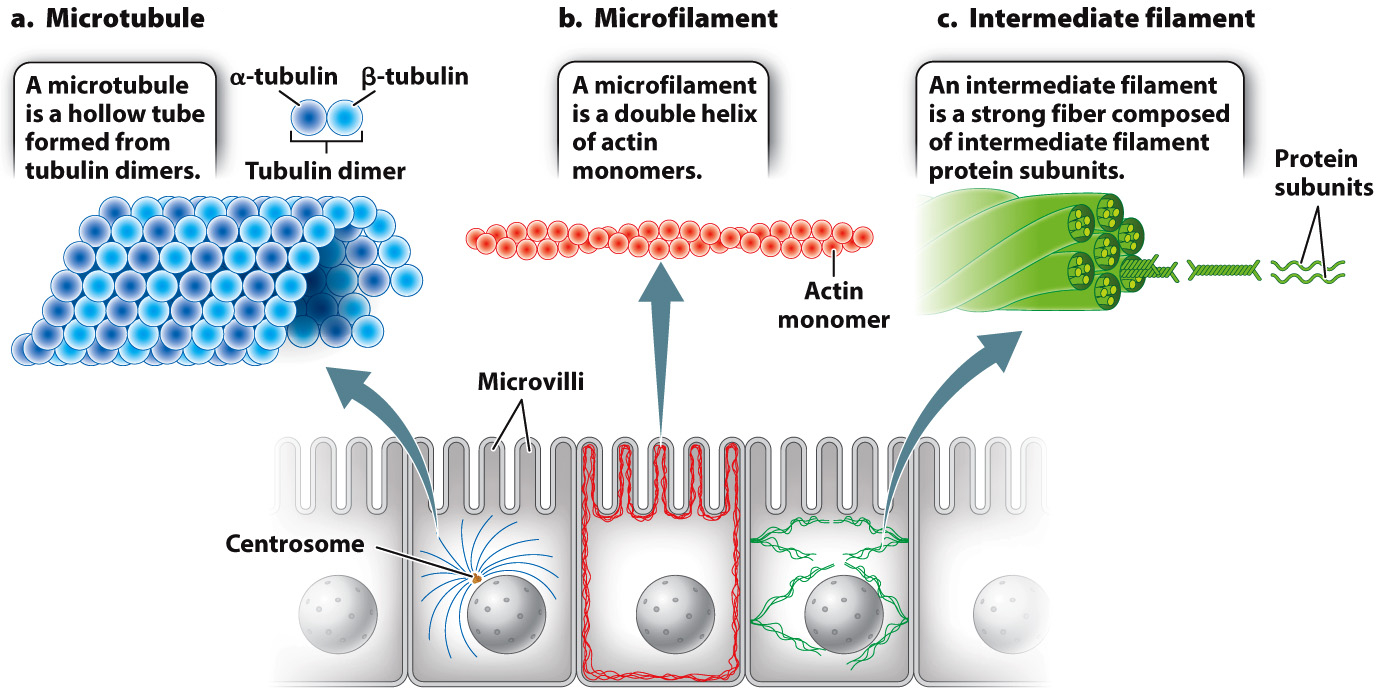
Structure
- Composition: Microfilaments are composed of globular actin monomers (G-actin) that polymerize to form long, thin, and flexible helical filaments known as filamentous actin (F-actin).
- Diameter: They have a diameter of approximately 5 nm, making them the smallest of the cytoskeletal elements.
- Polarity: Microfilaments have inherent polarity with a plus (+) end and a minus (-) end, which is crucial for their dynamic assembly and disassembly.
Function
- Cell Shape and Structure: Microfilaments provide structural support to the cell, helping maintain its shape and integrity. They form a dense network beneath the plasma membrane, contributing to the cell’s mechanical strength.
- Cell Movement: They are involved in various forms of cell movement, including amoeboid movement, cell crawling, and the extension of pseudopodia. Actin polymerization at the leading edge of the cell is essential for these processes.
- Muscle Contraction: In muscle cells, microfilaments are a major component of the thin filaments. They interact with myosin, a motor protein, to facilitate muscle contraction through the sliding filament model.
- Cytokinesis: During cell division, microfilaments form a contractile ring that helps in the division of the cytoplasm, leading to the formation of two daughter cells.
- Intracellular Transport: Microfilaments are involved in the transport of organelles and vesicles within the cell, often in conjunction with motor proteins like myosin.
Regulation
- Associated Proteins: Microfilaments interact with various proteins that regulate their assembly, stability, and function. These include tropomyosin, which stabilizes actin filaments, and the troponin complex, which regulates muscle contraction.
- Dynamic Instability: Microfilaments are highly dynamic, constantly undergoing polymerization and depolymerization. This dynamic nature allows cells to rapidly reorganize their cytoskeleton in response to internal and external signals.
Comparison with Other Cytoskeletal Elements
- Microtubules: Larger in diameter (approximately 20 nm) and composed of tubulin, microtubules are primarily involved in intracellular transport and maintaining cell shape.
- Neurofilaments: Intermediate in size (approximately 10 nm in diameter), neurofilaments provide structural support specifically in neurons.
Microfilaments, through their versatile roles and dynamic properties, are essential for numerous cellular functions, from maintaining cell structure to enabling movement and division. Their interactions with other cytoskeletal elements and regulatory proteins ensure that cells can adapt to various physiological demands.
Sources:
- Actin
- Neurofilaments
- Microtubules
- Myosin
- Intro to Neurobiology Deck
- Tropomyosin
- Intro to Neurobiology
see also
Tags: neurobiology science
Superlink: 051 ☣Neurobiology 050 🧠Neuroscience
Cytoskeletons
Source
Created: 12-02-25 17:53