PCR
Great! With your background in cognitive science and strong foundation in neurobiology, this review will take a deep dive into the workings of PCR (Polymerase Chain Reaction), not only from a molecular biology standpoint but also highlighting connections and relevance to neuroscience research. Let’s break it down into both the molecular mechanicsand the scientific context in which PCR operates.
🧬 What is PCR?
PCR (Polymerase Chain Reaction) is a laboratory technique used to amplify specific DNA sequences. It enables the generation of millions to billions of copies of a particular DNA region from a minuscule initial sample, all within a few hours.
Think of PCR as a kind of molecular photocopier, but highly specific—it amplifies only the sequences you are interested in, based on the design of primers.
Developed by Kary Mullis in 1983, PCR fundamentally transformed molecular biology, allowing DNA analysis from small tissue samples, single cells, or even degraded material (like ancient bones or forensic samples).
🧠 Why Should a Cognitive Scientist Care About PCR?
In neuroscience and cognitive science, PCR is used to:
-
Quantify gene expression in specific brain areas (e.g., BDNF, dopamine receptors).
-
Detect genetic mutations associated with neurodegenerative or psychiatric diseases.
-
Track neurodevelopmental gene dynamics across time or conditions.
-
Investigate neuroplasticity-related genes under different experimental conditions.
-
Perform single-cell PCR for precise transcriptomics at the neuron level.
🔬 The Molecular Steps of PCR
PCR is based on three key principles:
-
Denaturation of DNA strands.
-
Annealing of primers to the template.
-
Extension of new strands using DNA polymerase.
These steps are repeated in cycles (typically 25–40), leading to exponential amplification.
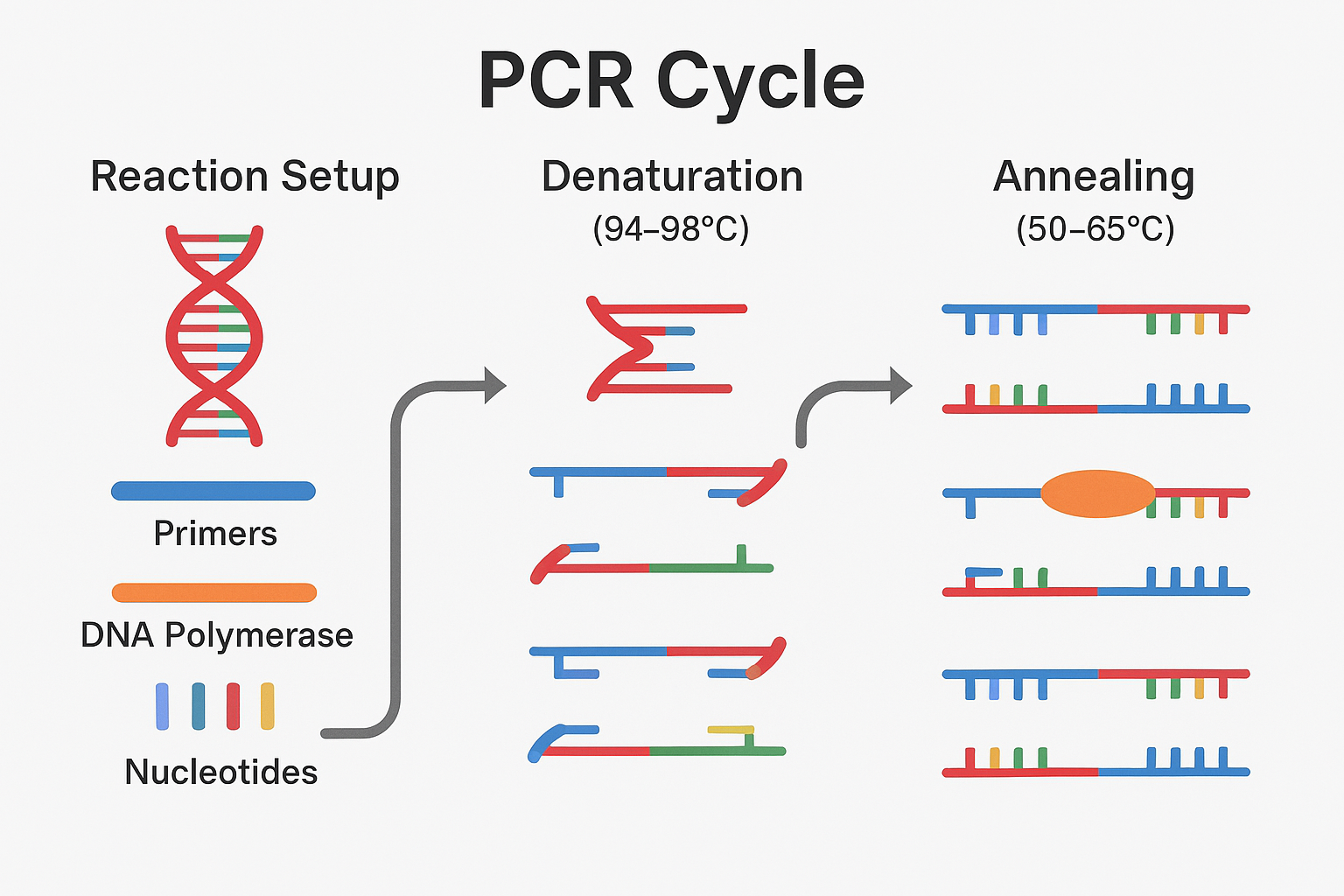
📘 Detailed Step-by-Step Mechanism
1. Reaction Setup
You need the following in a PCR tube:
| Component | Role |
|---|---|
| Template DNA | Contains the sequence you want to amplify |
| Primers (forward & reverse) | Short single-stranded DNA oligonucleotides (usually 18–25 bases) that flank the region of interest |
| DNA Polymerase | Thermostable enzyme (e.g., Taq polymerase) that synthesizes new DNA strands |
| dNTPs | Free nucleotides (A, T, G, C) to build new DNA |
| Buffer | Maintains pH and ionic strength |
| MgCl₂ | Essential cofactor for polymerase activity |
2. The Thermocycling Process
Each cycle involves three stages:
🔁 Step 1: Denaturation (94–98°C)
-
The double-stranded DNA melts into two single strands.
-
This breaks the hydrogen bonds between complementary bases.
🧲 Step 2: Annealing (50–65°C)
-
The primers bind (anneal) to their complementary sequences on the single-stranded template DNA.
-
The temperature depends on primer sequence and GC content.
🧬 Step 3: Extension (72°C)
-
DNA polymerase attaches to the primer-template complex.
-
It begins adding nucleotides to the 3’ end of each primer, synthesizing a complementary strand.
Each cycle doubles the number of DNA copies. After n cycles, you theoretically have ~2ⁿ copies of your target region.
🧠 The Power of Exponential Amplification
| Cycle Number | DNA Copies |
|---|---|
| 1 | 2 |
| 10 | ~1,000 |
| 20 | ~1 million |
| 30 | ~1 billion |
After 30–40 cycles, even a single molecule of DNA can be amplified into a detectable amount.
🔍 Variants of PCR Relevant to Neurobiology
1. RT-PCR (Reverse Transcription PCR)
-
Converts RNA to cDNA via reverse transcriptase.
-
Amplifies cDNA to measure gene expression.
-
Used extensively to study mRNA levels of neuronal genes (e.g., synaptophysin, CREB).
2. qPCR (Quantitative PCR)
-
Measures DNA amplification in real-time using fluorescence.
-
Allows quantification of gene expression or DNA copy number.
-
Ideal for comparing gene expression between brain regions, treatment groups, or developmental stages.
3. Multiplex PCR
-
Amplifies multiple targets in one reaction.
-
Useful for screening several neural genes simultaneously.
4. Digital PCR
-
Highly sensitive method that quantifies DNA without the need for reference standards.
-
Detects rare mutations or low-abundance transcripts, e.g., in microglia or rare neuron types.
🧠 Practical Use Cases in Cognitive Science & Neuroscience
🧠 Gene Expression in Memory Formation
- Investigating BDNF, Arc, or Egr1 expression in the hippocampus during learning tasks.
🧠 Parkinson’s or Alzheimer’s Research
-
Quantifying the expression of dopaminergic or cholinergic genes.
-
Detecting mitochondrial DNA deletions in brain samples.
🧠 Psychiatric Genomics
- Testing for polymorphisms or expression differences in serotonin transporter genes (5-HTTLPR).
🧠 Developmental Cognitive Neuroscience
- Studying the timeline of gene expression during critical periods of brain plasticity.
🧬 Limitations and Considerations
| Limitation | Description |
|---|---|
| Primer specificity | Off-target amplification can lead to false results. |
| Contamination | Extremely sensitive—trace DNA contamination can lead to artifacts. |
| Semi-quantitative | Standard PCR is not precise for quantification—use qPCR for that. |
| Amplification bias | GC-rich or structurally complex regions may amplify poorly. |
🧠 Final Thoughts
PCR is a cornerstone technique that connects molecular biology with systems neuroscience. It allows cognitive scientists to zoom in on the genomic underpinnings of neural activity, plasticity, and disease. Whether you’re studying the expression of immediate-early genes in learning or identifying transcriptomic shifts in psychiatric disorders, PCR is your molecular scalpel—precise, powerful, and versatile.
Would you like me to create a diagram of the PCR cycle or a flowchart showing how PCR fits into a neuroscience experiment? Or maybe a comparison between RT-PCR and RNA-Seq for transcriptome analysis?
see also
Tags: neurobiology science
Superlink: 051 ☣Neurobiology 050 🧠Neuroscience
Source
Created: 03-04-25 14:07