Human ear
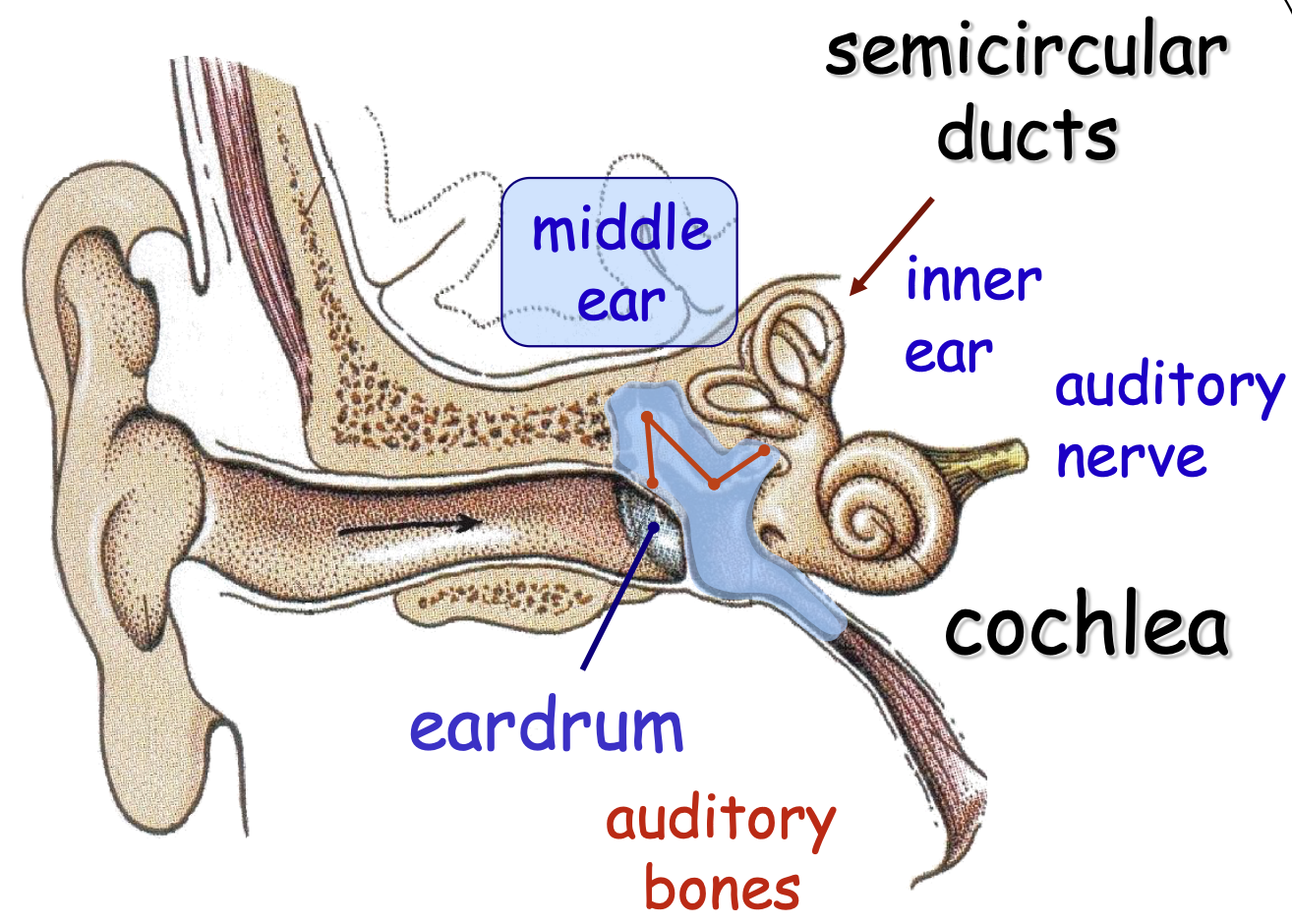
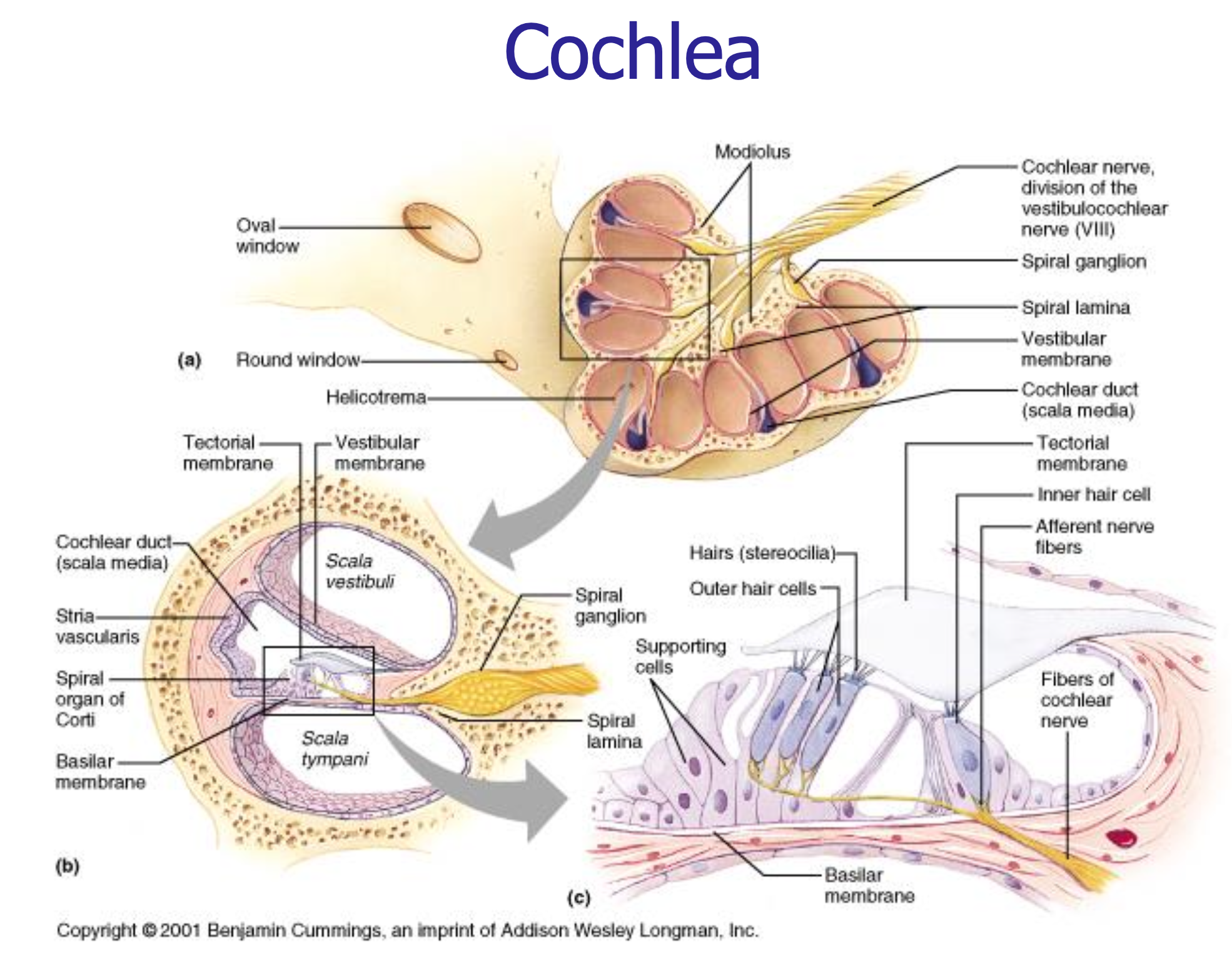
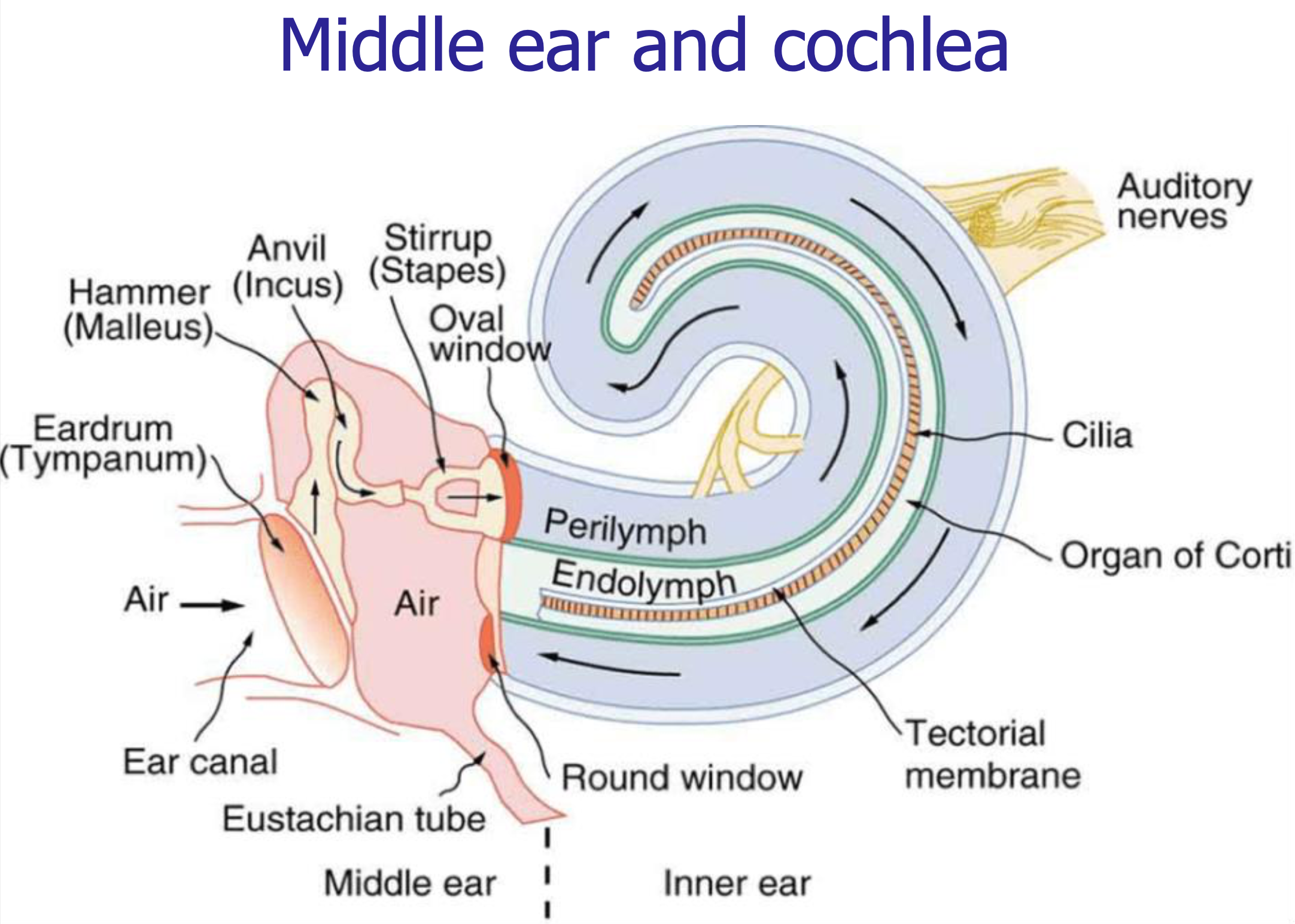
function of external ear in sound collection
-
Collects sound waves: The external ear acts as a funnel that gathers sound waves from the environment.
-
Directs sound to the eardrum: It channels these sound waves efficiently towards the eardrum (tympanic membrane).
-
Amplifies certain frequencies: The shape and structure of the external ear selectively amplify sounds within a specific frequency range, enhancing hearing sensitivity for those frequencies.
-
Directional selectivity: It provides a degree of directional hearing, helping to determine the origin of sounds, which is crucial for spatial orientation and identifying sound sources.
In inner Ear
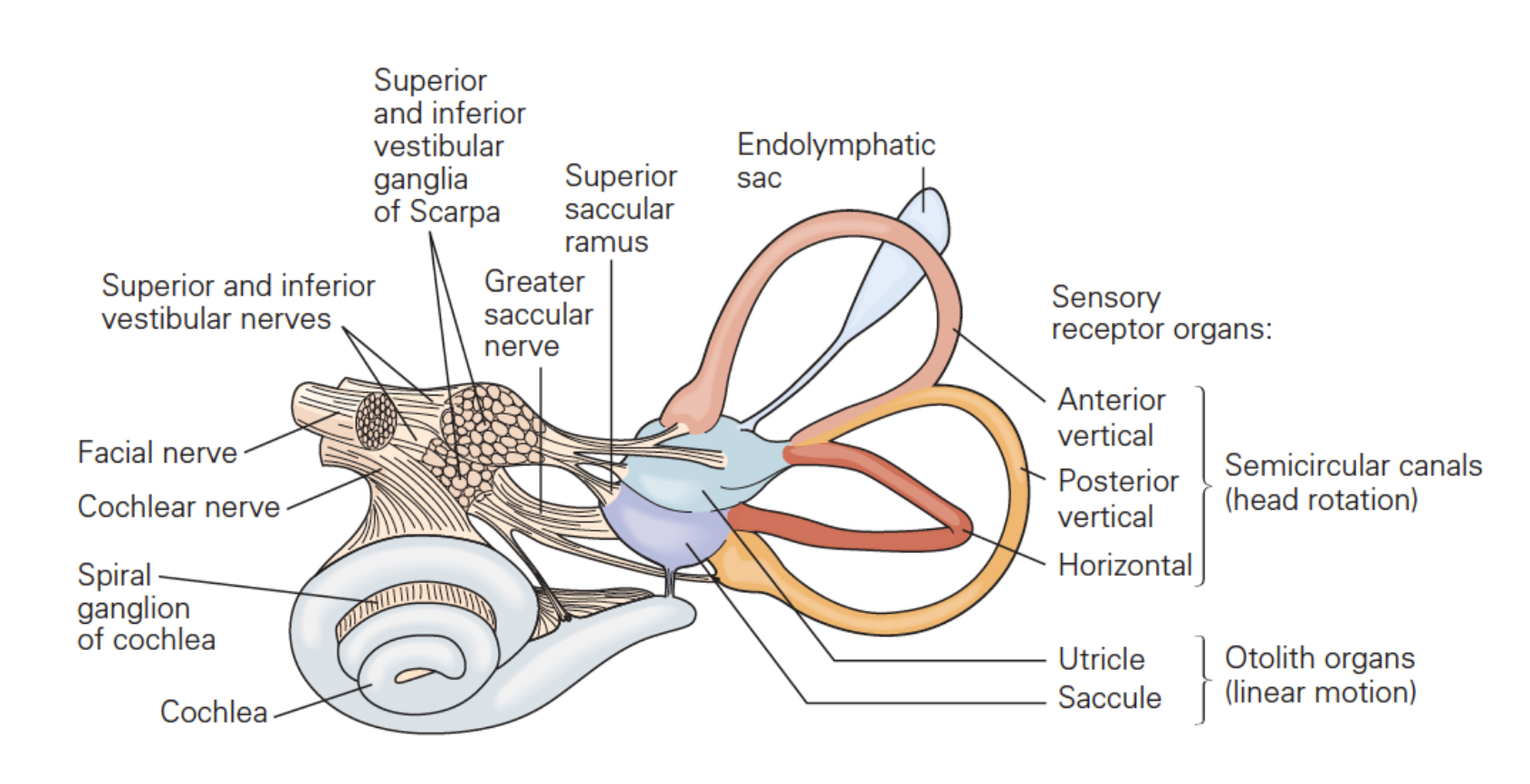
sensory organs in the vestibulum
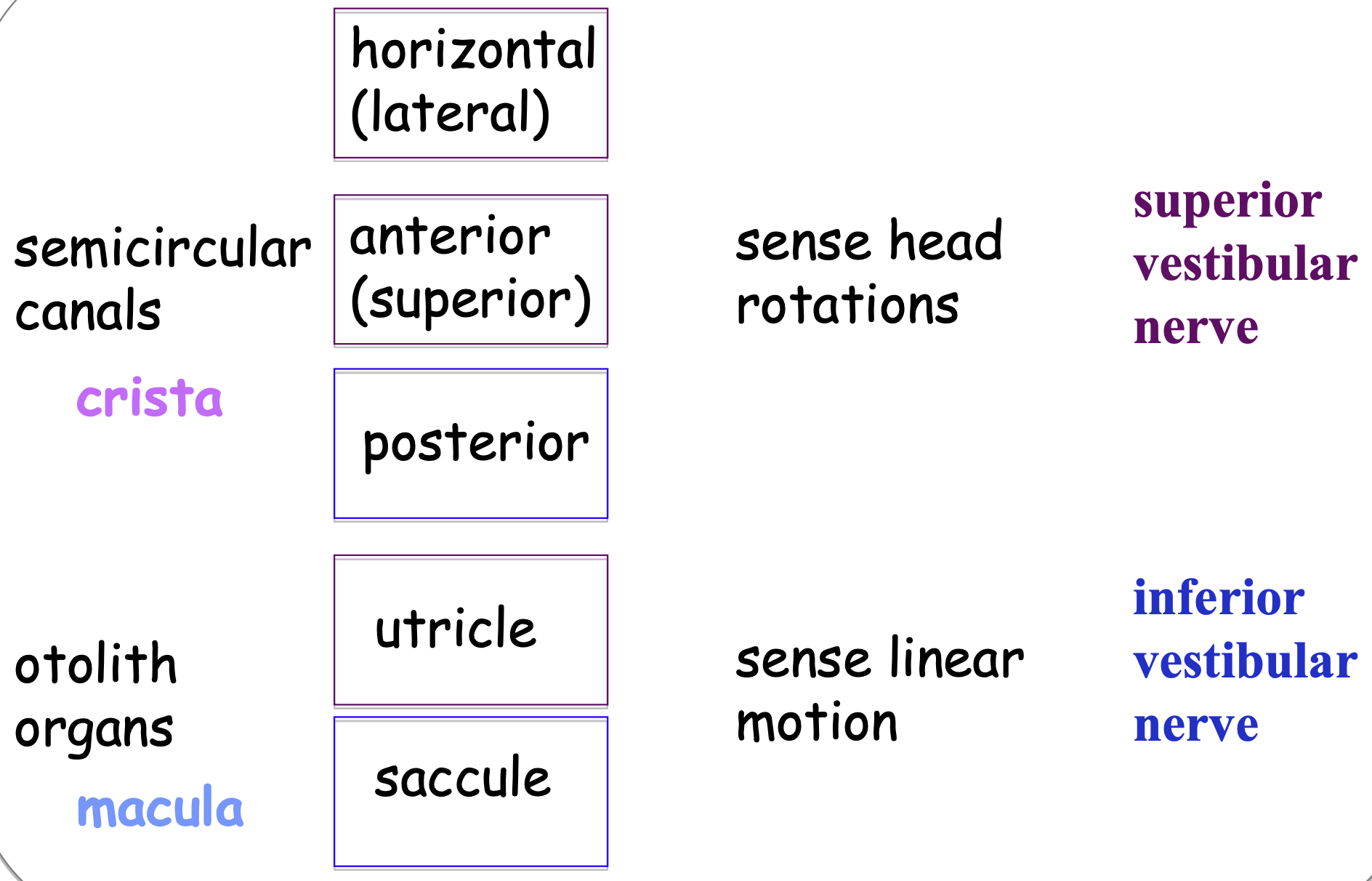
Semicircular ducts
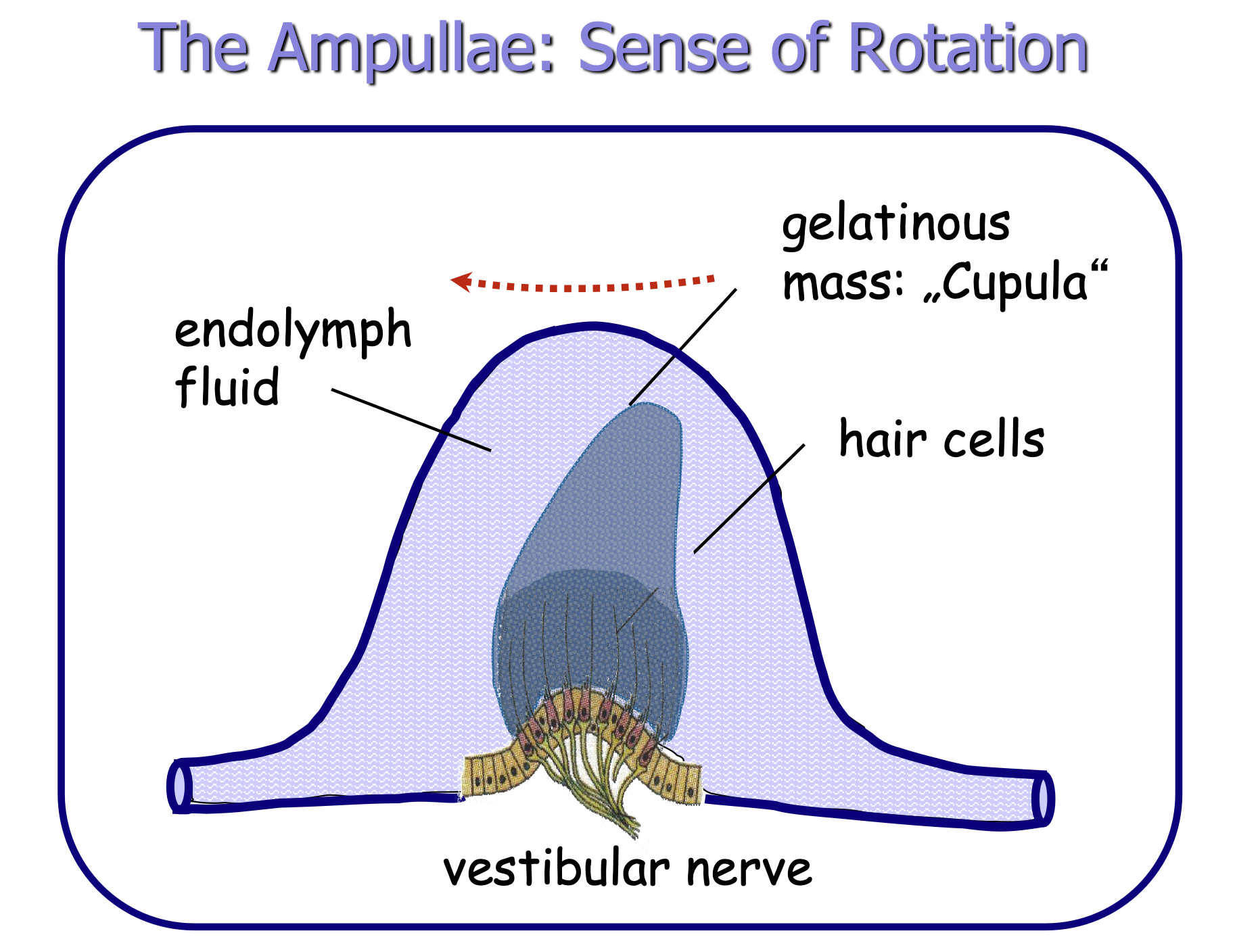
- Semicircular ducts: Three tubes filled with endolymph fluid, arranged perpendicular to each other in the inner ear.
- Function: They harbor the sense of rotation, detecting head movements and rotational acceleration.
- Ampulla: Each duct widens into an ampulla at its base, containing a patch of sensory cells.
- Cupula: Sensory cells’ hairs extend into a gelatinous mass called the cupula, which acts like a swinging door into the endolymph fluid.
- Mechanism of action: When the head rotates, the cupula tilts against the stationary endolymph fluid due to physical inertia, causing deflection of the hairs.
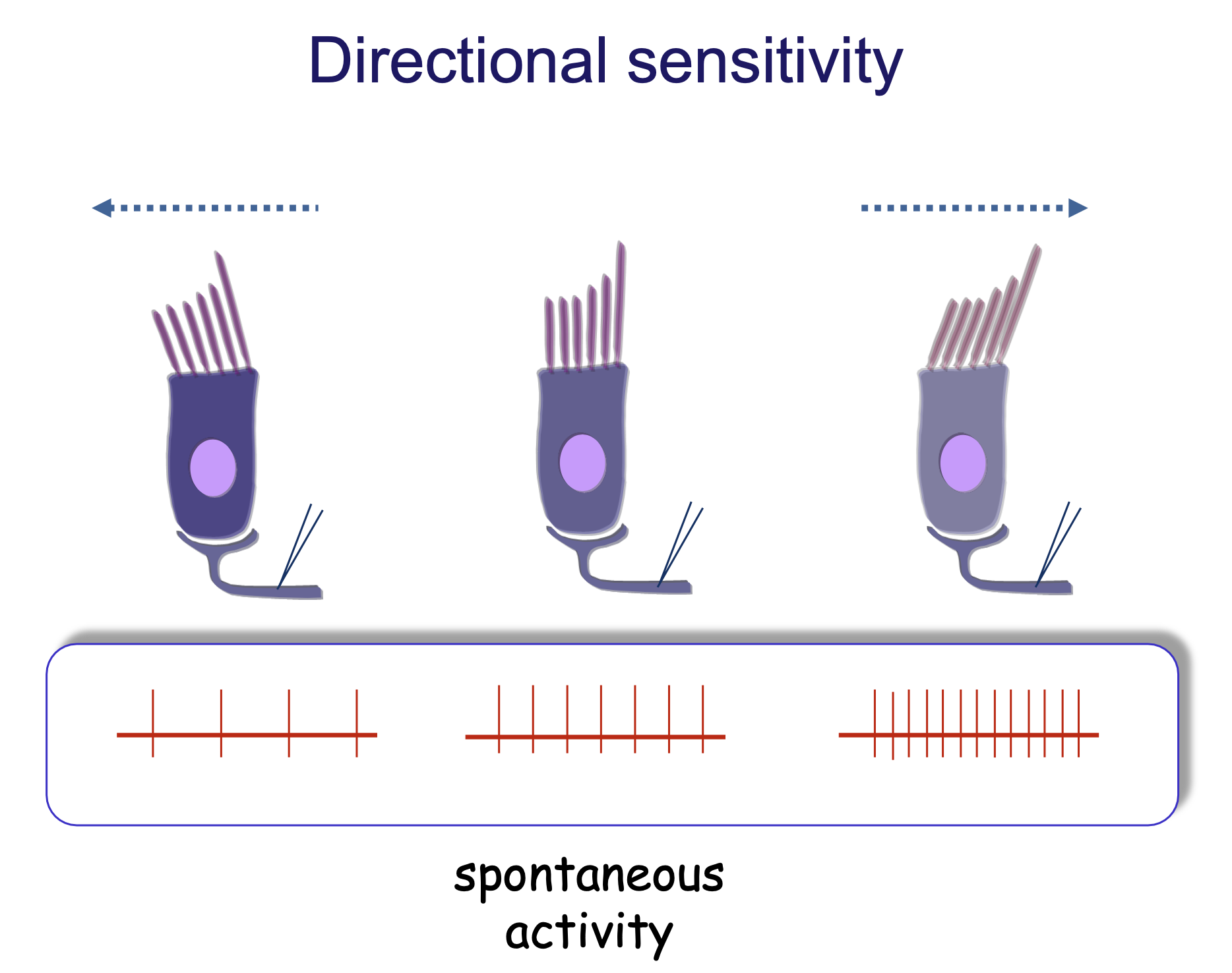
- Hair cells: These are directionally sensitive; movement towards the longest hair (kinocilium) depolarizes the cell, while movement in the opposite direction hyperpolarizes it.
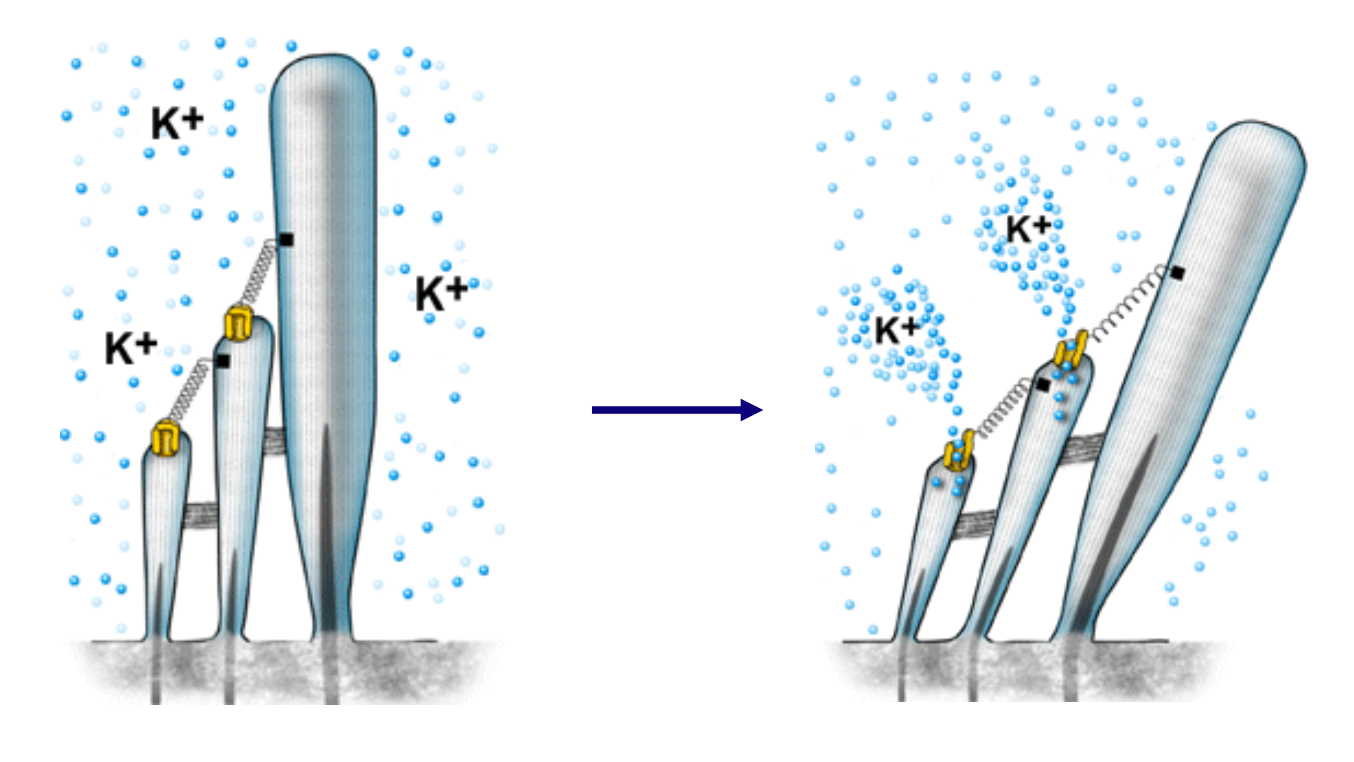
- Ion channels: Deflection of hairs opens mechanically gated ion channels, leading to changes in membrane potential.
- Dizziness: A sudden stop in rotation can cause the cupula to bend in the opposite direction, potentially leading to dizziness due to the continued perception of motion.
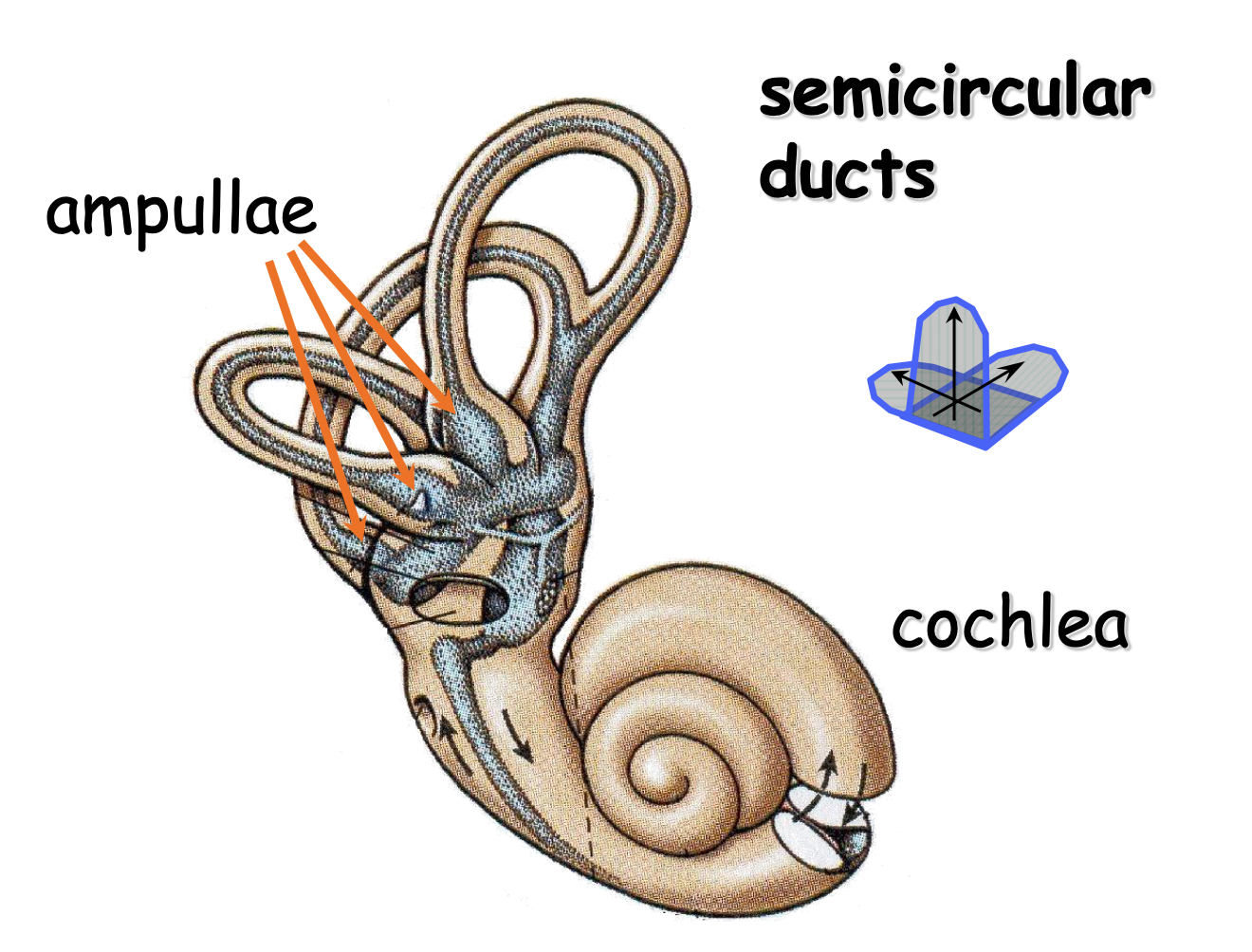
Macula Organs
-
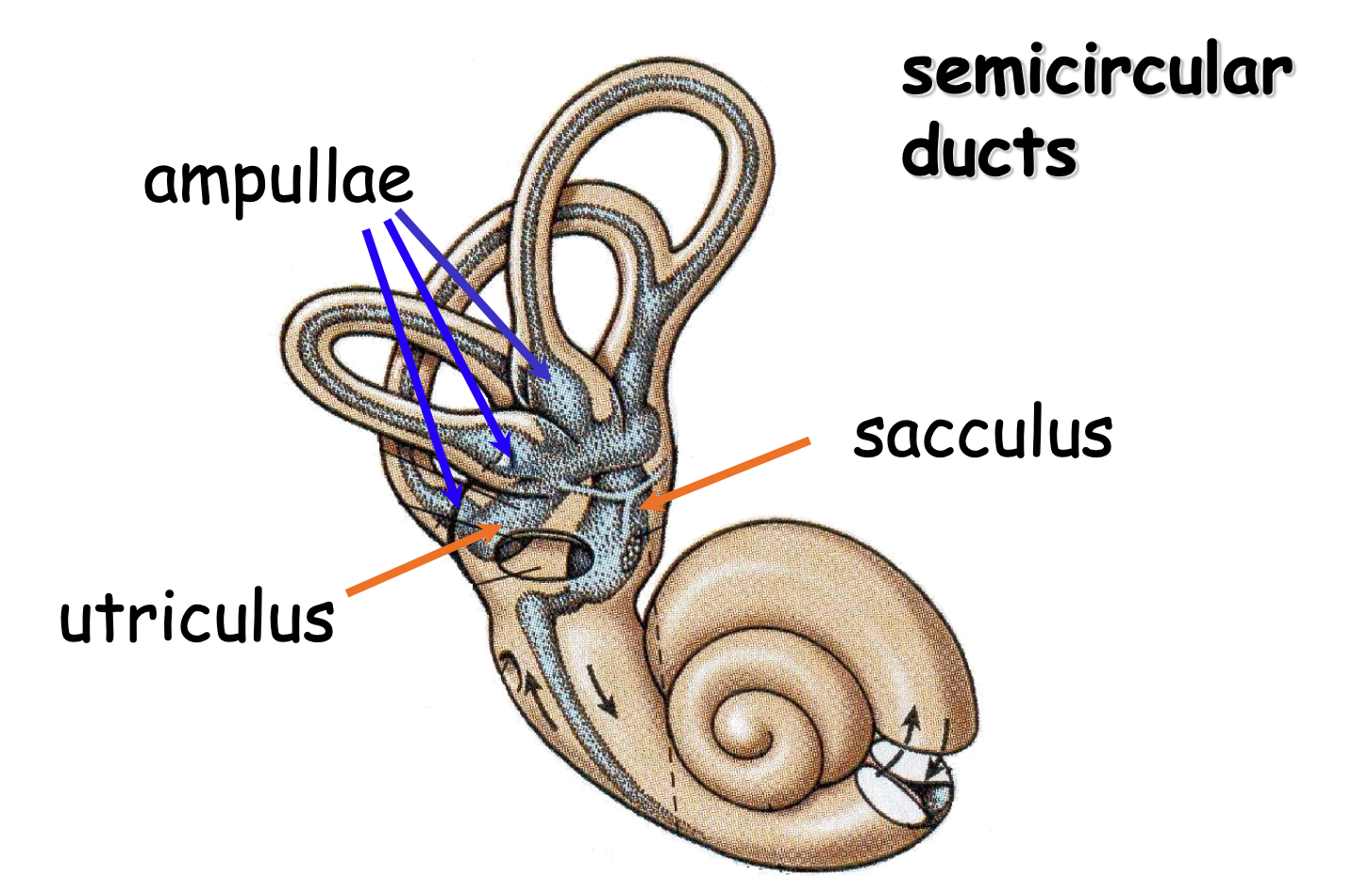
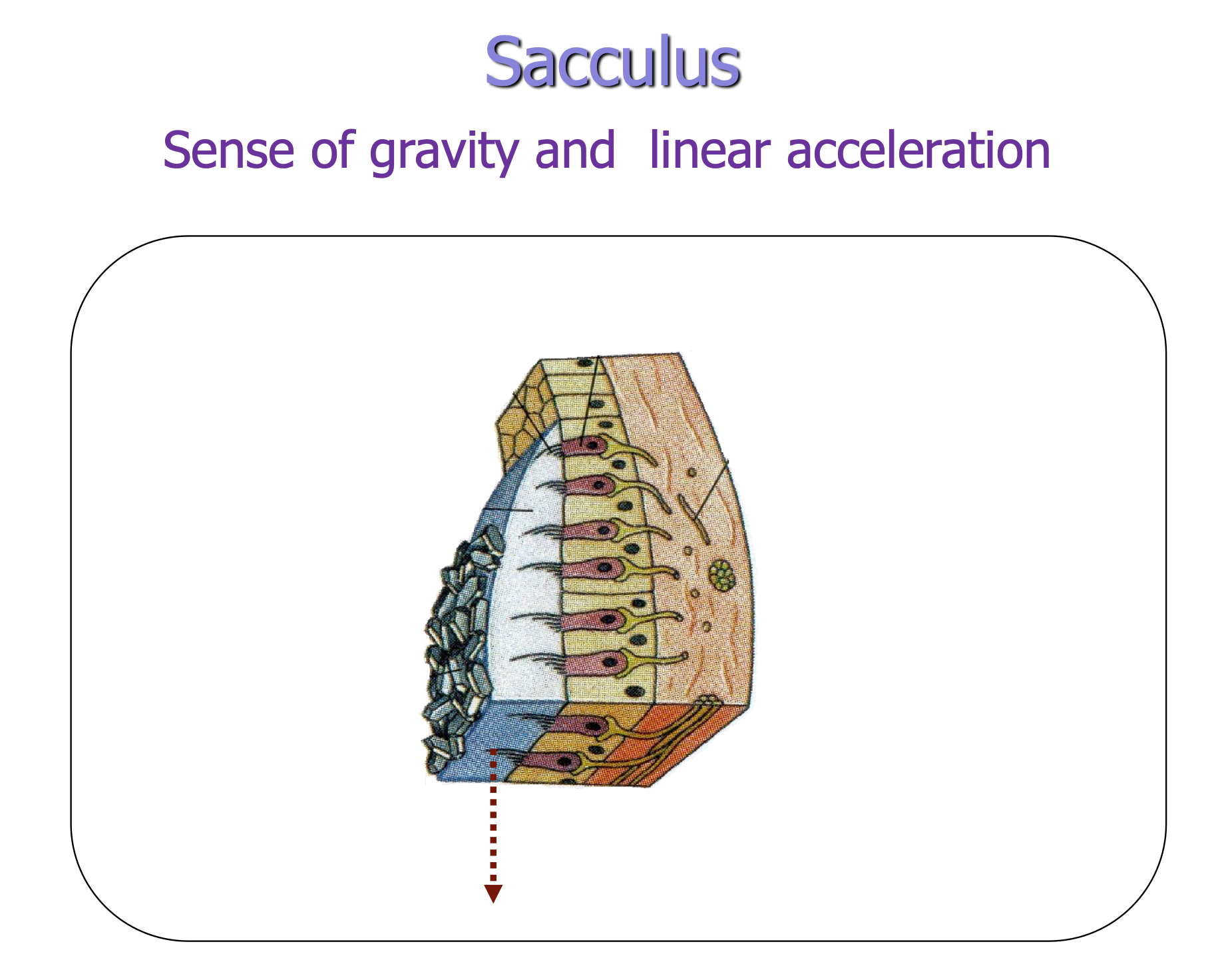
The macula organs (utricle and saccule) are specialized for detecting gravity and linear acceleration.
-
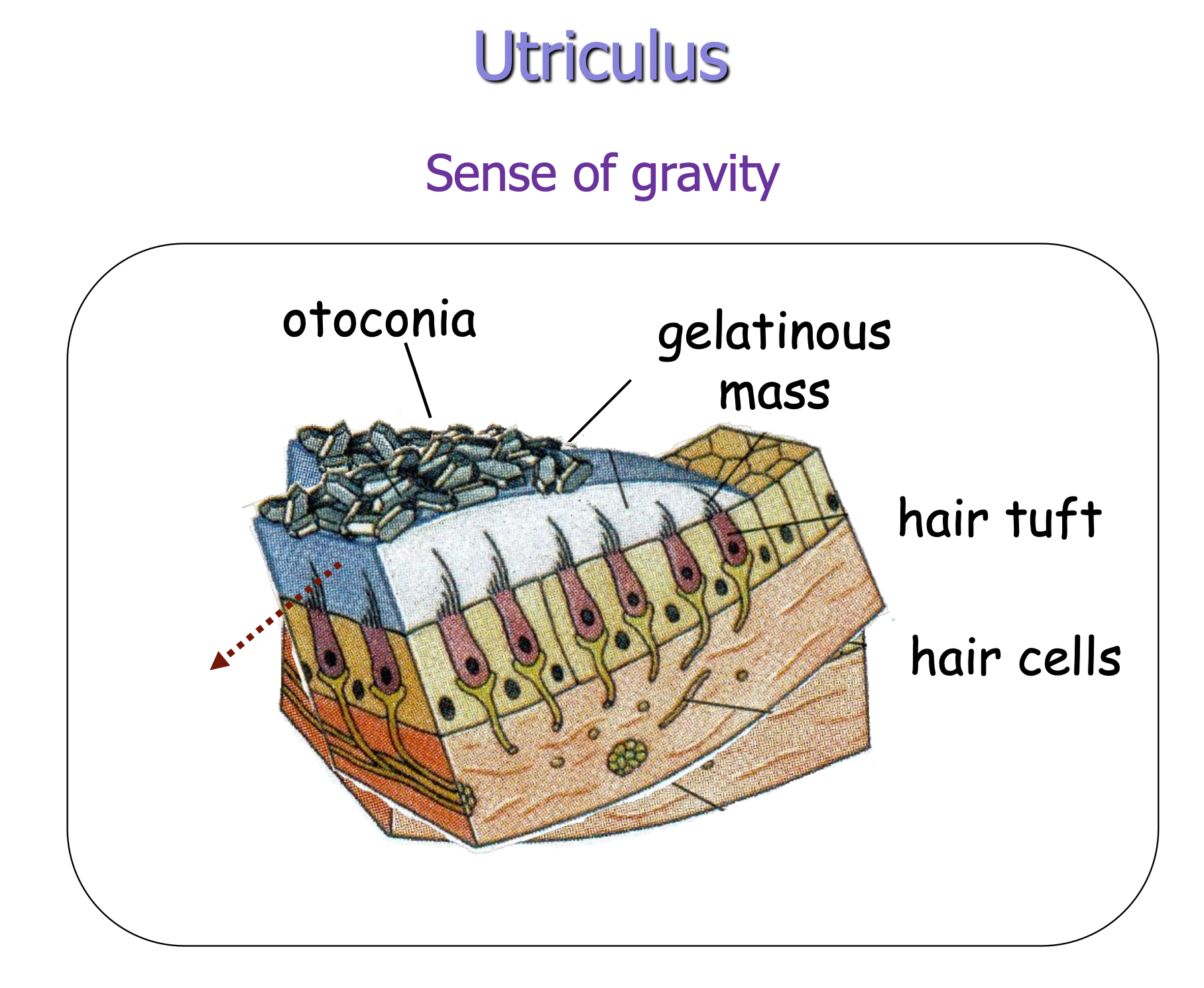
They contain a field of hair cells that are covered by a gelatinous mass.
-
Otokonia (calcite crystals containing calcium carbonate) are embedded near the tips of the hairs within this gelatinous mass.
-
During sudden movements, the otokonia lag behind due to inertia, causing the hairs to deflect in the opposite direction of the movement.
-
At rest, the otokonia are influenced by gravitation, exerting a constant force on the hair cells.
-
The orientation of the utricle is horizontal, making it more sensitive to horizontal movements, while the orientation of the saccule is vertical, making it more sensitive to vertical accelerations.
-
The deflection of the hairs by otokonia, whether due to gravity or linear acceleration, leads to changes in the electrical potential of the hair cells.
-
These changes in potential initiate the release of neurotransmitters from the hair cells, which then communicate the information about gravity and linear acceleration to the brain via the vestibular nerve.
-
The brain processes this information to maintain balance and orientation in space.
 x
x
Explain how hair cells in the vestibular system respond to head movements.
Hair cells in the vestibular system respond to head movements through a series of specialized mechanisms that allow for the detection of rotation and linear acceleration. Here’s a detailed explanation in bullet points, with the most important words highlighted:
-
Semicircular ducts: Detect rotational movements of the head. Each duct is filled with endolymph fluid and is oriented in one of the three perpendicular planes, allowing for the detection of rotation in any direction.
-
Cupula: A gelatinous mass in which the hair cells’ stereocilia are embedded. Rotational movement causes the endolymph to lag behind due to inertia, moving the cupula and bending the stereocilia.
-
Directional sensitivity: Movement towards the kinocilium (the longest hair) causes depolarization (excitation), while movement away causes hyperpolarization (inhibition).
-
-
Macula organs (Utriculus and Sacculus): Detect linear acceleration and gravitational forces. They contain hair cells with stereocilia embedded in a gelatinous layer topped with otoliths (calcium carbonate crystals).
-
Otoliths: Add mass to the gelatinous layer, causing it to lag behind during linear acceleration or tilt, bending the stereocilia and altering the hair cells’ electrical state.
-
Orientation: The utriculus is horizontally oriented, making it more sensitive to horizontal acceleration, while the sacculus is vertically oriented, responding to vertical acceleration and gravity.
-
-
Mechanosensitive ion channels: Opening or closing in response to the bending of stereocilia, leading to changes in the hair cells’ membrane potential.
-
Depolarization: Occurs when stereocilia bend towards the kinocilium, leading to the opening of ion channels, potassium influx, and the release of neurotransmitters that excite afferent nerve fibers.
-
Hyperpolarization: Results from bending away from the kinocilium, reducing neurotransmitter release and inhibiting the afferent nerve fibers.
-
-
Neurotransmitter release: The change in membrane potential triggers the release of neurotransmitters at the base of the hair cells, modulating the activity of the vestibular nerve.
-
Directionally sensitive: Each hair cell is polarized, meaning its response to deflection is directional. This allows the brain to interpret the direction of head movement based on the pattern of hair cell activation across the vestibular system.
In summary, hair cells in the vestibular system detect head movements by responding to changes in the position of the stereocilia caused by movement of the surrounding fluid or the lagging of dense otoliths during acceleration. These mechanical changes translate into electrical signals that inform the brain about the head’s movement and orientation in space.
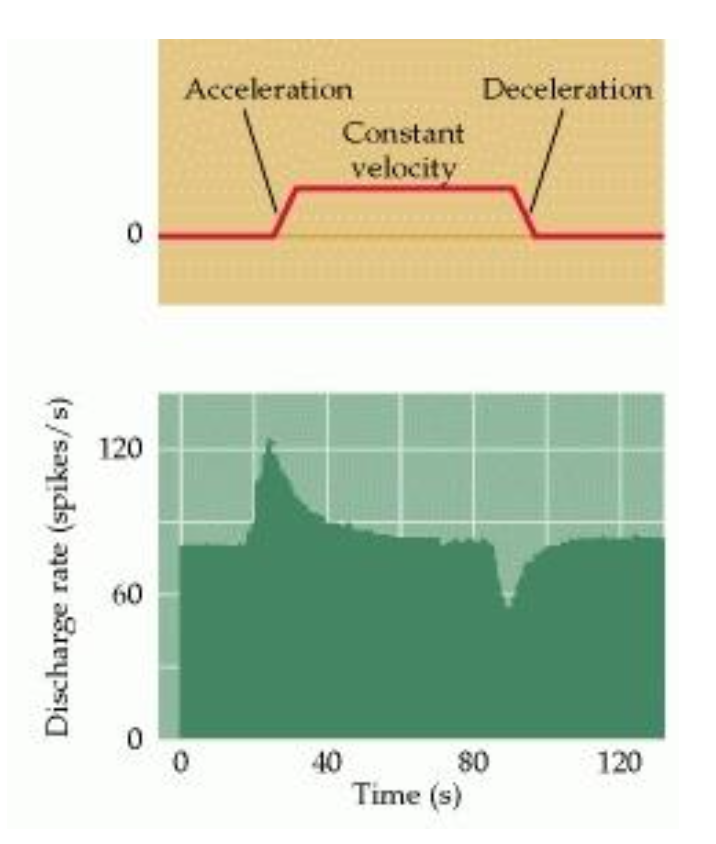
Response to acceleration
The stimulus is a rotation that first accelerates, then maintains constant velocity, and then decelerates the head. The axon increases its firing above resting level in response to the acceleration, returns to resting level during constant velocity, then decreases its firing rate below resting level during deceleration; these changes in firing rate reflect inertial effects on the displacement of the cupula. (After Goldberg and Fernandez, 1971.)
see also
Tags: science medicine biology
Superlink: 091 🏃Body and Medicine, 090 🌱Biology
Range of human hearing
Source
Created: 24-10-24 09:53