-
Deep Neural networks are highly specialized and good in a narrow domain.
-
CNNs process images in a sequential manner like the brain does (from low resolution to full picture)
-
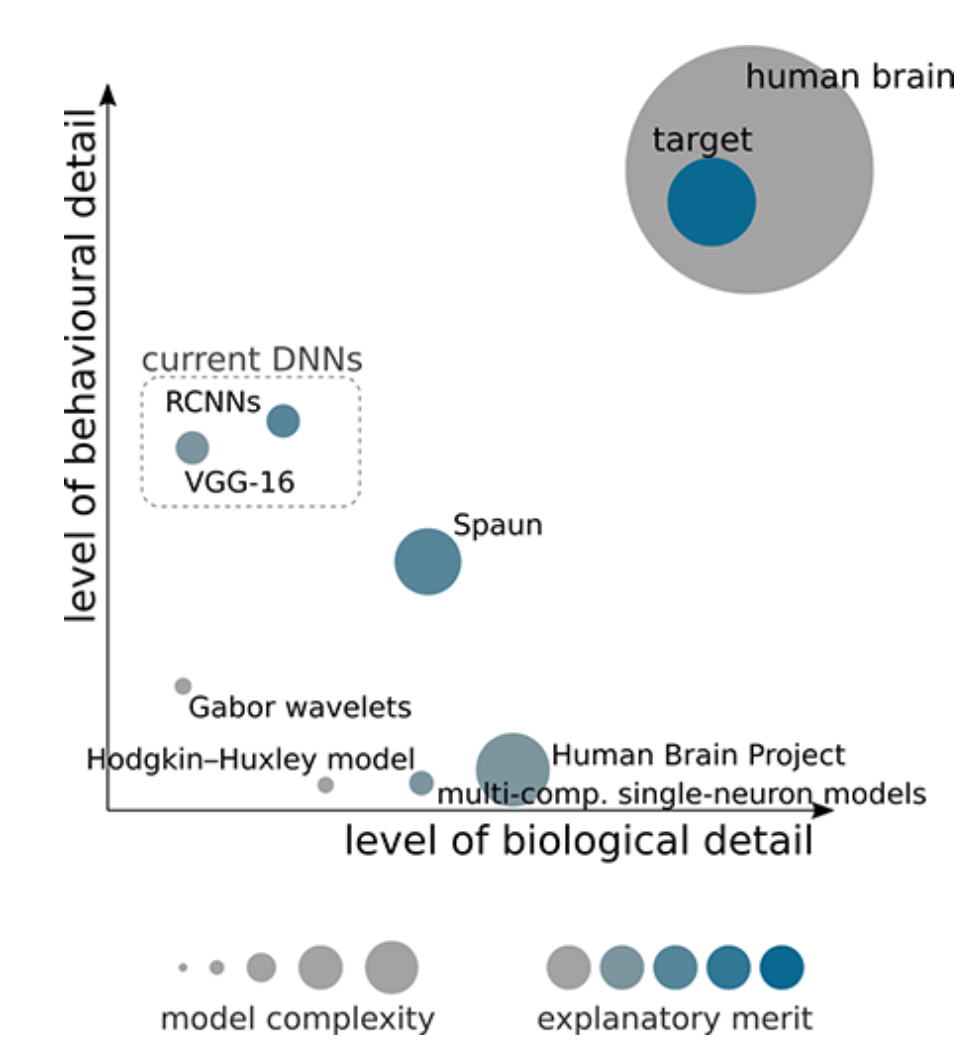
But they do not include a lot of biological details.
-
DNNs focus on solving the task the best rather than mimicking neural data
-
“Models should be as simple as possible, but not simpler”
-
the mechanisms in a DNN are simple, but the parameter count is complex ⇒ interesting to see how biological details would change the models (SNNs)
-
performance of CNNs is positively linked to the ability to predict neural data
- it is likely that the brain follows multiple objectives at once. This might be difficult to mimic
-
DNNs are highly vulnerable to manipulation
-
DNNs deterministic, brain stochastic
- DNNs with stochastic sampling → higher performance and better estimation of its own uncertainty
-
DNNs in computational neuroscience still in its infancy
-
spiking models are besser at explaining neural activity
-
LSTM units proposed for explaining cortical microcircuits
biological plausible
- spatially restricted receptive fields
- some kind of optimization technique (maybe something like stochastic gradient descent)
biological implausible:
- parameter sharing
Fragen
wenn V1 striche erkennt, was passiert. wenn ein object richtig klein is? erkennt der V1 dann nicht das gesamte bild?