Die Entwicklung des Gehirns
Die ersten Jahre
Babys können schon Wahrscheinlichkeiten einschätzen und verstehen die grundsätzlichen Gesetze der Physik. Sie haben zudem eine angeborene intuitive Logik.
Sie probieren so lange aus, schmeißen Dinge um, lassen Dinge fallen, nur um ihre inneren Modelle der Realität anzupassen.
Deshalb fassen Kinder auch so viel an probieren viele neue Dinge aus. Sie müssen erstmal die eigenen Modelle korrigieren.
Sie haben sogar ein angeborenes Verständnis für Mengen.
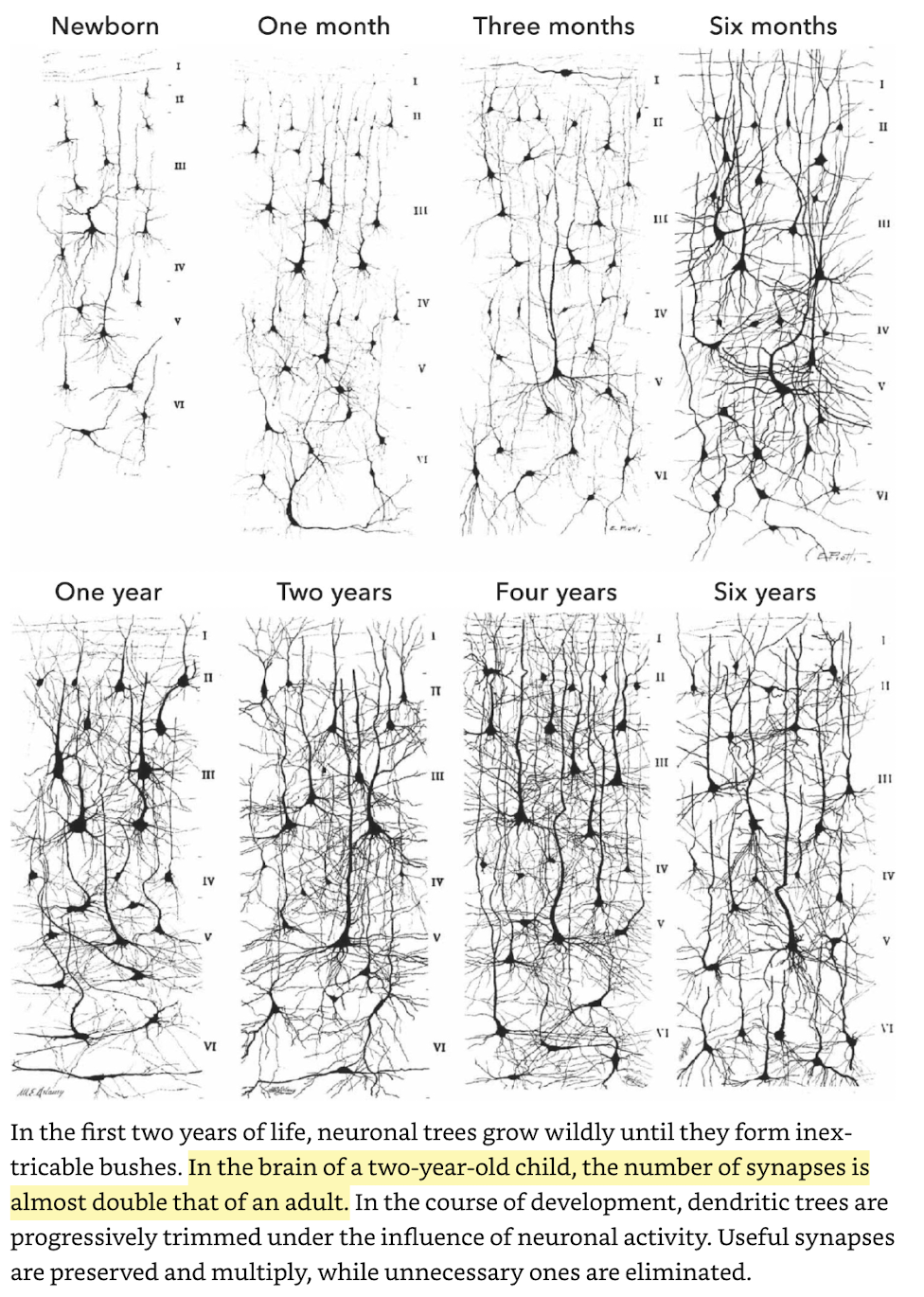
In the first two years of life, neuronal trees grow wildly until they form inextricable bushes. In the brain of a two-year-old child, the number of synapses is almost double that of an adult. In the course of development, dendritic trees are progressively trimmed under the influence of neuronal activity. Useful synapses are preserved and multiply, while unnecessary ones are eliminated.
Danach:
Frontal Cortical Maturation
für andere Lebewesen
Sie verstehen schnell, dass andere Lebewesen ein eigenes Denken haben und auch Ziele verfolgen, etwas wollen, Dinge anderen Dingen bevorzugen und verschiedene Fähigkeiten haben. Sie können schon sehr früh erkennen, ob jemand etwas aus Versehen oder mit Absicht macht.
⇒ Siehe Knowledge of Animals and People
Zudem bevorzugen Babies schon im Uterus Anordnungen, die Gescihtern ähnlich sehen
andere Aspekte
The Object concept
Babies already know the laws of physics and can predict probabilities.
They experiment a lot so reject all wrong theories and build a model which is correct.
The Number Sense
Babies already can distinguish different amounts. So they can count without ever learning one single number.
The Intuition of Probabilities
Babies’ brains contain an intuitive logic.
When you have eliminated the impossible, whatever remains, however improbable, must be the truth.<
- Sherlock Holmes
Knowledge of Animals and People
From their observations, babies can infer not only the goals and intentions of those around them, but also their beliefs, abilities, and preferences.
(p.62)
nine-month-old baby can distinguish between someone who intentionally does harm and someone who does it by accident, or someone who intentionally refuses to help another person and someone who does not have the opportunity to help.
(p.62)
Face Perception
face recognition starts in the utero. Babies prefer objects that are arranged like eyes and nose.
The Language Instinct
by the third trimester of pregnancy, the fetus is already able to hear. The melody of language, filtered through the uterine wall, passes on to babies, and they begin to memorize it.
(p.64)
We are born with the ability to learn any language. Even in deaf communities.
Scaling
The human brain looks like a linearly scaled primate brain. There are systematic differences in scaling of rodent and primate brain.
aus Behave
Thus fetal life produces a Hypothalamus that is more complexly wired in females.
Seite 175 · Position 3509
hier kommt noch viel aus dem Adolescence Teil aus Behave rein
See also
Frontal Cortical Maturation
Chapter 3 Babies’ Invisible Knowledge
Status:
Tags: neuroscience science
Superlink: 050 🧠Neuroscience
Quellen
Erstellt: 26-02-22 12:21