RDMs and RSA
Representational Dissimilarity Matrices (RDMs) allow the comparison of response dissimilarities to various stimuli.
That makes RDMs highly interpretable and comparable with other RDMs, making them especially useful for exploring information representation in specialized brain regions like the FFA (fusiform face area).
RSA (Representational Similarity Analysis) takes the analysis a step further by transforming RDMs into long vectors for better comparison between them.
These tools allow researchers to explore questions like whether the FFA specializes beyond face-selectivity.
In Op de Beeck’s study, The RDMs show clear distinctions between the stimuli of various birds in the frontal cortex and IT of bird experts, which were not observable in controls.
FFA not only responds to faces but also to areas of expertise. A study by Gauthier shows higher activity in the FFA for categories of expertise such as cars or birds.
Experts even show higher activity in FFA when not paying attention. Also, right FFA shows more activity for expertise categories than the left FFA.
This supports the findings of Op de Beeck study shown in the RDMs.
This leads to the conclusion that the Fusiform face area might be better called the flexible fusiform area (Gauthier, 2000).
How can RDMs help us understand the Brain?
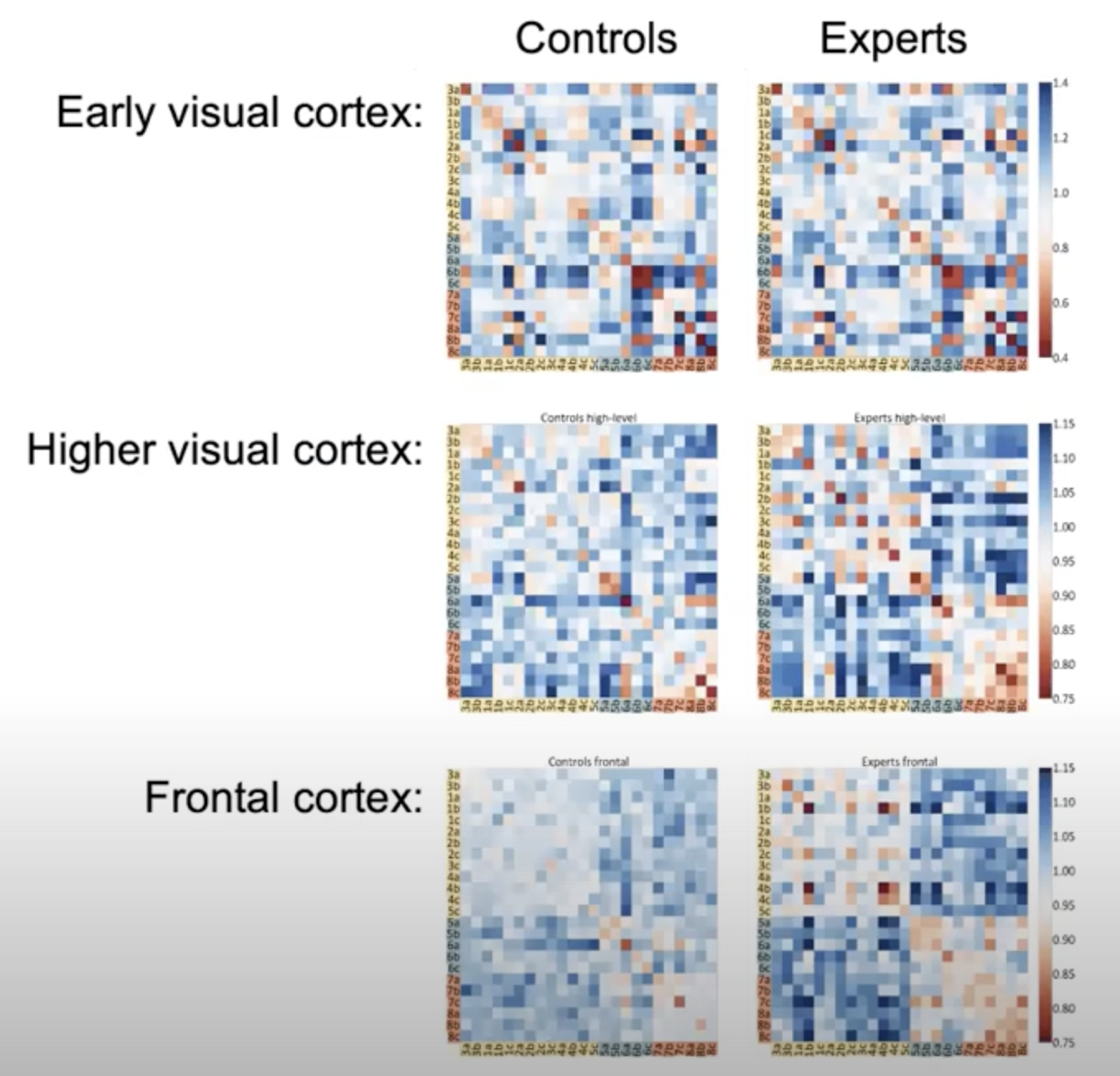
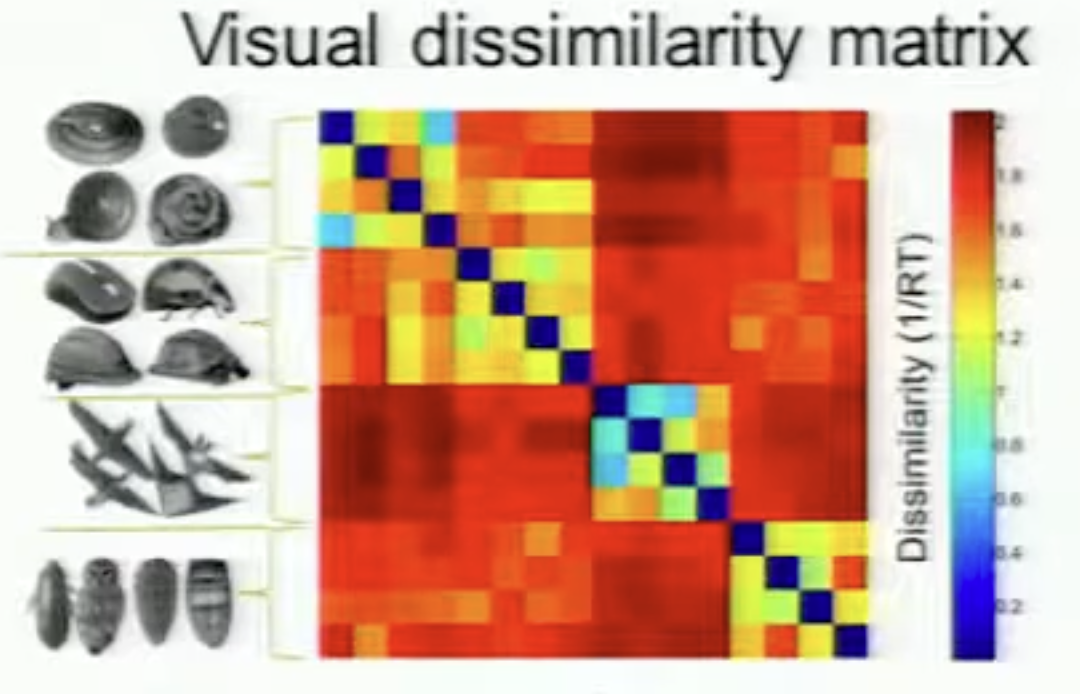
Representational Dissimilarity Matrices introduce an nice overview of the actual diference in the data that needs to be observed.
see also
Type:
Tags:
Status:
Location:
Created: 14-11-24 21:40
Machine Learning for Cognitive Computational Neuroscience
Representational Dissimilarity Matrix (RDM)
Source
Stefanie Duyck, Farah Martens, Chiu-Yueh Chen, Hans Op de Beeck; How Visual Expertise Changes Representational Geometry: A Behavioral and Neural Perspective. J Cogn Neurosci 2021; 33 (12): 2461–2476. doi: https://doi.org/10.1162/jocn_a_01778
Tarr, M. J., & Gauthier, I. (2000). FFA: A flexible fusiform area for subordinate-level visual processing automatized by expertise. Nature Neuroscience, 3(8), 764–769. https://doi.org/10.1038/77666