Primary Motor Cortex
The Primary motor cortex (M1) is identical to Brodmann Area 4.
It receives input from premotor cortex, Supplementary motor area (SMA), frontal association cortex, post central gyrus. It is somatotopically organized and transforms the desired
the movement to muscle activity patterns and sends this
command to the spinal cord. Lesions lead to paralysis of the
contralateral side of the body.
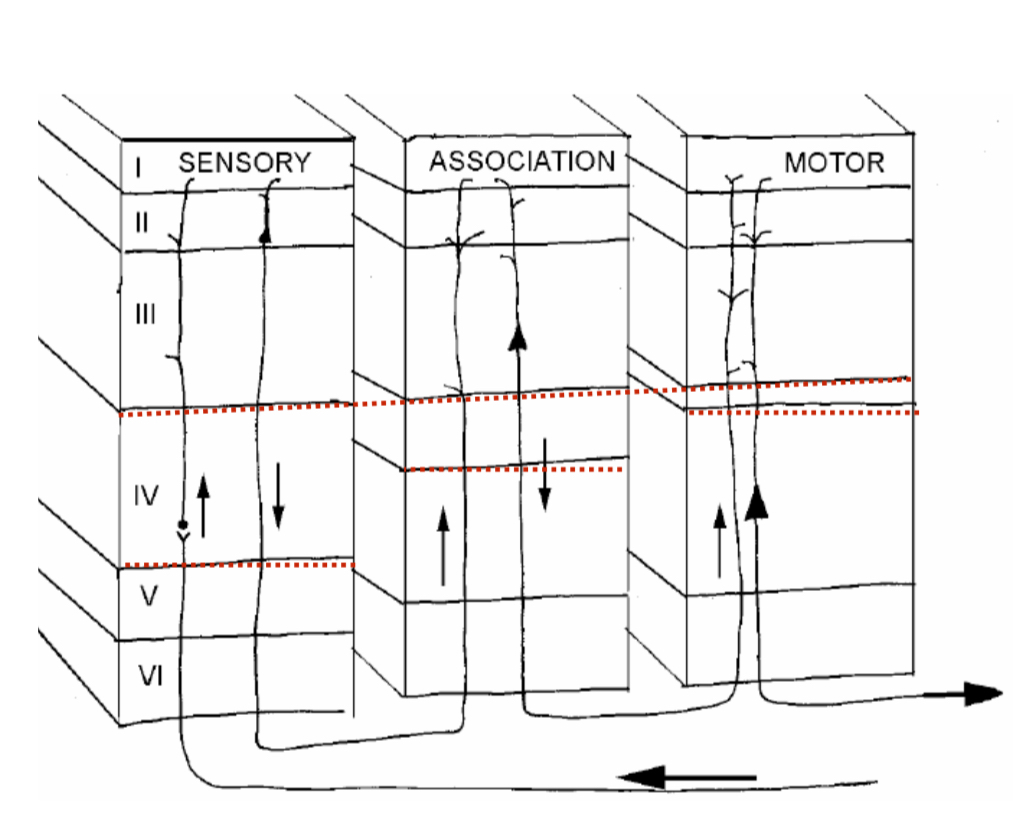
- Motor cortex has a smaller Layer 4
The primary motor cortex is a highly organized, five-layered convoluted sheet of neural cells, located on the precentral gyrus of the cerebral cortex. In the motor cortex, intermingled with the inhibitory GABAergic interneurons, the excitatory glutamatergic pyramidal neuron is the principal cell type1,2. Pyramidal cells are most abundant in layers III and V. However, their horizontal and vertical extensions into other layers provide the motor cortical networks with a flexible synaptic organization3. This organization provides a cortical platform for neuroplasticity in the primary functions, such as movements. Neuroplasticity is a crucial characteristic in the central nervous system, enabling recruitment of the neuronal connections to adapt, as well as to maladapt, to modified requirements. Neuroplasticity is also mediated by the inhibitory GABAergic interneurons4.
see also
Tags: neuroscience science gehirnregion
Status: offen
Superlink: 050 🧠Neuroscience
Quellen
https://www.nature.com/articles/s41598-019-47932-9
Kariminezhad, S., Karhu, J., Säisänen, L. et al. Interaction between repetition suppression in motor activation and long-interval intracortical inhibition. Sci Rep 9, 11543 (2019). https://doi.org/10.1038/s41598-019-47932-9
Erstellt: 25-02-22 17:51