Amygdala
Einleitung
- Die Amygdala ist zuständig für die 4 F’s: fight, flight, fear und sex.
- Sie ist Teil von Layer 1
- spielt eine wichtige Rolle im Verarbeiten von negativen Emotionen
- not only important for aversive stimuli, but also for appetitive stimuli; however, aversive stimuli are processed faster for reasons of urgency (Carretié, Albert, López-Martin & Tapia, 2009)
- Angst kommt nicht ausschließlich von der Amygdala
The Amygdala plays an important role in the decision making process.
Link zum Original
In other words, the default state is to trust, and what the amygdala does is learn vigilance and distrust.
Nuclei and their projections
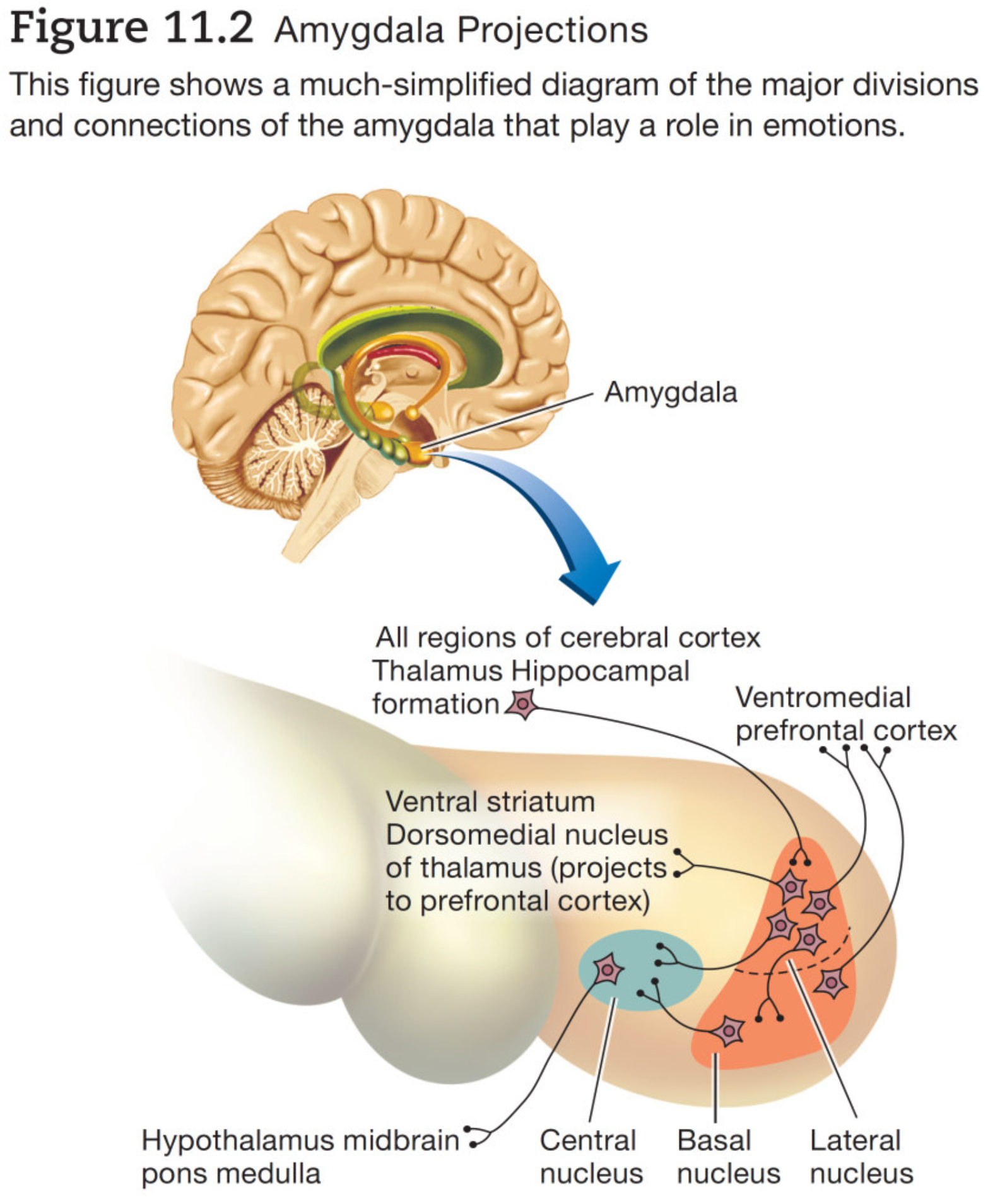
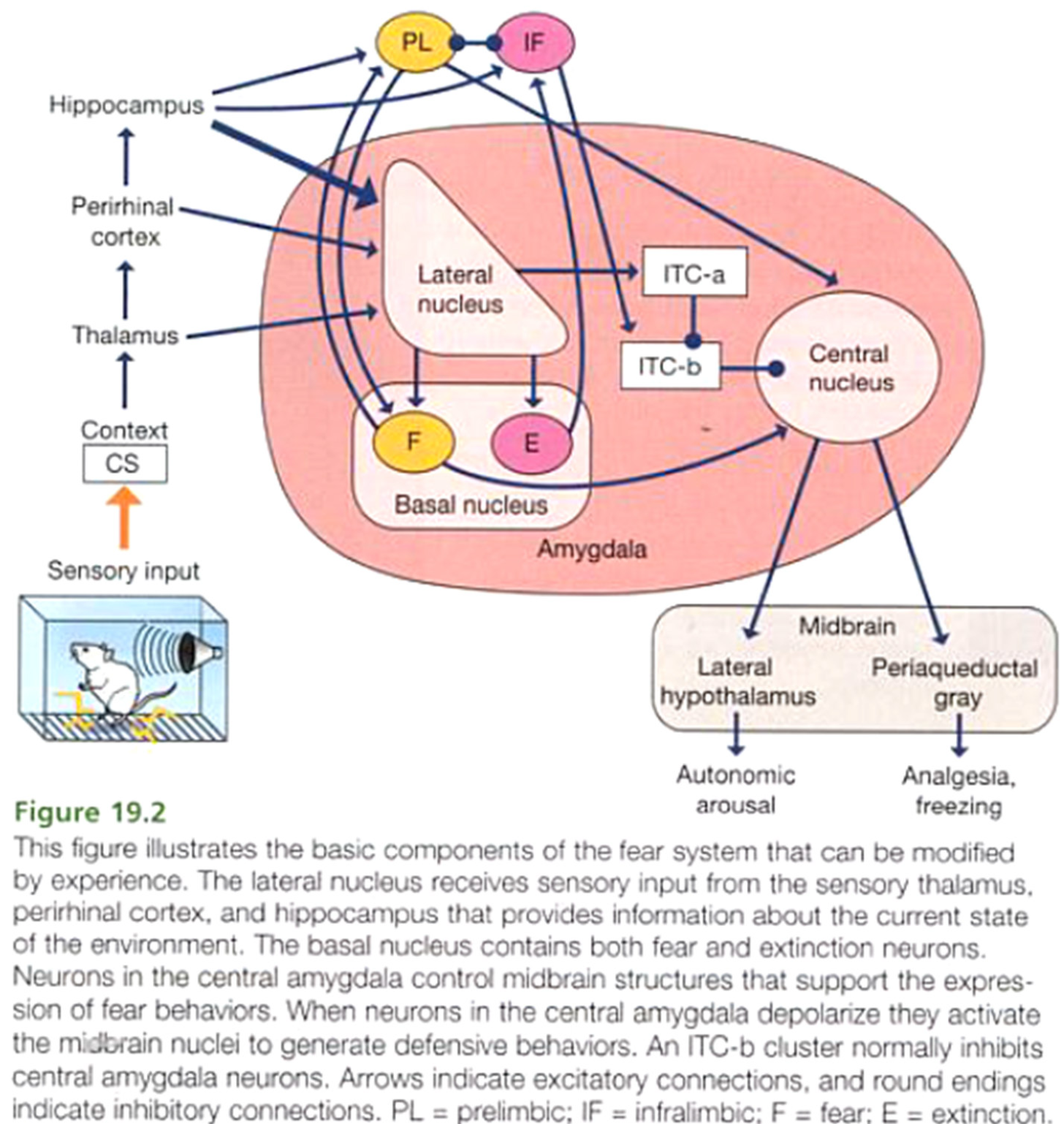
Source: Rudy (2014) Fig. 19.2 p.383
Lateral nucleus, input = afferents
From sensory pathways of all modalities (input via thalamus, cerebral cortex,
hippocampus: possibly only through thalamus = “quick and dirty”)
For sensory pathways of all modalities:
Sensory information first goes to the Thalamus (“gateway to consciousness”)
LeDoux: from there, information runs simultaneously through two pathways:
- Quickly from the thalamus directly to the amygdala
quick and dirty, low road
imprecise impression of the stimulus - Slowly from the thalamus via the cerebral cortex,
from there to the amygdala
high road
processes the image more thoroughly and decides
whether the alarm reaction (which may have already
occurred),
is justified, only then to the amygdala
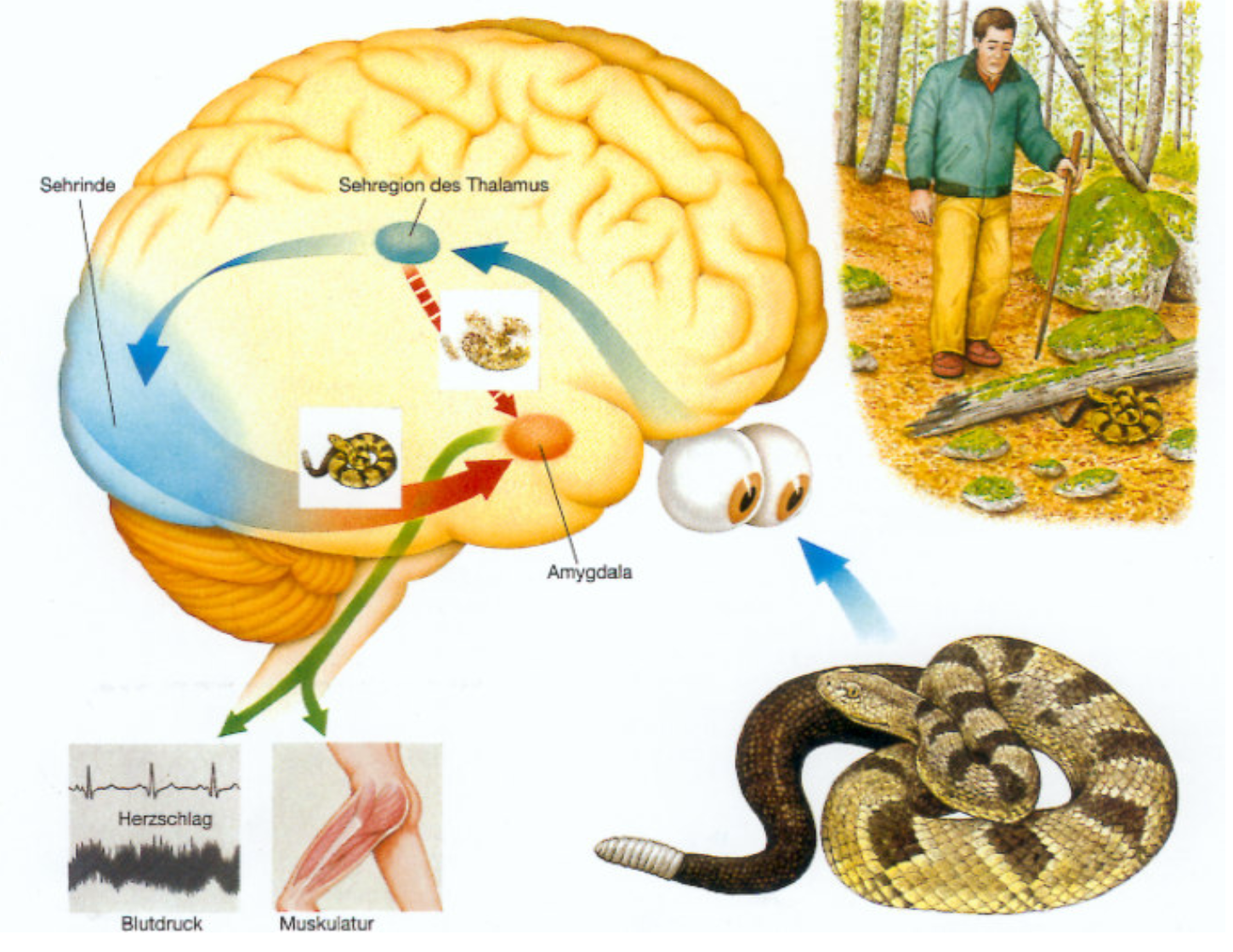
Source: LeDoux, J. E. (1998) Bild 5. S.102.
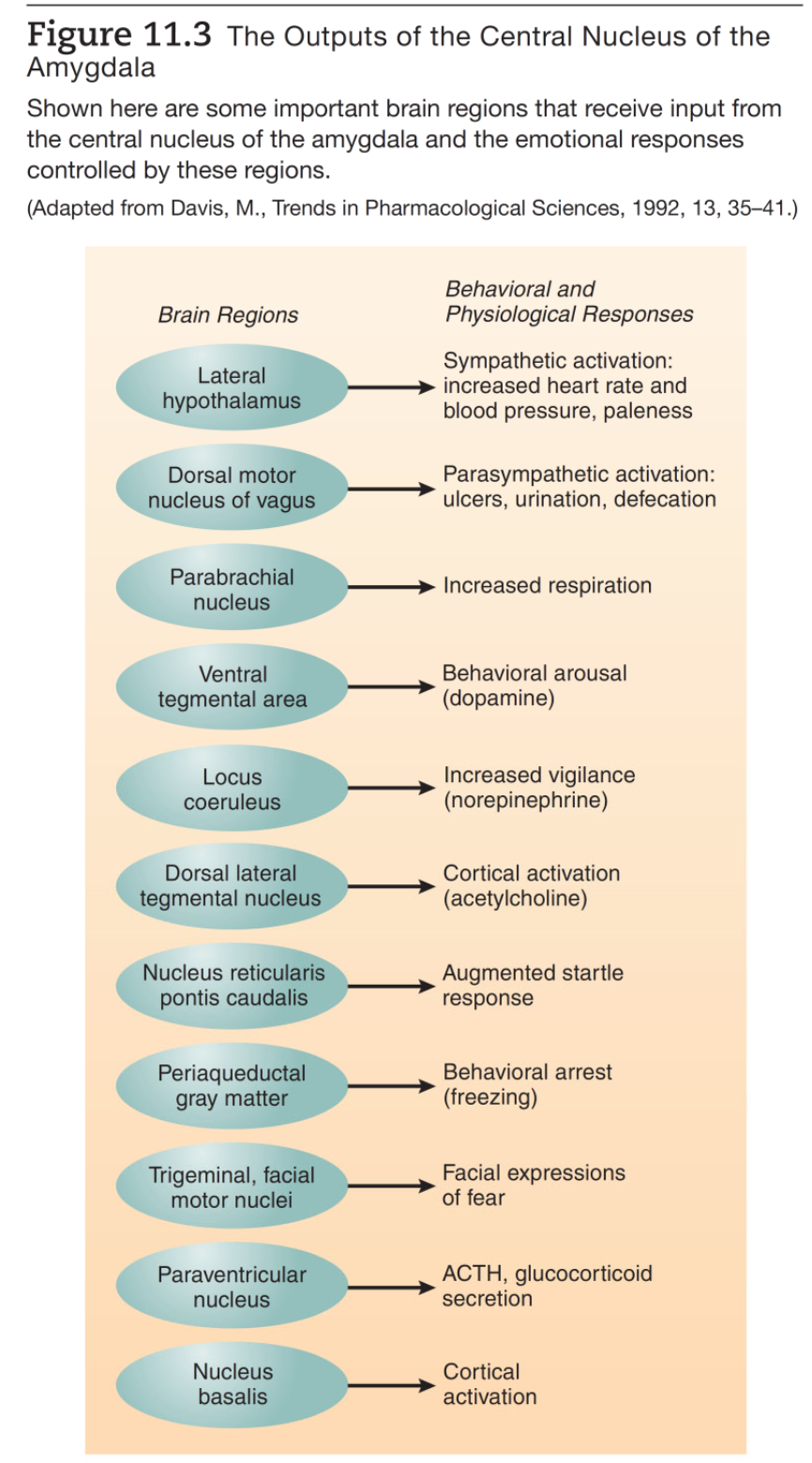
Central nucleus, output = efferents
- central nucleus sends efferents to
- (1) the motor system via the midbrain: Freezing (mediated through the central grey matter)
- (2) the endocrine system (mediated through the Hypothalamus) and the autonomic system (mediated through nuclei in the brainstem) ⇒ The Autonomic Nervous System and the Ancient Core Regions of the Brain
- brainstem (pons, medulla, oblongata)
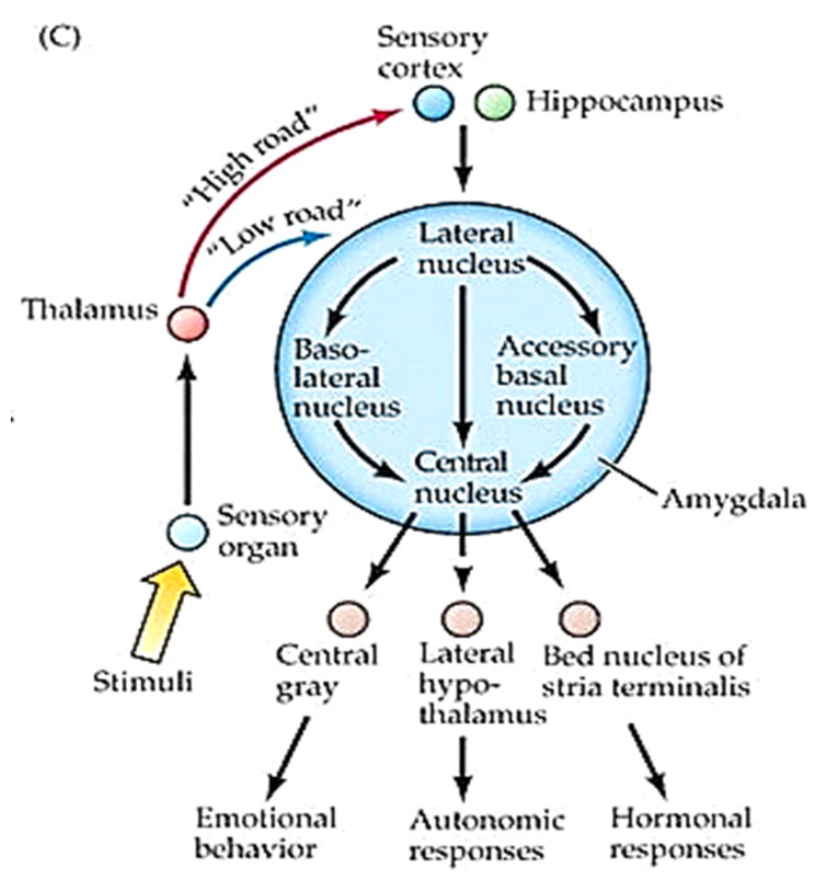
Source: Breedlove& Watson (2013). The Circuitry of Fear. Fig. 15.15 (c), p. 470
Pathways to the Amygdala
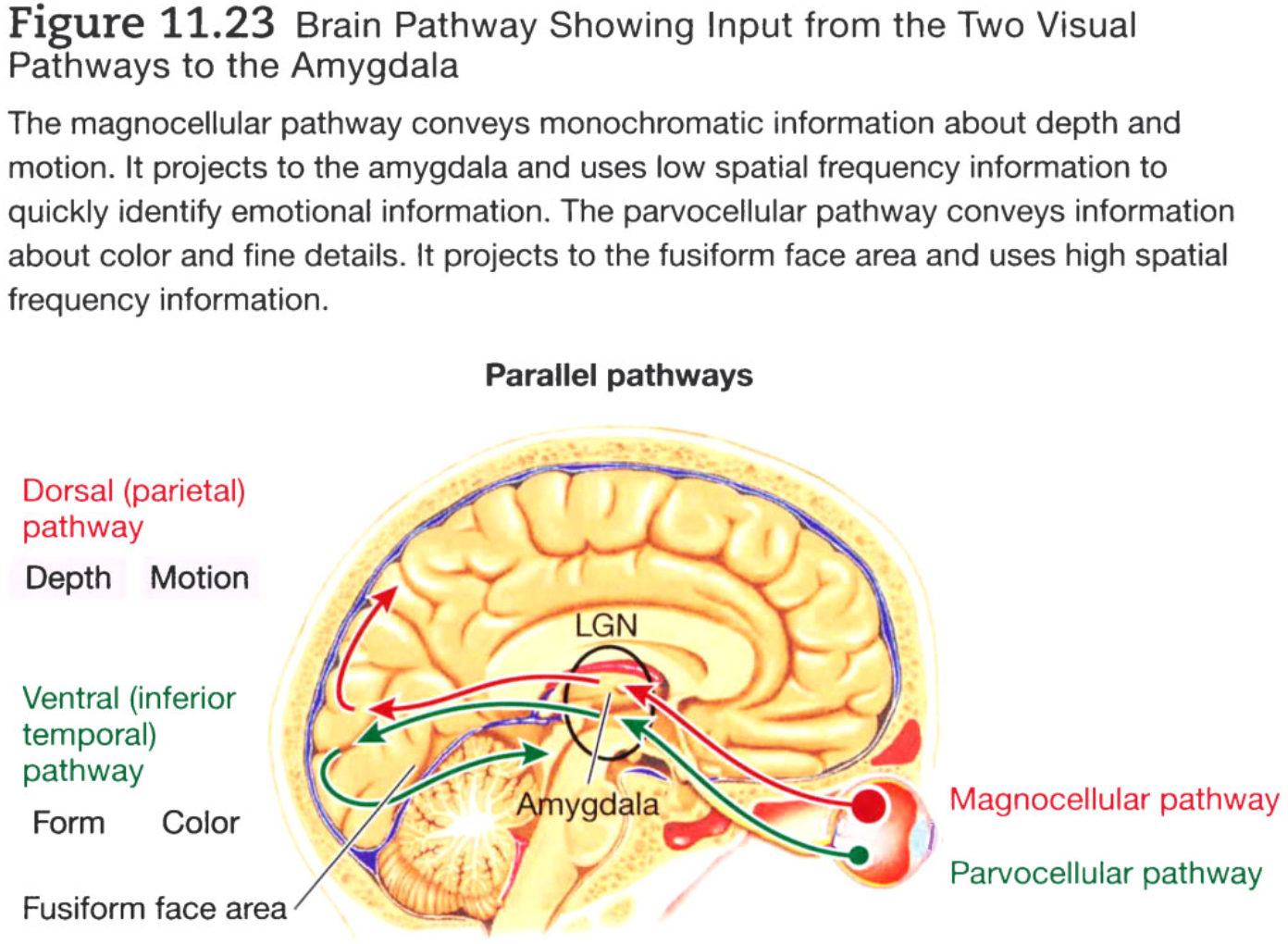
Source: Carlson & Birkett (2022). Fig. 11.23, p. 362
Important brain regions that receive input from the central nucleus
Damage to the Amygdala
- Patient S.M.
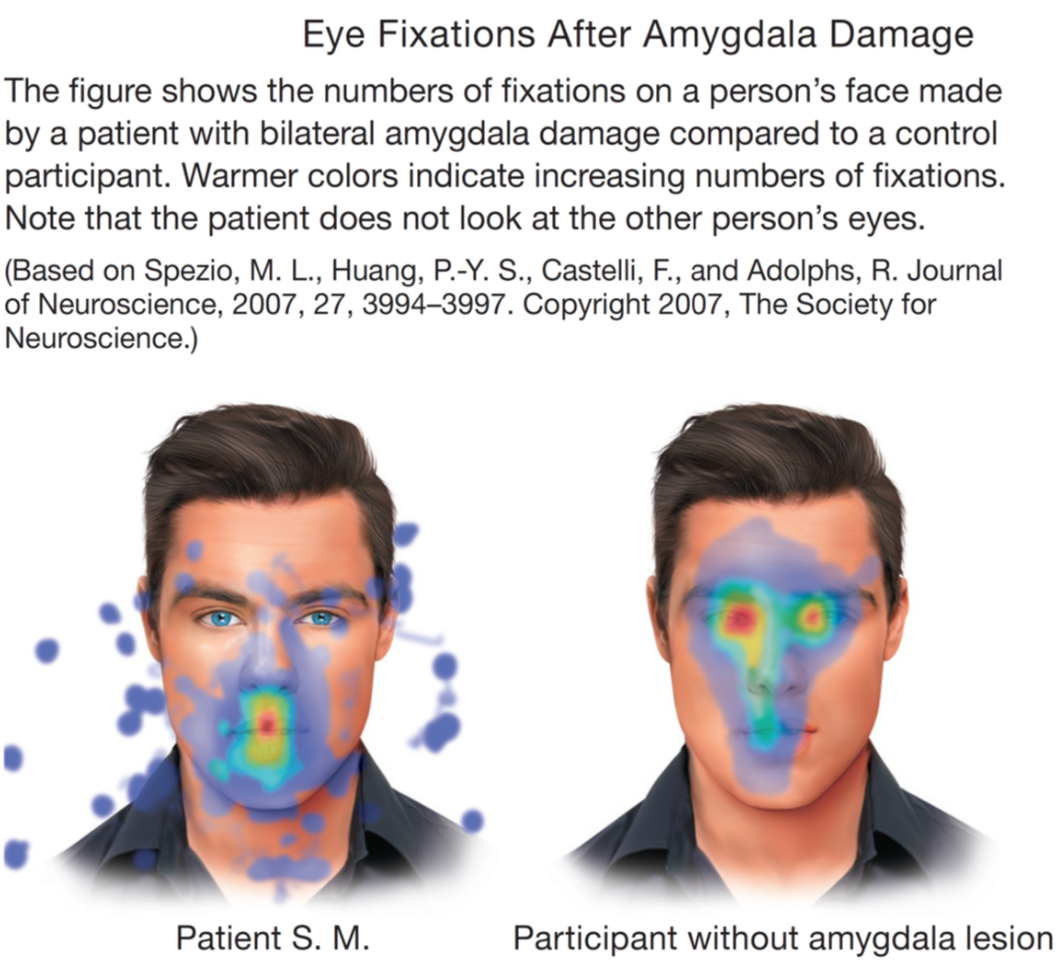
Source: Carlson & Birkett (2022). Fig. 11.31, p. 367
in Kombination mit Testosteron
Ein hoher Testosteronspiegel führt nicht gleich zu einem höheren Aggressionslevel, aber dann das bereits vorhandene Niveau deutlich verstärken. -⇒ Siehe Testosterone, Aggression
Emotionserkennung
- Erkennung des mimischen Emotionsausdrucks:
- nach Amygdala-Läsion nicht mehr möglich: Amygdala notwendig
- Emotionserkennung bei Blinden mit unilateraler Läsion im visuellen
- Cortex möglich (affective blindsight): Amygdala hinreichend
- Emotionserkennung in Stimme und Tönen
- trotz Amygdala-Läsion möglich: Amygdala nicht notwendig
- Verbesserte Erinnerung für emotionale (im Vergleich zu neutralen) Gedächtnisinhalten (flash bulb memories) nach Amygdala-Läsion nicht mehr möglich: Amygdala notwendig (Achtung: aber nur wenige Daten)
verbesserte Erinnerung
Die verbesserte Erinnerung für emotionale im Vergleich zu neutralen Inhalten [s. Vorlesung 1, Flashbulb memories] setzt intakte Amygdala voraus
Patient mit bilateraler Degeneration der Amygdala:
Die Präsentation einer emotionalen Geschichte (Unfallgeschichte, s. Vorlesung Thema 1) führt nicht zu einer verbesserten Erinnerung an
Details der emotionalen Geschichte:
Amygdala im Vergleich
Hippocampus
- Hippocampus: Verarbeitung expliziter Anteile
- reine Sachinformation einer emotionalen Information:
- wer war anwesend, Speicherung, dass eine Situation schrecklich war
- reine Sachinformation einer emotionalen Information:
- Amygdala: Verarbeitung impliziter Anteile emotionaler Situationen
- furchtbezogene Reize (nicht Ekel) lösen Aktivation aus, körperliche Reaktionen
- emotionale Repräsentanz einer Situation
- furchtbezogene Reize (nicht Ekel) lösen Aktivation aus, körperliche Reaktionen
Prefrontal cortex
⇒ PFC
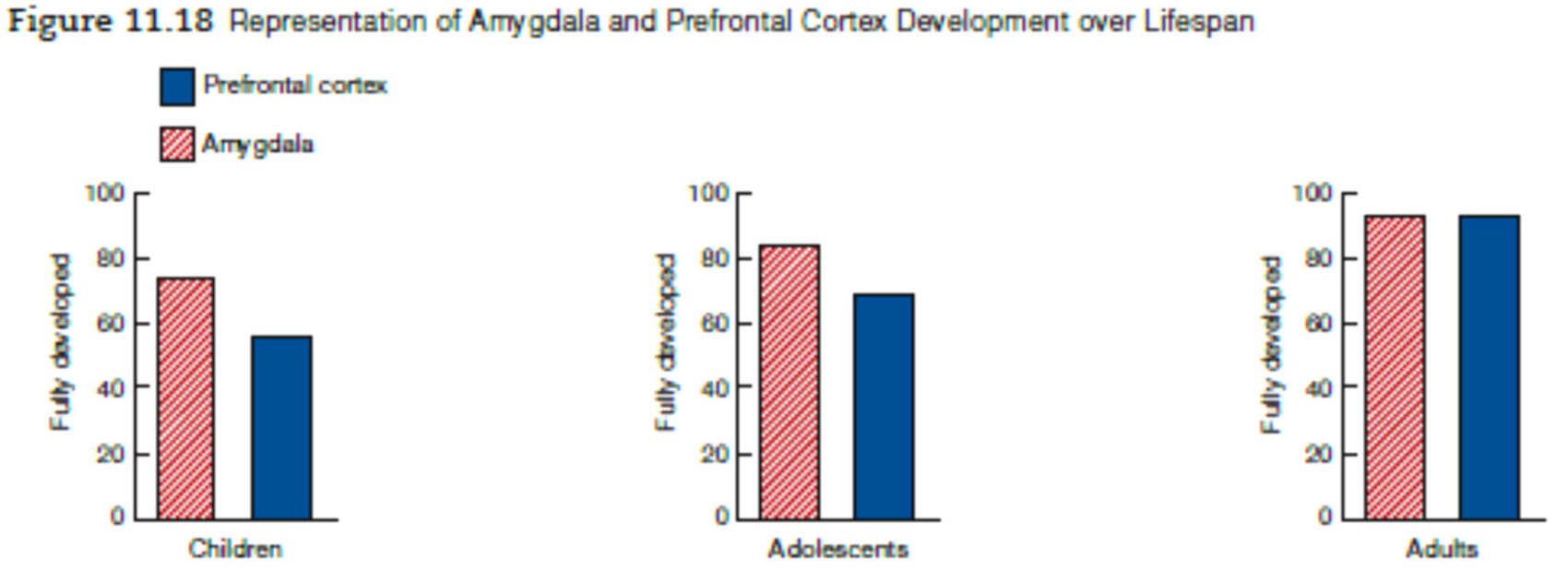
Source: Carlson, & Birkett (2022) Fig. 11.18, p. 355
Krankheiten
beim PTSD reagiert die Amygdala auf mild-angstvolle Einflüsse über und auch nach dem Einfluss kommt die Amygdala nur langsam auf das ursprüngliche Niveau zurück.
Lebensumstände
Je größer eine Population, in der die Probandin lebt, desto stärker reagiert die Amygdala auf Stress.
Store the memory
The amygdala is triggered by strong emotions (mostly negative) and sends a signal to the hippocampus, which stores the memory.
-
When a mouse learns to avoid a place where it received a small electrical shock, the synapses of the hippocampus, the region responsible for spatial and episodic memory, change:5 the connections between the hippocampus and the amygdala hardwire such a traumatic experience. When the mouse becomes terrified by a sound, the synapses that connect the amygdala to the auditory cortex undergo a similar change.
(p.88) ⇒ Chapter 5 Nuture’s Share
⇒ memory processing
⇒How Memories are created -
Tone (CS) is paired with aversive stimulus (US), both signals reach the lateral nucleus.
-
Synapse of Tone-signal is strengthened through LTP - long term potentiation
-
Signal is passed on to basal nucleus (indirect pathway) and central nucleus. Letter sends signals to Hypothalamus, midbrain, pons, medulla for a conditioned emotional response.
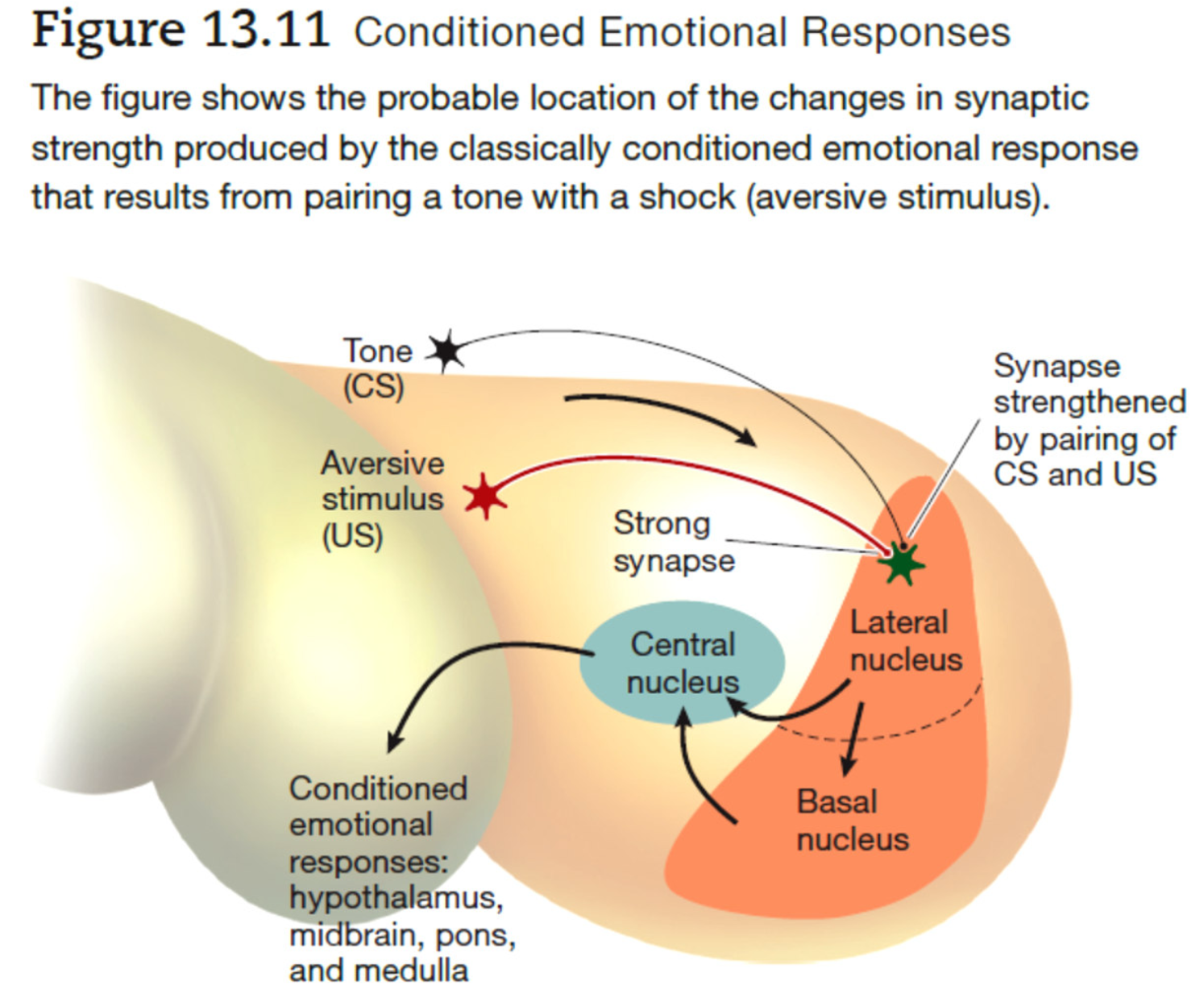
Source: Carlson & Birkett(2022), Fig. 13.11, p. 424
see also
050 🧠Neuroscience
Classical Fear Conditioning
Quelle: Behave S.42
Tags: gehirnregion neuroscience science